Anitha Scored 1,176 Out of 1,200. It Wasn't Enough.
•INVESTIGATIVE DISPATCH•BY ADITYA
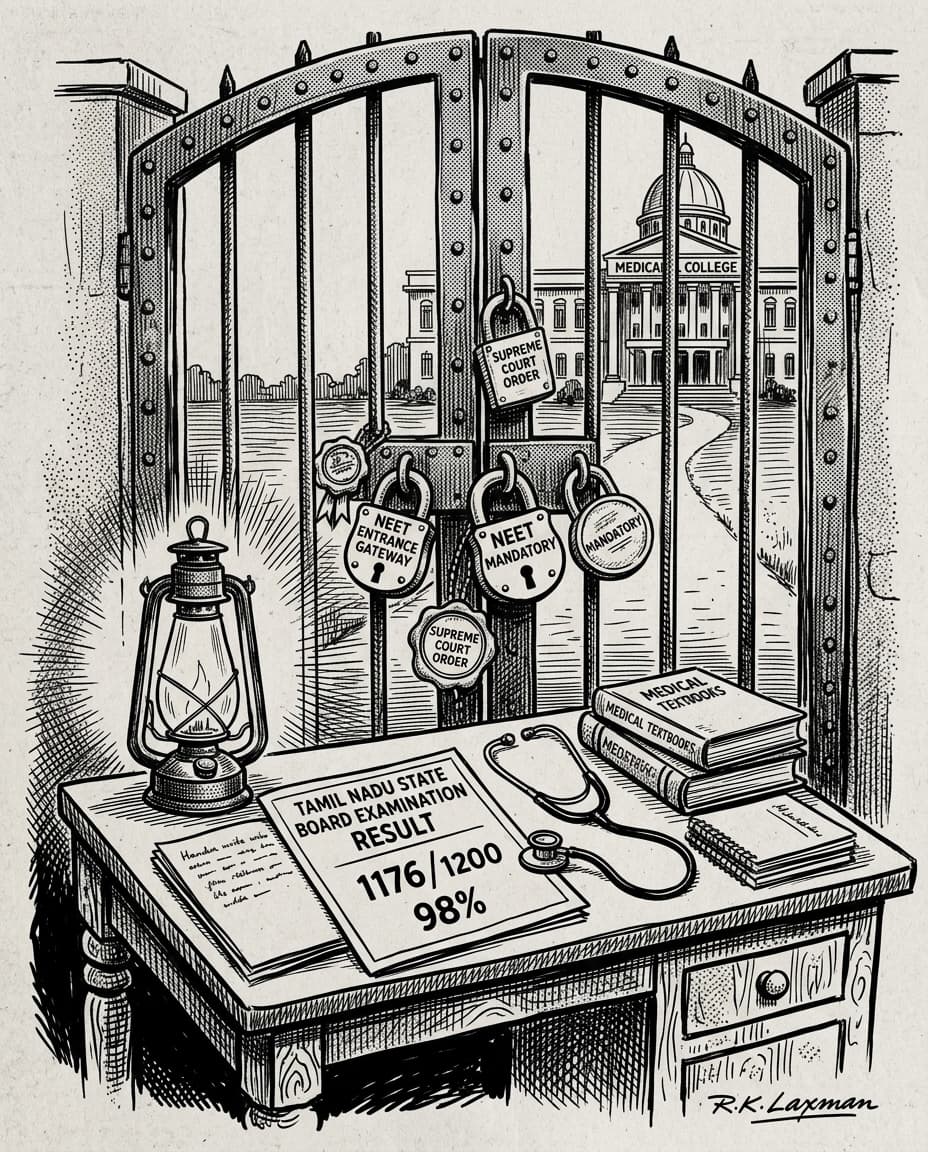
Editorial Illustration:Locked out by law: an editorial illustration representing the sudden barrier placed before rural students achieving top state board scores.
VINTAGE INK ARCHIVE
Anitha Scored 1,176 Out of 1,200. It Wasn't Enough.
S. Anitha of Ariyalur, Tamil Nadu, had petitioned the Supreme Court, addressed press conferences, and fought a national examination policy by herself at age 17. On 1 September 2017, ten days after the Supreme Court dismissed her petition, she died.
If you or someone you know is struggling, please contact iCall at 9152987821 or Vandrevala Foundation at 1860-2662-345 (24/7).
Anitha's father, P. Sathish Kumar, was a daily-wage labourer in Kuzhumur village, Ariyalur district, Tamil Nadu. Her mother worked as a domestic helper. The family had no land and no savings. What they had was a daughter who studied.
In Tamil Nadu's state board Class 12 examination, Anitha scored 1,176 out of 1,200 — a percentage of 98%. Under the state's long-standing medical admissions system, that score would have secured her an MBBS seat. She had planned to become a doctor.
In 2017, that system changed.
The Exam She Was Never Prepared For
The National Eligibility cum Entrance Test (NEET-UG), made compulsory by a Supreme Court order in 2016, replaced state board merit lists as the gateway to medical college. NEET required a syllabus aligned to CBSE — a curriculum that Tamil Nadu's rural government school students did not study. It also required expensive coaching: the average NEET coaching fee in Kota or Chennai ranged from ₹80,000 to ₹3,00,000 per year.
Anitha's family could afford neither a coaching centre nor a curriculum shift.
She scored 86 marks out of 720 in NEET. The seat she had earned through five years of disciplined state-board study was gone.
She did not accept this quietly.
The Fight She Took to Delhi
Anitha became one of the petitioners in the legal challenge against NEET's imposition on Tamil Nadu students. She personally travelled to New Delhi. She held press conferences. She explained, in measured Tamil and halting Hindi, why a uniform national test administered in English and Hindi, calibrated to CBSE, was structurally inaccessible to students like her.
The Supreme Court of India dismissed the exemption petitions on 22 August 2017.
On 1 September 2017, ten days later, Anitha died at her home in Kuzhumur. She was 17 years old.
What Followed
Tamil Nadu came to a standstill.
Students blocked roads across Chennai, Madurai, Coimbatore, and Trichy. Protest marches stretched for kilometres. Political leaders across party lines converged to condemn NEET. The Tamil Nadu Legislative Assembly unanimously passed the Tamil Nadu Admission to Undergraduate Medical Degree Courses Bill — seeking complete state exemption from NEET — and forwarded it to the President of India.
The President did not give assent. The exemption remains legally contested.
What did change: Tamil Nadu introduced a 7.5% preferential reservation in state medical colleges for government school students — a structural reform directly credited to the political aftermath of Anitha's death. The state also established government-funded NEET coaching centres in rural districts specifically for students from low-income families.
These measures exist because Anitha fought, and because the country watched what happened when she lost.
The Structural Question She Asked
Anitha's case is documented not as an individual tragedy but as the clearest articulation of a policy argument that continues to be contested seven years later: whether a single-entry examination, designed around a CBSE curriculum and dependent on expensive private coaching, can fairly serve students from rural government schools, vernacular-medium education, and economically marginalised families.
She asked that question to the Supreme Court herself.
The answer she received cost her the future she had studied for.
Timeline: INC-2017-TN-ARIYALUR-0006
| Date | What Happened | Source |
|---|---|---|
| 2016–2017 | NEET made compulsory nationwide; Tamil Nadu students petition for state exemption | Supreme Court of India Records |
| April–May 2017 | S. Anitha scores 86/720 in NEET despite 1,176/1,200 in State Board; denied MBBS seat | The News Minute, 1 Sep 2017 |
| 22 August 2017 | Supreme Court dismisses Tamil Nadu NEET exemption petitions | Supreme Court Judgment |
| 1 September 2017 | S. Anitha dies at her home in Kuzhumur village, Ariyalur | The Hindu, 2 Sep 2017 |
| 2 September 2017 | State-wide protests erupt across Tamil Nadu; political leaders condemn NEET | The Hindu, 2 Sep 2017 |
| 2017 | Tamil Nadu Legislative Assembly unanimously passes anti-NEET Bill; forwarded to President | Tamil Nadu Assembly Records |
| 2020 onwards | Tamil Nadu institutes 7.5% reservation for government school students in MBBS admissions | The Hindu, 2020 |
Sources & Further Reading
- "Anitha, Dalit student who fought NEET in Supreme Court, dies by suicide in Tamil Nadu" — The News Minute, 1 September 2017. thenewsminute.com
- "Protests erupt across Tamil Nadu following Anitha's suicide over NEET" — The Hindu, 2 September 2017. thehindu.com
- Supreme Court of India — NEET Exemption Petition (Tamil Nadu), 22 August 2017. sci.gov.in
- iCall Mental Health Helpline: 9152987821 | Vandrevala Foundation: 1860-2662-345 (24-hour, multilingual)
Comments
0Want to participate in the discussion?
No comments yet. Start the discussion above.