The Box That Saw Everything and Understood Nothing: Haveri's Cardboard Helmet Exam and the Surveillance Imagination of Indian Education
•INVESTIGATIVE DISPATCH•BY ADITYA
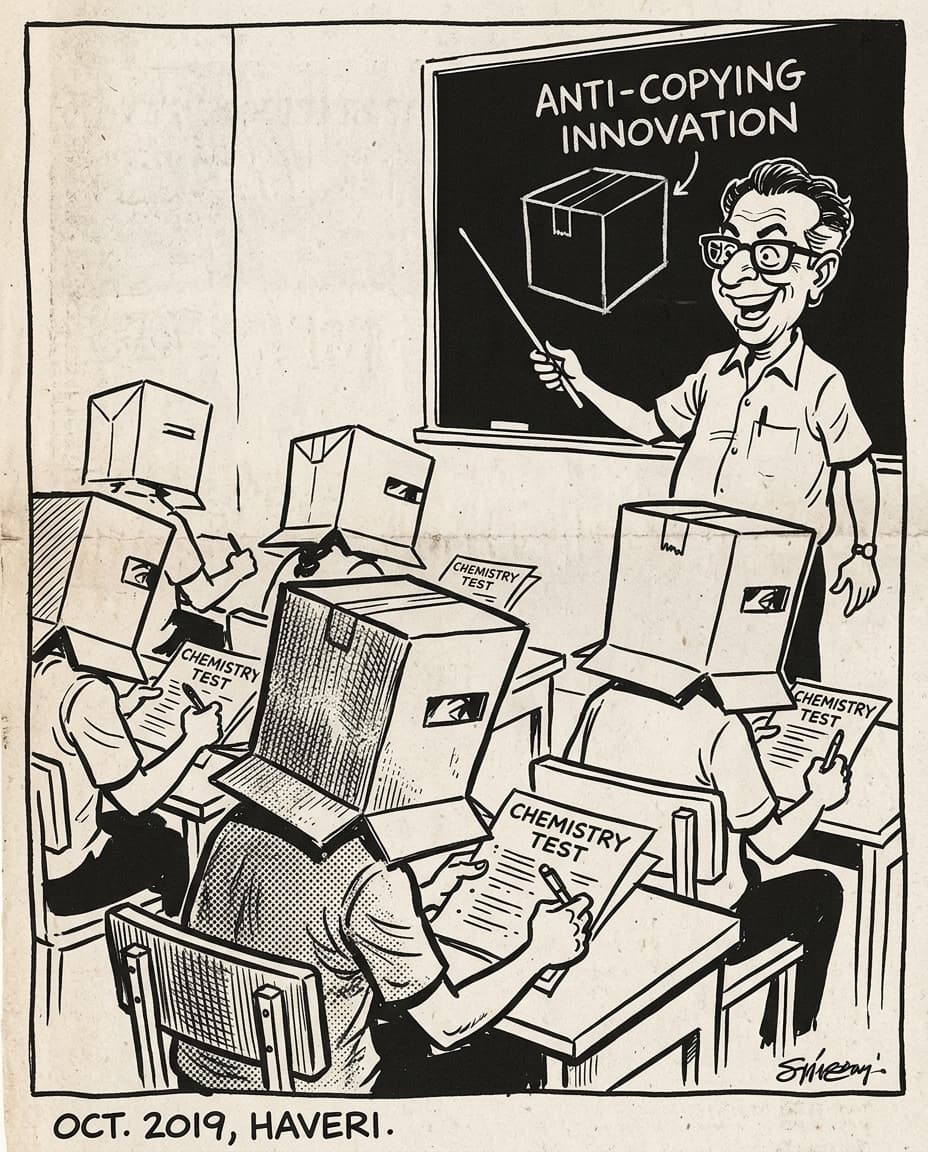
Editorial Illustration:Cardboard conformity: an editorial cartoon on the Haveri college midterm exam where students were made to wear cardboard carton boxes.
VINTAGE INK ARCHIVE
The Box That Saw Everything and Understood Nothing: Haveri's Cardboard Helmet Exam and the Surveillance Imagination of Indian Education
On 16 October 2019, students at Bhagat Pre-University College in Haveri, Karnataka, arrived to write their mid-term chemistry examination and were told to place upside-down cardboard shipping cartons over their heads. A staff member posted photographs on Facebook. Forty-eight hours later, the images were on BBC, CNN, and Reuters — and Karnataka's Education Minister had called the practice "inhuman."
Every examination hall in India has its own familiar sensory landscape: the anxious clicking of ballpoint pens, the rhythmic rustle of supplementary answer sheets, the solemn patrol of the invigilator's leather shoes along the aisle, and the perpetual, desperate lateral darting of teenage eyes searching for a classmate who actually studied Chapter 4.
On the morning of 16 October 2019, the students of Class 11 (First PUC) at Bhagat Pre-University College in Haveri district, Karnataka, experienced a radically different sensory environment. They smelled corrugated kraft paper. They breathed recycled air. They stared at the world through a hand-cut rectangular slit approximately ten centimetres wide and six centimetres tall.
They were writing their mid-term chemistry examination inside upside-down cardboard packing boxes.
Photographs taken by an administrative staff member and posted with some institutional pride to a college Facebook page detonated a forty-eight-hour media explosion. Within two days, images of rows of students — bodies human, heads replaced by identical brown shipping cartons — had circulated from Karnataka to the BBC World Service, and from BBC World Service to newsrooms across Southeast Asia, Europe, and the Americas. Karnataka's Education Minister issued a public condemnation calling the scheme "totally unacceptable." The district administration served a show-cause notice and dispatched an inspection team. The college director issued a written apology and surrendered the cardboard boxes.
The incident left behind a question that was simultaneously comic and serious: what institutional logic produces an administration that solves the problem of cheating by boxing its students inside shipping containers?
I. Haveri and the Architecture of Examination Anxiety
Haveri is a mid-sized district headquarters in northern Karnataka, positioned in the agricultural belt approximately 335 kilometres northwest of Bengaluru. It is an unremarkable town of modest engineering colleges, pre-university science coaching centres, and the particular aspirational pressure that characterises second-tier Indian educational ecosystems.
Bhagat Pre-University College was a private institution competing in a crowded local market. Like hundreds of similar colleges across Karnataka's semi-urban hinterland, it was deeply invested in its board examination results: the First and Second PUC (Pre-University Course) results that determine whether students gain admission to MBBS, B.Tech, and B.Sc programmes at state universities. In this fiercely competitive environment, colleges develop enormous institutional anxiety about malpractice — both about their students cheating during internal examinations and about the college's own examination conduct record with the Department of Pre-University Education.
The management of Bhagat College had been thinking about peripheral vision. Specifically, the ability of students seated in adjacent rows to tilt their gaze slightly — a fifteen-degree horizontal rotation of the eyeball — and read answers from a neighbour's booklet. They had tried conventional solutions: staggered seating, divided cubicle arrangements, wide aisles, increased invigilator ratios. Either the budget was insufficient, or the results were unsatisfactory.
In mid-2019, the college's director, M.B. Satish, came across a viral photograph that had been circulating on education-focused Facebook groups and WhatsApp forwards. In the photograph — variously attributed to a school in Thailand or a classroom in Mexico, with the original source disputed and unverified — students sat at examination desks with large cardboard blinders attached to their heads, preventing lateral vision. The concept appeared, from a purely optical standpoint, effective. No horizontal gaze. No copying.
Satish proposed trialling the system.
II. The Preparation: Cardboard, Box Cutters, and the Best of Intentions
In the days before 16 October 2019, the Bhagat College administration sourced several dozen medium-sized corrugated cardboard shipping boxes — the kind used for household goods, provisions, and electronic appliance packaging — from local stores and the college's own storage.
The boxes were turned upside down. A college staff member, armed with a utility knife, cut a rectangular slit into the front face of each box: a viewing window designed to be positioned at eye-level when the box sat on a student's head, restricting the student's visible world to the desk surface immediately in front of them.
The mechanism was, in principle, exactly what it appeared: a cardboard blinker. Lateral vision was occluded by the box walls. Rearward vision was similarly eliminated. The student could see only through the narrow front window — enough to read the question paper, locate the inkwell, and guide the pen across the answer booklet, but not enough to communicate visually with any adjacent student.
When the approximately fifty Class 11 science students entered the examination hall on the morning of 16 October, they found a cardboard carton placed on every desk. An invigilator explained the new protocol. The students were, according to the college's later account, given the option to decline. Roughly 56 of the 72 registered students present agreed to wear the boxes, according to the management's statement. Those who subsequently complained of discomfort or claustrophobia were permitted to remove them after fifteen to thirty minutes.
The chemistry mid-term paper was distributed. The examination commenced.
From above, the classroom resembled something that had never existed in the history of human education: rows upon rows of brown corrugated squares, each surmounting a student's torso and set of furiously scribbling hands.
A member of the college administrative staff found the sight educational enough to photograph.
They then posted the photographs to the college's official Facebook page.
III. From Facebook to the BBC: The Forty-Eight-Hour Global Detonation
The images that appeared on Facebook on the afternoon of 16 October 2019 showed exactly what had happened: neat rows of First PUC students in their blue-and-white uniforms, their heads entirely enclosed within upside-down cardboard boxes, bent over their answer booklets in the quiet, focused posture of examination-takers who have absolutely no alternative but to stare directly down.
The images were genuinely arresting. In the absence of any contextual explanation, they resembled either a performance art installation, an industrial dystopia, or a low-budget science fiction film set.
Overnight, the photographs were shared across WhatsApp networks by people who could not resist the visual. By the morning of 17 October, they had arrived on Reddit. The posts to r/india and r/mildlyinteresting attracted tens of thousands of upvotes within hours. From Reddit, the images were picked up by social media aggregators, entertainment news sites, and — critically — the wire desks of international news agencies.
By the afternoon of 17 October, the photographs were circulating across the global internet with the full, unstoppable momentum of a genuinely unprecedented visual:
- The Indian internet nicknamed the classroom "Minecraft High School" — a reference to the angular, pixellated aesthetic of the popular video game.
- Gaming and technology forums suggested the college had pioneered a real-world version of VR headsets on a zero-rupee budget.
- Meme creators produced composites overlaying Daft Punk helmets, Amazon Prime delivery boxes, and WALL-E's facial panels onto the students' cardboard-encased heads.
- Others, in a darker register, drew comparisons to experimental isolation research, sensory deprivation studies, and the treatment of livestock in industrial farming.
By the morning of 18 October, BBC News, CNN, The Guardian, The New York Times, and Reuters had all filed stories. The photographs — published with captions translating the concept of a government-affliated Indian pre-university college — generated enormous international bafflement and amusement.
IV. The Government Intervention: "Totally Unacceptable"
The photographs reached Karnataka's then Primary and Secondary Education Minister, S. Suresh Kumar, by the morning of 18 October. His response was immediate and unambiguous. Reaching out via social media before the formal bureaucratic process had even mobilised, he issued a public condemnation:
"This is totally unacceptable. Nobody has any right to treat anyone, more so students, like animals. This perversity will be dealt with aptly. We will never tolerate such practices in educational institutions."
The Karnataka Department of Pre-University Education activated its district machinery. S.S. Piraje, the Deputy Director of Public Instruction (DDPI) for Haveri district, drove to the Bhagat College campus that same morning for an emergency inspection.
A show-cause notice was served to the management under the Karnataka Educational Institutions (Classification, Regulation and Prescription of Curricula) Act. The notice required the college director to explain in writing why the institution had implemented an unapproved, unilateral, non-standard examination procedure that had neither sought nor received clearance from the Department of Pre-University Education, and why disciplinary action should not follow.
The cardboard boxes were ordered to be immediately confiscated and permanently removed from the examination premises.
V. The Director's Defence and the Written Apology
Facing the prospect of formal disciplinary proceedings and potential impacts on the college's recognition status, director M.B. Satish appeared before the press and before district officials to offer an account of the college's reasoning.
His justification addressed three points: inspiration, voluntariness, and intent.
On inspiration: Satish maintained that the scheme had been adapted from a viral photograph circulating on social media, purportedly from a school in Thailand or a similar educational context abroad, where the technique had reportedly been implemented without controversy. He acknowledged that he had not verified the authenticity of the foreign example or sought any expert endorsement before introducing it at Bhagat College.
On voluntariness: The college maintained that no student was compelled to wear the cardboard box. Parents had been informally briefed at a previous meeting about experimental anti-cheating measures, and students had been told they could refuse. The management cited the fact that a subset of students had indeed removed the boxes early without academic penalty as evidence that the measure was not coercive.
On intent: Satish insisted the sole motivation was to prevent malpractice in a mid-term examination where monitoring resources were constrained, and that there was no intention to humiliate, punish, or demean students. The school had believed, in good faith, that the visual restriction devices would help serious students concentrate without distraction from peers who might be attempting to peek.
None of these explanations satisfied the department. On 19 October 2019, Satish submitted a formal written apology to the DDPI, acknowledging that the measure had been poorly conceived, inadequately planned, and implemented without proper administrative approvals.
The apology was accepted. The matter was closed at the institutional level, with the mandatory written undertaking that no such experiment would be repeated.
VI. The Larger Reckoning: What the Boxes Were Trying to Solve
Beyond the comedy — and the images were genuinely, uncommonly funny — the Haveri incident served as a diagnostic snapshot of the institutional psychology that pervades Indian competitive examination culture.
The problem the college was trying to solve was real. Exam malpractice in Indian schools and pre-university colleges has historically been significant, particularly in internal and mid-term assessments where supervision resources are thinner than in board examinations. The pressure to secure marks that will satisfy both students and institutional rankings creates powerful incentives for copying, and conventional seating arrangements do not always prevent it.
The response the college chose — vision-occluding cardboard boxes — was the product of a specific kind of institutional thinking: one that treats the problem of cheating as primarily a hardware problem. If the student cannot see the neighbour, the student cannot copy. If lateral vision is physically eliminated, the vulnerability is physically patched.
This logic is not irrational. It is, however, reductive to a degree that collapses the distinction between a student and a machine. The solution treats the examination hall as an engineering problem rather than a human environment. It imports a surveillance logic — restrict inputs, control outputs — into a space inhabited by adolescent human beings who are already under intense psychological pressure.
The Education Minister called the practice inhuman. Child rights activists pointed out that the boxes raised uncomfortable parallels with isolation experiments and industrial livestock management. Education researchers noted that the documented psychological effects of even brief sensory restriction — elevated anxiety, reduced cognitive performance, distorted time perception — were precisely opposite to the conditions needed for accurate examination results.
Karnataka's Department of Pre-University Education subsequently issued a state-wide advisory to all affiliated colleges specifying that anti-malpractice measures must remain within published DDPI guidelines, must not involve physical apparatus attached to or placed over the student's body, and must not impede normal physiological functions including breathing, thermoregulation, or comfortable seated posture.
The brown corrugated boxes of Haveri thus became, in their brief and inglorious examination-hall career, an accidental legislative catalyst — a case study in what happens when institutional anxiety about cheating is combined with minimal oversight, maximum creativity, and absolutely no consultation with the humans whose heads the boxes were intended to enclose.
Chronological Timeline: INC-ABS-2019-KA-002
| Date | Authority / Entity | What Happened | Verified Source |
|---|---|---|---|
| Mid-October 2019 (pre-exam) | Bhagat PU College management | Cardboard boxes sourced from local stores; rectangular viewing slits hand-cut with utility knife; plan cleared internally without DDPI approval | DDPI Haveri Inspection Report |
| 16 October 2019, 10:00 a.m. | Bhagat PU College invigilators | ~50 Class 11 students instructed to don inverted cardboard cartons; chemistry mid-term conducted under vision-restricted conditions | The Hindu, 18 Oct 2019 |
| 16 October 2019 (afternoon) | College administrative staff | Photographs of boxed students posted to college Facebook page, described as an "innovative anti-cheating" initiative | Facebook (original post; archived) |
| 17 October 2019 | Reddit / Twitter / WhatsApp | Images reach r/india and r/mildlyinteresting; viral explosion begins; international wire agencies pick up the story overnight | Indian Express, 19 Oct 2019 |
| 18 October 2019 (morning) | DDPI S.S. Piraje | Emergency campus inspection conducted; show-cause notice served to college management; cardboard boxes ordered confiscated immediately | Karnataka PUE Dept Show Cause Notice Ref: Haveri/DDPI/PU/2019/314 |
| 18 October 2019 (noon) | Karnataka Education Minister S. Suresh Kumar | Public condemnation issued: "totally unacceptable… treating students like animals… perversity will be dealt with" | The News Minute, 18 Oct 2019 |
| 18–19 October 2019 | BBC, CNN, Reuters, NYT | International media coverage; story goes global; images described as "dystopian" and "surreal" | BBC News, 19 Oct 2019 |
| 19 October 2019 | College Director M.B. Satish | Formal written apology submitted to DDPI; undertaking given that practice will not be repeated; boxes permanently banned | DDPI Haveri Official Files |
| November 2019 | Karnataka PUE Department | State-wide advisory issued prohibiting all unapproved physical apparatus during examination; anti-malpractice guidelines updated | Karnataka PUE Circular Nov 2019 |
Sources & Further Reading
Tier 1 — Official Records
- Show Cause Notice, DDPI Haveri — Ref: Haveri/DDPI/PU/2019/314, issued to Bhagat Pre-University College, 18 October 2019. Karnataka Department of Pre-University Education.
- Karnataka PUE Anti-Malpractice Circular — State-wide advisory prohibiting unapproved physical examination apparatus, November 2019. Department of Pre-University Education, Government of Karnataka.
Tier 2 — Verified Press Coverage
- "Karnataka college makes students wear cardboard boxes on head to prevent cheating" — The Hindu, 18 October 2019. thehindu.com
- "Karnataka: Haveri college uses cardboard boxes to prevent cheating in exams; minister reacts" — The Indian Express, 19 October 2019. indianexpress.com
- "India college apologises for exam cardboard boxes" — BBC News, 19 October 2019. bbc.com
- "Carton boxes on head to prevent cheating: Karnataka college draws flak" — The News Minute, 18 October 2019. thenewsminute.com
- "India School Makes Students Wear Cardboard Boxes Over Heads to Prevent Cheating" — Newsweek, 19 October 2019. newsweek.com
Comments
0Want to participate in the discussion?
No comments yet. Start the discussion above.