The Open-Air Exam in Underwear
•INVESTIGATIVE DISPATCH•BY ADITYA
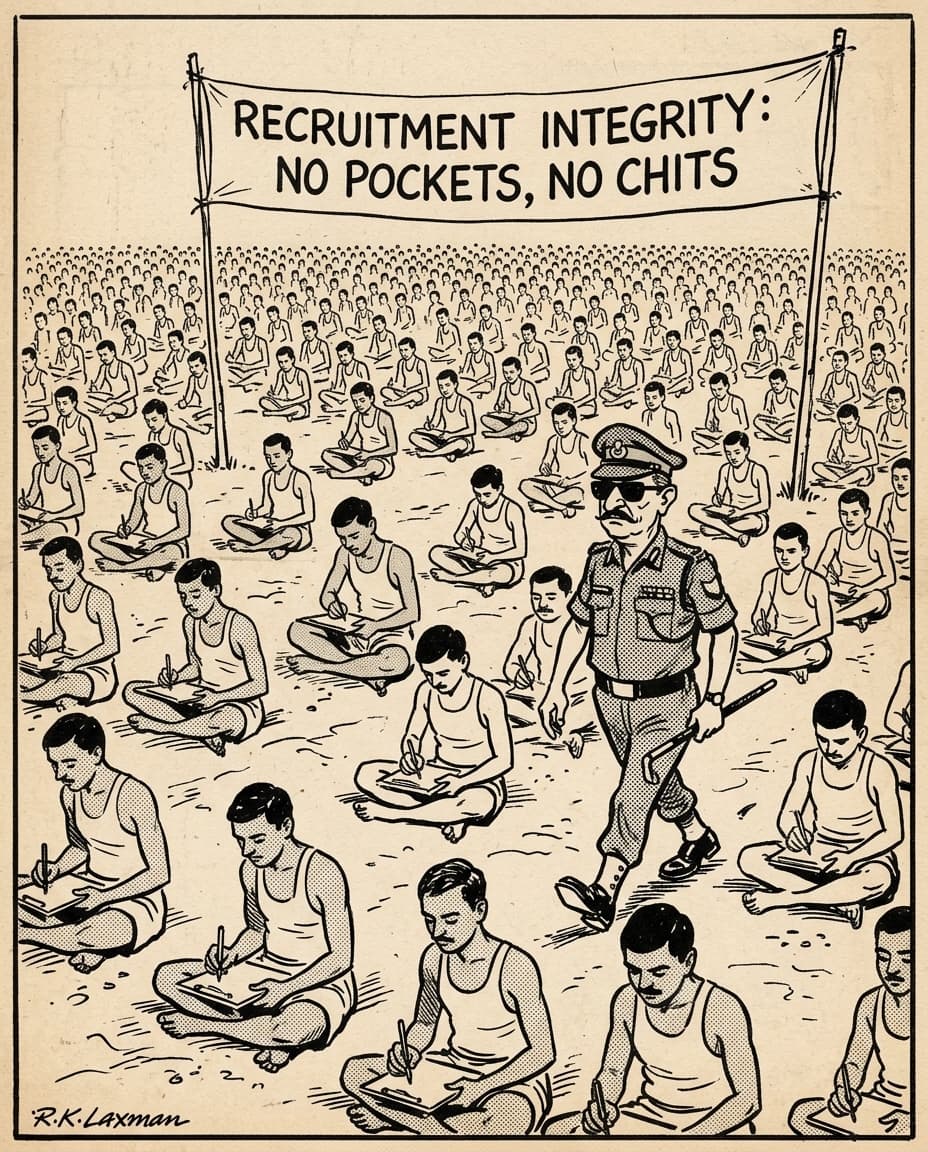
Editorial Illustration:The open-air exam: an editorial cartoon depicting the 2016 Muzaffarpur army recruitment drive where candidates sat in an open field in undershirts.
VINTAGE INK ARCHIVE
The Open-Air Exam in Underwear
In February 2016, over 1,150 army clerk recruitment candidates in Muzaffarpur were told to strip to their underpants and write their exam in an open field. The Guardian covered it. The Patna High Court was not amused.
On 28 February 2016, more than a thousand young men arrived at an army recruitment venue in Muzaffarpur, Bihar, hoping to secure a clerical post in the Indian Army.
They left wearing considerably less than they came in.
Faced with the logistical challenge of frisking 1,150 candidates for hidden chits, earpieces, and written notes, the organising officer — Colonel V.S. Godara of the Army Recruiting Office — devised a solution that was efficient, thorough, and almost certainly unprecedented in the history of competitive examinations anywhere on Earth.
He told the candidates to take off their clothes.
All of them. Down to their underwear.
The candidates complied. They sat cross-legged in an open dusty field, in their briefs, under armed guard, and wrote their army clerk recruitment exam for two hours.
The Photographs
Someone took photographs.
Within 48 hours, images of rows upon rows of young men — sitting in the open air in their undergarments, hunched over exam papers balanced on their knees, surrounded by uniformed soldiers — had circulated from Bihar to Delhi to London. The Guardian ran the story. Associated Press filed a wire. International outlets described the scene as "bizarre" and "surreal." Reddit compared it to hazing rituals and dystopian fiction.
In India, the reaction was split between dark comedy and genuine outrage.
The Colonel's Defence
Colonel Godara, when approached by reporters, offered an explanation that was logically coherent and deeply alarming in equal measure:
"We have seen candidates hide chits in their socks, shoes, belt loops, collar folds, and waistbands. Strip frisking takes too long. This was the most efficient way to ensure a cheat-free examination."
He was not wrong that army recruitment exams in Bihar had a serious cheating problem. He was, however, dramatically wrong about the solution.
What Happened Next
The Patna High Court took suo motu cognisance of the photographs and summoned the Army Recruiting Office to explain itself. The Army filed an affidavit expressing formal regret and pledging that no such procedure would ever be repeated.
The Defence Ministry in New Delhi separately demanded an explanation from the Muzaffarpur recruiting office.
The candidates who sat the exam in their underwear received no formal apology. Several who spoke to reporters described sitting on dusty ground in February cold, unable to concentrate, unable to write comfortably without a desk, and deeply humiliated by the experience.
The exam results were declared. Life moved on.
The underwear protocol was never used again — officially.
Timeline: INC-ABS-2016-BR-008
| Date | What Happened | Source |
|---|---|---|
| 28 February 2016 | 1,150+ candidates stripped to underwear; exam conducted in open field, Muzaffarpur | The Hindu, 1 Mar 2016 |
| 1 March 2016 | Photographs reach international media; The Guardian, AP file stories | The Guardian, 1 Mar 2016 |
| 1–2 March 2016 | Patna High Court takes suo motu cognisance; Army Recruiting Office summoned | Indian Express, 2 Mar 2016 |
| March 2016 | Army files affidavit expressing regret; Defence Ministry demands explanation | Hindustan Times, Mar 2016 |
Sources & Further Reading
- "Army makes candidates write exam in underwear" — The Hindu, 1 March 2016. thehindu.com
- "Indian army candidates take recruitment exam in their underwear" — The Guardian, 1 March 2016. theguardian.com
- "Bihar army exam in underwear: Patna HC seeks army's reply" — The Indian Express, 2 March 2016. indianexpress.com
Comments
0Want to participate in the discussion?
No comments yet. Start the discussion above.