The Six-Lakh Chappal: Bluetooth Soles, Magnetic Earpieces, and the Wearable-Tech Cheating Ring That Made 1.6 Million REET Candidates Write Barefoot
•INVESTIGATIVE DISPATCH•BY ADITYA
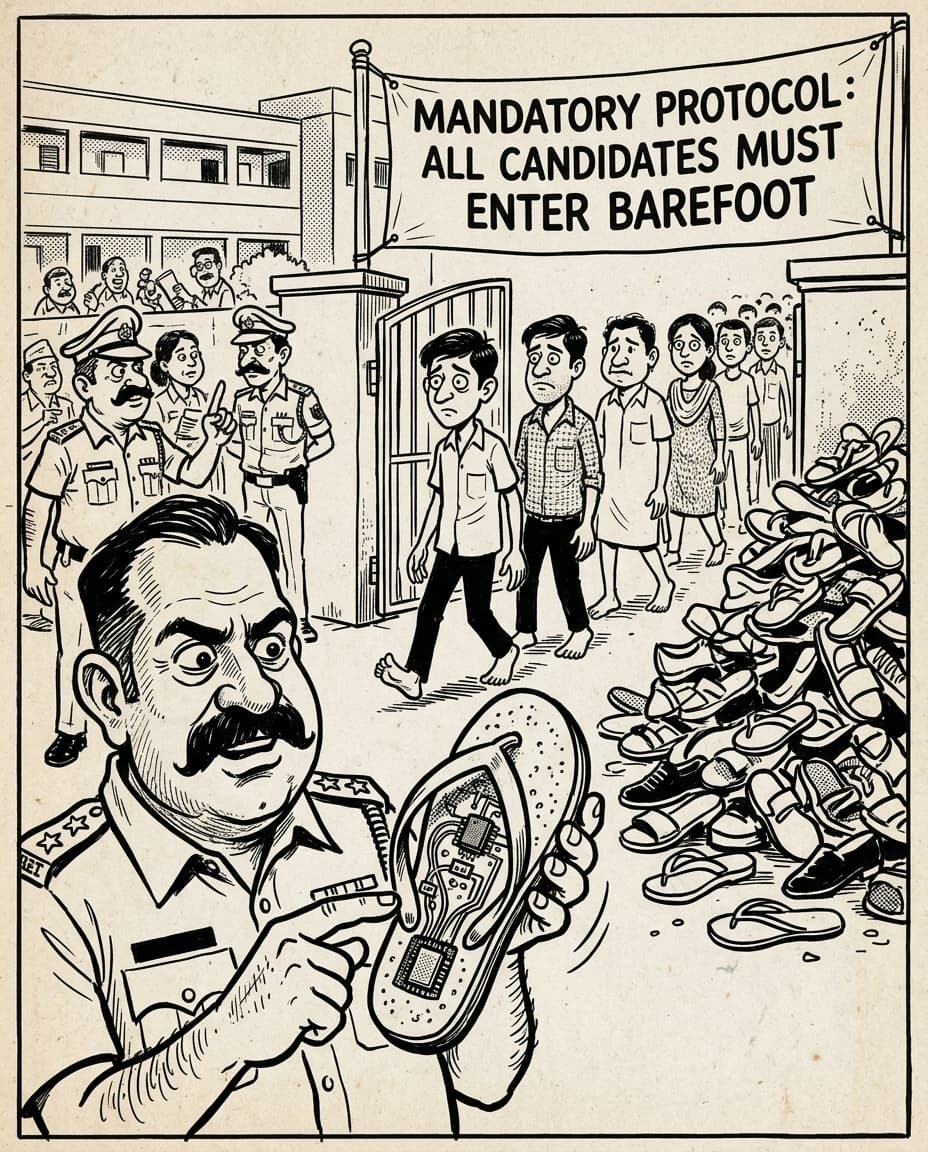
Editorial Illustration:Editorial illustration reflecting the events and context of The Six-Lakh Chappal: Bluetooth Soles, Magnetic Earpieces, and the Wearable-Tech Cheating Ring That Made 1.6 Million REET Candidates Write Barefoot.
VINTAGE INK ARCHIVE
The Six-Lakh Chappal: Bluetooth Soles, Magnetic Earpieces, and the Wearable-Tech Cheating Ring That Made 1.6 Million REET Candidates Write Barefoot
On 26 September 2021, Rajasthan suspended mobile internet across sixteen districts and deployed thousands of armed police for the REET teaching eligibility exam. An organized gang responded with a custom-engineered solution: ₹6 lakh rubber slippers with embedded GSM SIM cards, induction transmitters, and auto-answer circuits that bypassed the blackout entirely. They were undone not by cybersecurity — but by a candidate who walked funny.
In India's competitive examination ecosystem, the arms race between anti-cheating authorities and cheating syndicates is perpetual, iterative, and — in its more baroque episodes — genuinely astonishing.
By September 2021, the Rajasthan government had deployed what it considered a comprehensive, layered defence for the Rajasthan Eligibility Examination for Teachers (REET): a statewide mobile internet suspension across sixteen districts, thousands of armed police at four thousand examination centres, metal detectors, thermal scanners, and the most stringent physical frisking protocol the state had ever administered at an entrance exam.
The syndicate operating around a Bikaner coaching centre proprietor named Tulsaram Kaler responded with a piece of consumer hardware that bypassed every single one of those measures without touching the internet at all.
They engineered it into a pair of rubber slippers.
The device — containing a miniaturized GSM module, an auto-answer-capable SIM card, a lithium-polymer battery, and a magnetic induction coil — transmitted incoming voice calls through the slipper's sole and up through the candidate's foot, leg, and body to a sub-millimetre Bluetooth bead pressed deep into the ear canal. The candidate needed only to sit quietly, feet flat on the floor, and listen as an external solver dictated answers in real time.
The price for this bespoke examination assistance technology: ₹6 lakh per pair.
The syndicate was exposed not by a sophisticated cyber forensics operation or a network intercept. It was exposed by a police constable who noticed a young man walking with the stilted, self-conscious gait of someone whose shoes weighed half a kilogram.
I. The State of Rajasthan's Teaching Emergency
To understand the REET and the scale of what surrounded it in 2021, it is necessary to understand what the examination represented for an enormous swathe of rural Rajasthan.
The Rajasthan Eligibility Examination for Teachers is a mandatory qualification test for appointment to Grade-3 primary and upper-primary teaching posts in Rajasthan government schools. In a state where government employment carries exceptional social and economic prestige — particularly in semi-urban and rural communities — and where alternative private-sector employment in comparable salary brackets is scarce, the REET is not merely an exam. It is, for many families, a generational aspiration.
In 2021, the state government announced 31,000 teacher vacancies — the largest single recruitment in the state's recent history. The announcement triggered a registration stampede: 1.6 million candidates enrolled for the examination, making it one of the largest single-day recruitment examinations in India that year.
The state government, acutely aware of the REET's history of paper leak controversies and syndicate-driven malpractice, mobilized for 26 September 2021 like a wartime operation:
- Mobile internet and 4G data were suspended across sixteen Rajasthan districts from 6:00 AM to 6:00 PM on exam day, eliminating the primary conduit for WhatsApp and Telegram paper circulation.
- Approximately 55,000 police personnel were deployed — more than the annual policing deployment for Pushkar Mela — to man checkpoints, guard examination centres, and conduct frisking operations.
- Metal detectors and thermal imaging scanners were installed at entrance gates across all four thousand registered centres.
- Candidates were explicitly prohibited from carrying mobile phones, electronic watches, calculators, or any metallic accessories into the hall.
On paper, this was impenetrable. The internet was down. The hardware was banned. The physical perimeter was secure.
The syndicate's engineers had anticipated all of it.
II. The Engineering Inside the Rubber Sole
The Kaler syndicate's solution was elegant in the same way that a good confidence trick is elegant: it exploited the assumption of thoroughness.
Every anti-cheating protocol deployed by the Rajasthan government focused on known categories of contraband — mobile phones, earphones with visible wires, electronic watches, calculators, Bluetooth headsets. The assumption underlying all of these protocols was that the cheating device would be identifiable as an electronic device.
The syndicate's device was not identifiable as an electronic device. It was identifiable as footwear.
The construction process, as revealed by police technical investigation following the arrests, was as follows:
A standard pair of rubber strap slippers — the ubiquitous, inexpensive chappal available across Rajasthan's markets — was purchased. The thick foam-rubber sole was hollowed out along the internal cavity using precision cutting tools. Into this cavity, the syndicate's technical team — which police records suggest included at least one individual with formal electronics training — embedded the following components:
- A GSM SIM card module: configured to receive incoming 2G voice calls on a dedicated prepaid mobile number, operating entirely on voice networks that remained active even during the state's mobile data blackout.
- An auto-answer circuit: programmed to silently accept incoming calls without producing an audible ring or vibration that would alert invigilators.
- A magnetic induction coil (transmitter): which converted the incoming audio signal into a low-frequency magnetic field that could be detected by a paired receiver.
- A small lithium-polymer rechargeable battery: providing several hours of continuous standby and call-active operation.
The sole was resealed with industrial adhesive, sanded to remove seam lines, and repainted to match the original slipper colour. The finished product was, to visual inspection, indistinguishable from ordinary footwear.
The candidate's corresponding receiver was a nano-Bluetooth bead — approximately 3 to 4 millimetres in diameter, flesh-toned, and specifically designed to be inserted deep into the ear canal, invisible without direct otoscopic examination. The bead contained its own induction pickup coil that harvested the magnetic field broadcast from the slipper sole.
The operational protocol was straightforward:
- The candidate, seated at their desk, placed both feet flat on the floor.
- An external accomplice — positioned safely away from the examination zone, holding a copy of the question paper obtained in advance or in real time — dialled the embedded SIM's number.
- The slipper auto-answered silently. The magnetic field activated.
- The nano-bead in the candidate's ear received the magnetic field and converted it to audio.
- The candidate listened to dictated answers and marked the OMR sheet accordingly.
No visible earpiece wire. No mobile phone on the person. No active data connection. No detectable electromagnetic emission at frequencies covered by standard examination-hall RF sweepers of the era.
The technology was not improvised. It had been manufactured specifically for examination fraud. The price — ₹2.5 lakh to ₹6 lakh per candidate depending on the level of customisation and the seniority of the post being targeted — reflected the cost of the specialized components, the technical labour involved, and the extraordinary profit margins available in a market where a government teaching post was worth a lifetime of economic security.
III. The Constable Who Noticed a Walk
At approximately 8:30 AM on 26 September 2021, outside the Bhawani Niketan examination centre in the Gangashahar area of Bikaner district, a police constable assigned to entrance-gate duty was conducting the standard visual inspection of approaching candidates.
Among the stream of young men and women walking toward the gate, one candidate caught the constable's attention. The young man was walking with a noticeably unnatural gait — slightly rigid in the right ankle, taking steps with a self-conscious deliberateness that did not match the ordinary nervousness of an examination morning. He periodically glanced down at his right foot, as though checking that something remained in position.
The constable stopped the candidate and called for a senior officer.
When the candidate was asked to step aside and remove his slippers for inspection, the disparity was immediately apparent to the officers who picked them up. A standard pair of rubber slippers of that size weighs approximately 150 grams. The slippers removed from the candidate weighed approximately 450 to 500 grams — three times the expected mass.
The candidate was escorted to the nearest police station. Officers used a utility blade to carefully slice through the rubber sole.
Inside: a neatly assembled circuit board, soldered connections, a SIM card slot, and a small battery pack, all sealed in a compact waterproof housing and embedded within the hollowed foam core.
A physical search of the candidate's person revealed the nano-bead earpiece. It had been inserted so deeply into the ear canal that standard examination-hall tweezers could not grasp it. The candidate was transported to a local hospital, where an ENT specialist extracted the device using otoscopic instruments.
The candidate was arrested. A rapid alert was transmitted across the Rajasthan police network to all four thousand examination centres: be alert for candidates with unusually heavy footwear.
Within the next two hours, additional slipper devices were detected at centres in Ajmer, Jodhpur, and Kota districts. A coordinated sweep of nearby hotels and guest houses — where syndicate operators had established temporary operational bases — yielded dozens of undelivered slipper units, along with the phone numbers embedded in them, operational manuals, and cash payments recorded in a ledger.
Tulsaram Kaler, the coaching centre proprietor identified as the syndicate kingpin, was arrested. Several technical associates were apprehended at a guest house where they were positioned to make the outbound calls to the embedded SIM cards.
IV. The Emergency Barefoot Order
As the scope of the slipper-device network became clear to district collectors and examination authorities across the state, a critical administrative decision was made within hours of the initial discovery.
At centres across Rajasthan — from Bikaner to Barmer, from Jaipur to Jaisalmer — district officials issued a blanket emergency directive:
All candidates must remove all footwear before entering the examination premises. No shoes, sandals, slippers, or any form of foot covering are permitted inside.
The implementation of this order across four thousand examination centres simultaneously, on a morning when 1.6 million candidates were already queued at gates, was logistically remarkable. Within the space of approximately ninety minutes, the examination premises of Rajasthan were transformed. Piled outside school compounds, on pavements and empty lots, were mountains of footwear: rubber slippers, sports shoes, leather chappals, canvas sneakers, and dress shoes — the assembled footwear of a small city.
Over 1.6 million candidates sat for the REET Level 1 and Level 2 examinations on 26 September 2021 in bare feet.
Photographs of the enormous footwear piles outside examination centres — stretching for dozens of metres along school compound walls — became the defining visual document of the 2021 REET examination. They circulated alongside the dissected-slipper photographs with equal and complementary force: one image showing the technology that caused the emergency, the other showing the scale of the human response.
V. The Internet's Verdict: The Chappal Don and the Adibas Bluetooth Pro
When police press conferences in Bikaner released photographs of the dissected slippers — the circuit board nestled within the rubber sole like a technological fossil — the Indian internet processed the images with characteristic velocity.
The dominant register was, inevitably, comedic:
- "The most expensive wearable tech of 2021 is not an Apple Watch. It is a ₹6 lakh rubber chappal from Bikaner." — the line was repeated, in dozens of variations, across Twitter, Instagram, and Reddit.
- Meme creators launched a mock product line: "Adibas Bluetooth Pro", "Air Chappal Max 2021", and "Samsung Galaxy Slipper S21" — with design mockups showing the circuit board exposed through the transparent sole.
- Tulsaram Kaler was dubbed the "Chappal Don" by social media, with satirical Wikipedia-style biography pages appearing within hours.
- Finance-adjacent Twitter was particularly exercised by the maths: candidates were paying ₹6 lakh in bribery for examination assistance to secure a teaching post with a starting monthly salary of approximately ₹23,700.
"The ROI on these slippers, assuming you get the job and serve 30 years, is actually reasonable. This man understood fixed income investment better than the candidates he was cheating for."
But beneath the comedy, education commentators and journalists identified a more disquieting truth: the existence of a technically sophisticated, commercially operational cheating hardware market — with custom-manufactured bespoke devices, established supply chains, and paying clients — was evidence not merely of individual dishonesty but of a structural crisis in how examination integrity was being maintained.
A ₹6 lakh investment in a chappal was not the act of a desperate student. It was a commercial transaction in a functioning black market, one that required a client with access to that capital, a vendor with the technical capability to produce the hardware, and a shared certainty — grounded in historical experience — that the probability of being caught was low enough to justify the risk.
The constable who noticed the walk had disrupted a business operation.
VI. The Legislative Aftermath: The Rajasthan Anti-Cheating Act
The REET 2021 slipper scandal did not occur in isolation. It was one incident in a year of Rajasthan examination scandals that included paper leaks, solver gang arrests, and mass cancellations across multiple state recruitment boards. The cumulative political pressure was substantial.
In 2022, the Rajasthan Legislative Assembly passed the Rajasthan Public Examination (Measures for Prevention of Unfair Means) Act, 2022 — one of the most stringent state-level anti-examination-fraud statutes in India at the time of its passage. Key provisions included:
- Prison sentences of up to ten years for organising, funding, or operating a commercial cheating syndicate.
- Fines of up to ₹10 crore for examination fraud organisations.
- Property attachment of assets acquired through proceeds of examination fraud.
- Mandatory technological audits of all examination service vendors and hardware suppliers engaged for state recruitment examinations.
The barefoot protocol, meanwhile, entered mainstream examination administration. Across multiple northern Indian states, admit card guidelines were updated to explicitly specify that candidates must wear only thin-soled, open sandals during examinations. Closed shoes, thick-soled footwear, and boots were formally prohibited at competitive recruitment tests in Rajasthan, Uttar Pradesh, Madhya Pradesh, and Haryana — a policy directly traceable to a morning in Bikaner when a constable noticed that a young man's chappal weighed half a kilogram too much.
Chronological Timeline: INC-ABS-2021-RJ-003
| Date | Authority / Entity | What Happened | Verified Source |
|---|---|---|---|
| Pre-September 2021 | Tulsaram Kaler syndicate | Custom Bluetooth-embedded slippers manufactured; GSM SIM modules, induction transmitters, and nano-bead earpieces assembled in workshop; candidates recruited and devices sold for ₹2.5–6 lakh per unit | India Today, 26 Sep 2021 |
| 26 September 2021, 6:00 a.m. | Government of Rajasthan | Mobile internet and 4G data suspended in 16 districts; 55,000+ police deployed to 4,000 examination centres; metal detectors and thermal scanners at all gates | Rajasthan Home Department Order |
| 26 September 2021, 8:30 a.m. | Bikaner Police, Gangashahar checkpoint | Constable flags candidate with unnatural gait and unusually heavy slipper; suspect detained and slippers cut open revealing circuit board, SIM module, and battery | The Hindu, 26 Sep 2021 |
| 26 September 2021, 9:00–10:00 a.m. | ENT Specialist, Bikaner hospital | Nano-bead earpiece extracted surgically from candidate's ear canal; first confirmed unit of the Kaler network's hardware recovered intact | Police Medical Report |
| 26 September 2021, 10:00 a.m. | District Collectors, all 33 districts | Emergency barefoot order issued to all 4,000 REET centres across Rajasthan; all 1.6 million candidates required to remove footwear before entering exam halls | Hindustan Times, 27 Sep 2021 |
| 26 September 2021 (afternoon) | Rajasthan STF / District Police | Raids on hotels and guest houses in Bikaner and Ajmer; Tulsaram Kaler arrested; additional slipper units, SIM registries, and payment ledgers seized | NDTV, 27 Sep 2021 |
| September–October 2021 | Rajasthan Police Cyber Cell | Technical forensic examination of seized devices; SIM call logs analysed; network of client candidates and external solvers mapped | Rajasthan Police STF Report |
| 2022 | Rajasthan Legislative Assembly | Rajasthan Public Examination (Measures for Prevention of Unfair Means) Act, 2022 passed: up to 10 years imprisonment, ₹10 crore fines for organised exam fraud | Indian Express, 2022 |
| Post-2021 (Multiple States) | UPPRPB, MPESB, RBSE, Haryana SSC | Admit card guidelines updated: closed shoes, thick-soled footwear, and boots formally banned at competitive examinations; thin-soled open sandals mandated | State Exam Authority Circulars |
Sources & Further Reading
Tier 1 — Official Records
- FIR No. 342/2021 — Gangashahar Police Station, Bikaner District, Rajasthan, 26 September 2021. Registered against Tulsaram Kaler and co-accused.
- Rajasthan STF Technical Report — Forensic analysis of Bluetooth-embedded slipper devices; SIM call log analysis and network mapping. Rajasthan Special Task Force, October 2021.
- Rajasthan Public Examination (Measures for Prevention of Unfair Means) Act, 2022 — Rajasthan State Legislature. rajasthanlegislature.gov.in
Tier 2 — Verified Press Coverage
- "Rajasthan: Bluetooth device found hidden in chappal of candidate appearing for REET" — The Hindu, 26 September 2021. thehindu.com
- "REET 2021: Bluetooth hidden inside Rs 6 lakh slippers, gang busted in Rajasthan" — India Today, 26 September 2021. indiatoday.in
- "REET 2021: Rajasthan police bust gang using Bluetooth-fitted slippers to cheat" — Hindustan Times, 27 September 2021. hindustantimes.com
- "Over Rs 6 Lakh For Bluetooth-Fitted Slippers: How Rajasthan Aspirants Cheated in REET Exam" — NDTV, 27 September 2021. ndtv.com
Comments
0Want to participate in the discussion?
No comments yet. Start the discussion above.