The Unacknowledged Son of Bollywood: How a BA Examinee in Muzaffarpur Gave Himself the Most Star-Studded Parents in Indian Academic History
•INVESTIGATIVE DISPATCH•BY ADITYA
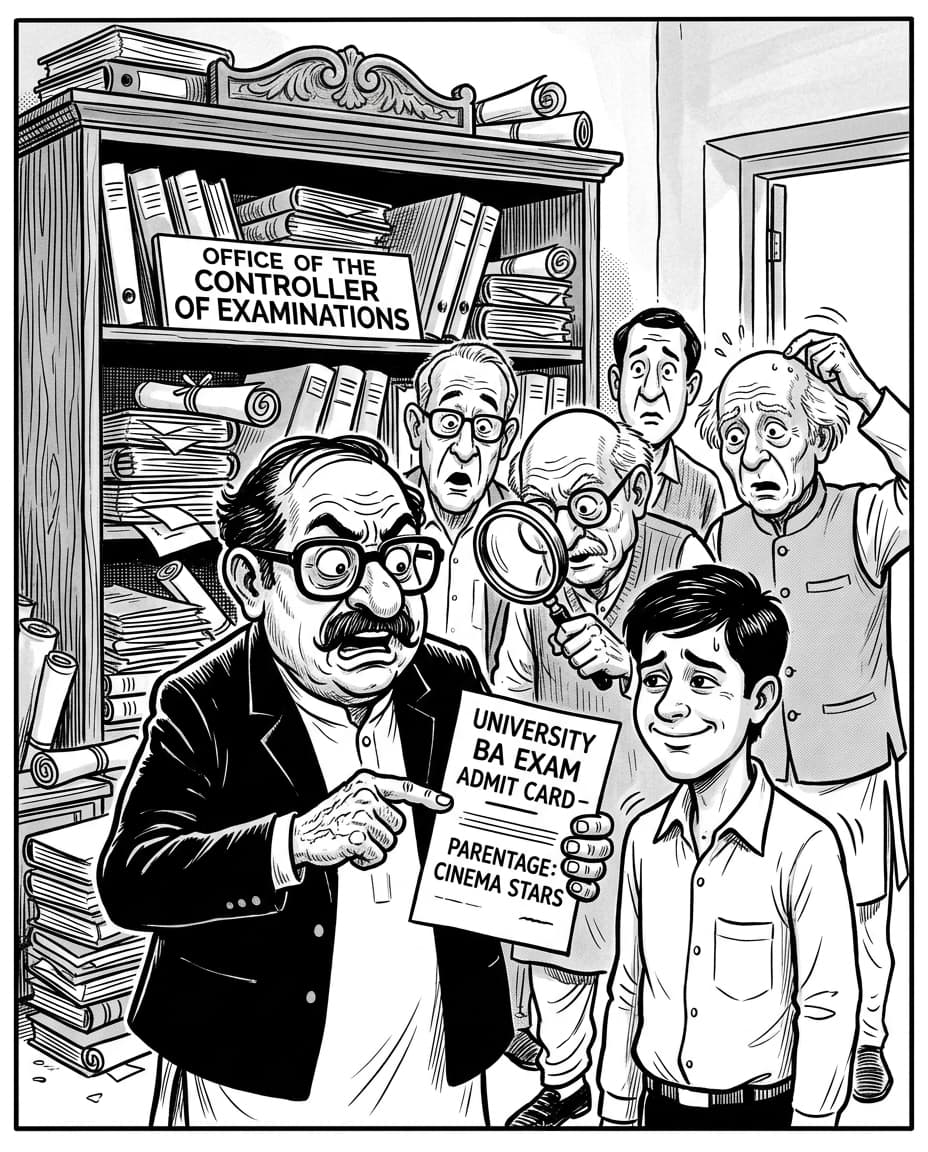
Editorial Illustration:Editorial illustration reflecting the events and context of The Unacknowledged Son of Bollywood: How a BA Examinee in Muzaffarpur Gave Himself the Most Star-Studded Parents in Indian Academic History.
VINTAGE INK ARCHIVE
The Unacknowledged Son of Bollywood: How a BA Examinee in Muzaffarpur Gave Himself the Most Star-Studded Parents in Indian Academic History
In December 2020, a second-year Arts student in North Bihar filled his BRABU examination registration form listing his father as "Emran Hasmi" and his mother as "Sunny Leone." The university printed it verbatim on the official admit card. When the photograph reached Twitter, both celebrities responded — and the story became a minor landmark in Indian internet culture.
The examination registration form is, in the long catalogue of undergraduate administrative experiences, among the most reliably tedious. You sit in a cyber cafe. You enter your roll number, intermediate marks, caste category, residential address, and the names of your parents. You pay the portal fee. You log out. You wait for the university to print and dispatch your admit card, which confirms, under the official seal and signature of the Controller of Examinations, that you are a registered candidate and may lawfully sit for the forthcoming examination.
The form, as a document, assumes certain facts about the world: that students have names, addresses, and biological parents, and that those parents are not prominent Bollywood film actors.
In early December 2020, a twenty-year-old second-year Bachelor of Arts student named Kundan Kumar, enrolled at Dhanraj Mahto Degree College in the Meenapur block of Muzaffarpur, Bihar, sat before a BRABU (Babasaheb Bhimrao Ambedkar Bihar University) examination registration portal and decided to test that assumption.
In the column marked Father's Name, he entered: "Emran Hasmi".
In the column marked Mother's Name, he entered: "Sunny Leone".
In the field for permanent residential address, he entered the name of Chaturbhuj Sthan — Muzaffarpur's historically renowned red-light district.
He paid the examination fee. He submitted the form. He waited.
The university printed the admit card verbatim.
On 8 December 2020, Kundan Kumar — BA Part-2, Roll No. 2021404, Registration No. 1821101140023 — was officially certified by Babasaheb Bhimrao Ambedkar Bihar University as the enrolled examination candidate and son of Emraan Hashmi and Sunny Leone, resident of Chaturbhuj Sthan, Muzaffarpur, Bihar.
Both celebrities subsequently acknowledged his existence on Twitter. Neither agreed to pay college fees.
I. Muzaffarpur, BRABU, and the Honour System of Examination Registration
Babasaheb Bhimrao Ambedkar Bihar University, headquartered in Muzaffarpur, is one of the largest affiliating universities in Bihar, enrolling hundreds of thousands of undergraduate students across dozens of affiliated degree colleges spread through northern Bihar's districts. The university's examination administration has the structural challenge inherent to all such large affiliating systems: processing applications, printing credentials, and dispatching results for an enormous candidate base with limited administrative staff and under perpetual deadline pressure.
In the autumn of 2020, students across affiliated colleges were filling online registration forms for the BA Part-1, Part-2, and Part-3 examinations. The process was as follows: a student would enter their details on the university's online portal, after which the data would be compiled and sent to affiliated colleges for physical verification and forwarding. The college, in theory, would scrutinise the registration details, match them against internal admission records, and certify the application before the university processed it into an official admit card.
The system was, in practice, operating on a combination of digital speed and institutional inertia. The volume of registrations was substantial. The checking was, at many affiliated colleges, cursory or absent.
The registration portal itself imposed no validation constraints on the parent-name fields beyond a character-count limit. There was no check against any national identity database. There was no cross-referencing with existing BRABU student records from prior years. There was no automated flag for improbable inputs. Any alphabetical string of appropriate length would be accepted by the system and printed on the credential that followed.
Kundan Kumar knew his university, and he knew his portal.
II. The Form, the Submission, and the Extraordinary Outcome
The specific motivation behind Kundan Kumar's decision has never been comprehensively documented in the public record. Accounts that emerged in the days following the viral exposure of the admit card suggested a range of possibilities: a private bet with classmates, a test of the system's credulity, a minor act of undergraduate rebellion dressed in Bollywood fancy dress.
What is documented, with precision, is what was submitted and what the university produced.
The registration form, as completed by the candidate, contained:
- Candidate Name: Kundan Kumar (authentic)
- Father's Name: Emran Hasmi (the colloquial spelling of actor Emraan Hashmi)
- Mother's Name: Sunny Leone (the screen name of the Bollywood actor and producer born Karenjit Kaur Vohra)
- Permanent Address: Chaturbhuj Sthan, Muzaffarpur — an address that would have immediately raised questions in any institution with local geographic knowledge
The form traversed the submission pipeline. It reached the college administrative office at Dhanraj Mahto Degree College, where it was processed within a batch of other applications. The principal's office, or whoever was responsible for certification, forwarded the batch to the university without flagging any entry.
The university's examination section compiled the admitted candidates and sent the print job to the credential printing facility.
On 8 December 2020, Admit Card Roll No. 2021404 was generated and dispatched. The card bore the university crest, the examination controller's signature, the candidate's photograph, the roll number, the paper schedule, the examination centre location, and — faithfully reproducing the submitted data — the names of both parents.
The credential was handed to Kundan Kumar at his college's examination counter.
Classmates gathered. A smartphone appeared. A photograph was taken.
III. From Muzaffarpur to Mumbai: How the Photograph Travelled
The first circulation of the admit card photograph occurred in the immediate social environment of Dhanraj Mahto Degree College — through the WhatsApp groups of students who had been present at the counter or who received the image from those who were. Regional Bihar-based groups passed it forward into broader education-adjacent networks.
By the morning of 9 December 2020, the photograph had reached digital media desks in Delhi and Mumbai. Entertainment news portals — for whom the combination of a Bollywood name and a government credential was irresistible — filed breaking items. Hindi news television channels ran the photograph during prime-time entertainment segments.
By the afternoon of 9 December, the photograph was on Twitter, and the tweet threads quickly escalated in absurdity as users began investigating the canonical question: had either celebrity been informed that they had a son writing BA Part-2 in Muzaffarpur?
The answer arrived that evening.
Emraan Hashmi, best known for a catalogue of romantic Bollywood films spanning two decades and an enormous social media following, quote-tweeted a news report about the admit card. His response was five words, precisely calibrated to the comedic register of the moment:
"I swear he ain't mine."
The tweet registered over 85,000 likes and more than 12,000 retweets within the first twelve hours. The brevity was magnificent. The denial was categorical. The implied acknowledgement that the situation required public comment was itself a comedic gift.
The following afternoon, Sunny Leone — actor, producer, and serial disruptor of Indian government portals, having previously appeared on a Bihar PHED junior engineer merit list in 2019 — retweeted the coverage with what appeared to be genuine affection for the student's audacity:
"This kids awsome !!!!! Way to dream big :)))))))) XO hahahaha"
The spelling was imperfect. The sentiment was unmistakable. Sunny Leone, for the second time in two years, had been unofficially enrolled in a Bihar government document — and had responded to the fact with something approaching maternal warmth.
Both celebrities' responses were screenshot, memed, and compiled into viral threads that circulated for the better part of a week. A generation of Indian Twitter users who had not previously tracked the minutiae of BRABU's examination administration were suddenly deeply invested in the institutional oversight failures of affiliated university credential systems in northern Bihar.
IV. The Official Fury
The tone in Muzaffarpur's academic administrative corridors was considerably less amused.
Dr. Ram Krishna Thakur, the Registrar of BRABU, convened an emergency press conference for local and regional journalists. His statement was formal, emphatic, and somewhat distressed:
"We have taken cognisance of the matter and ordered a formal inquiry. This is a clear case of deliberate mischief designed to bring the university into disrepute. An admit card is an official academic document carrying the seal and authority of the university. The student, or someone at the cyber cafe or college level, has intentionally entered false and objectionable details. We have identified the student's Aadhaar-linked registration. Strict disciplinary action will follow against the candidate and all college staff who failed to verify the registration before forwarding it."
The university immediately cancelled Admit Card Roll No. 2021404. Kundan Kumar's examination registration was suspended pending a disciplinary inquiry. The principal of Dhanraj Mahto Degree College was summoned to the university headquarters to submit a written explanation for how a credential bearing parodic parent names and a red-light district address had received institutional certification and forwarding without any scrutiny.
Kundan Kumar himself, when eventually questioned by university officials and local reporters, offered an account broadly consistent with the impulsive logic that the internet had already assumed: he had filled the form as a private joke, fully expecting that the system would catch and reject the false entries. He had not anticipated that the administrative pipeline would print his submission verbatim on an official government credential and hand it to him under a university stamp.
V. What the Incident Revealed
The Muzaffarpur admit card sat, when examined without the comedy, at the intersection of two distinct systemic failures.
The first failure was technical. The BRABU registration portal had no validation logic applied to the parent-name fields beyond basic character acceptance. A properly designed portal would cross-reference submitted parent names against the candidate's existing enrollment records from prior academic years — Kundan Kumar's parents would have been recorded at the time of college admission — and flag discrepancies for human review. The portal did neither.
The second failure was administrative. The multi-step credential generation process included a mandatory college-level verification stage, precisely to catch errors, fraudulent entries, and data anomalies before they propagated into official documents. At Dhanraj Mahto Degree College, this verification stage did not happen in any meaningful sense. The batch was forwarded wholesale.
Neither failure was unique to BRABU or to Muzaffarpur. The same architectural vulnerabilities — self-declared data, no cross-referencing, batch processing without human spot-checks — characterised dozens of state university and recruitment portals across Bihar and the wider northern Indian academic landscape in 2020. The Muzaffarpur admit card was not an outlier. It was a system behaving exactly as designed, with a student clever enough to notice and willing enough to test it.
The university's post-incident response centred on disciplining Kundan Kumar. The more durable question — why the portal existed without validation, and why the college verification stage was functionally inoperative — received considerably less institutional attention.
VI. Sunny Leone and the Bihar Portal: A Pattern
The Muzaffarpur incident was, in a specific and notable sense, Sunny Leone's second appearance in a Bihar government document within two years.
In February 2019, she had topped the Bihar PHED Junior Engineer merit list at Rank 1 with a score of 98.5, placed there by an anonymous prankster who had exploited the absence of validation on the department's recruitment portal.
In December 2020, she appeared as a mother on a BRABU examination credential, placed there by a student who had exploited the absence of validation on the university's registration portal.
In both cases: the portal accepted the input. The system printed the document. The celebrity's name appeared on an official government credential. The photograph went viral. The administration announced a disciplinary inquiry.
The pattern was consistent enough that the internet began to treat it as a data series, noting that Sunny Leone had now officially appeared on more Bihar government documents than most Bihar residents.
"At this rate, she will be chairing the Bihar Public Service Commission by 2025."
She has not, to date, been issued a BPSC admit card. The portal architecture, however, has not been independently audited.
Chronological Timeline: INC-ABS-2020-BR-004
| Date | Authority / Entity | What Happened | Verified Source |
|---|---|---|---|
| Early December 2020 | Kundan Kumar, Dhanraj Mahto Degree College | BRABU BA Part-2 examination registration submitted online; father listed as "Emran Hasmi", mother as "Sunny Leone", address as Chaturbhuj Sthan, Muzaffarpur | BRABU Admit Card Roll No. 2021404 |
| Early December 2020 | Dhanraj Mahto Degree College admin | Registration batch forwarded to BRABU without scrutiny; prank entries unchecked and unchallenged | BRABU Inquiry Report |
| 8 December 2020 | BRABU Examination Controller | Official Admit Card Roll No. 2021404 printed and dispatched bearing false parent names under university seal | Indian Express, 10 Dec 2020 |
| 8–9 December 2020 | Kundan Kumar's classmates | Photograph of admit card taken at college counter; shared on WhatsApp study groups; reaches regional Twitter and entertainment portals by morning | Hindustan Times, 10 Dec 2020 |
| 9 December 2020 (evening) | Emraan Hashmi (@emraanhashmi) | Quote-tweets news report with: "I swear he ain't mine." — receives 85,000+ likes, 12,000+ retweets | Twitter/X — verified |
| 10 December 2020 | Sunny Leone (@SunnyLeone) | Retweets coverage: "This kids awsome !!!!! Way to dream big :)))))))) XO hahahaha" | Twitter/X — verified |
| 10 December 2020 | BRABU Registrar Dr. Ram Krishna Thakur | Emergency press conference; formal inquiry ordered; Admit Card Roll No. 2021404 cancelled; college principal summoned | Mumbai Mirror, 10 Dec 2020 |
| December 2020–January 2021 | BRABU Disciplinary Committee | Kundan Kumar's registration suspended; affidavit with authentic family documents required for reinstatement; college staff cautioned | BRABU Administrative Records |
Sources & Further Reading
Tier 1 — Official Records
- BRABU BA Part-2 Admit Card, Roll No. 2021404 — Reg. No. 1821101140023, Babasaheb Bhimrao Ambedkar Bihar University, 8 December 2020 (photographic evidence, widely archived).
- BRABU Registrar Inquiry Order — Formal disciplinary inquiry ordered by Dr. Ram Krishna Thakur, Registrar, BRABU Muzaffarpur, December 2020.
Tier 2 — Verified Press Coverage
- "Bihar student lists Emraan Hashmi and Sunny Leone as parents on admit card, actors react" — The Indian Express, 10 December 2020. indianexpress.com
- "Emraan Hashmi, Sunny Leone react to Bihar student's admit card listing them as parents" — Hindustan Times, 10 December 2020. hindustantimes.com
- "Emraan Hashmi and Sunny Leone are parents to 20-year-old Bihar student, says his admit card" — Mumbai Mirror, 10 December 2020. mumbaimirror.indiatimes.com
- "Mischief in Bihar: Admit card shows Emraan Hashmi, Sunny Leone as parents" — The New Indian Express, 10 December 2020. newindianexpress.com
Tier 4 — Verified Social Media
- Emraan Hashmi (@emraanhashmi) — "I swear he ain't mine." Twitter/X, 9 December 2020. twitter.com/emraanhashmi
- Sunny Leone (@SunnyLeone) — "This kids awsome !!!!! Way to dream big :)))))))))" Twitter/X, 10 December 2020. twitter.com/SunnyLeone
Comments
0Want to participate in the discussion?
No comments yet. Start the discussion above.