The Blank Bubbles of Godhra: Inside the Schoolhouse Conspiracy to Rig NEET-UG
•INVESTIGATIVE DISPATCH•BY ADITYA
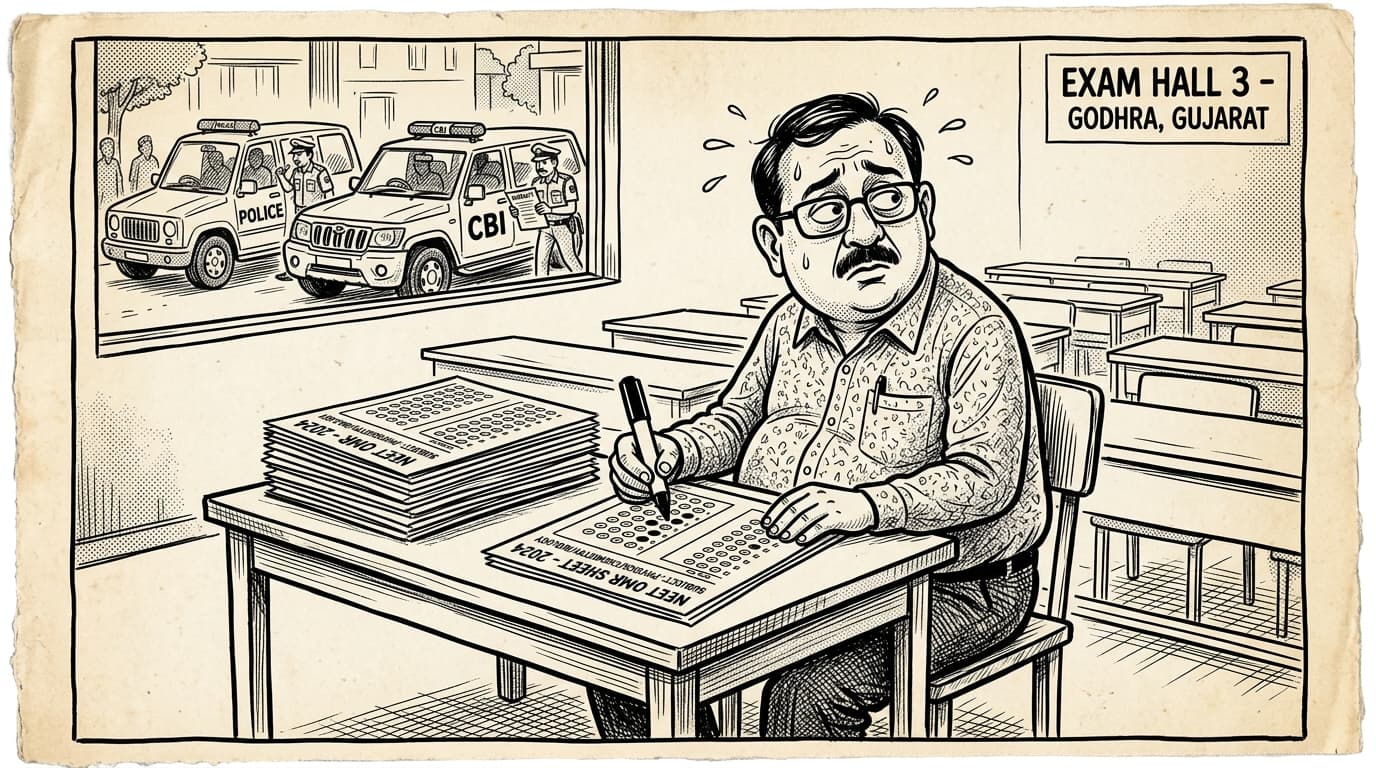
Editorial Illustration:Editorial illustration reflecting the events and context of The Blank Bubbles of Godhra: Inside the Schoolhouse Conspiracy to Rig NEET-UG.
VINTAGE INK ARCHIVE
### By Newsroom Editorial Desk
*Published August 30, 2024 (Archived in the National Examination Integrity Repository)* | Archival Incident INC-2024-GJ-GODHRA-022
On the blazing hot morning of Sunday, May 5, 2024, approximately twenty-three lakh young men and women across India sat down for the National Eligibility cum Entrance Test (NEET-UG 2024).
For millions of middle-class families, the examination represents a secular pilgrimage. To gain admission to a government medical college and wear the white coat of a physician, a student must conquer 180 questions across Physics, Chemistry, and Biology, darkening circular bubbles on pink-and-white Optical Mark Recognition (OMR) sheets with black ink. In competitive medicine, a single mark separates an admission from another wasted year of life.
In the national headlines that followed May 5, public outrage would be dominated by the burnt test booklets seized by police at Learn Play School in Patna, and the statistical anomalies of sixty-seven candidates scoring a mathematically improbable perfect 720/720.
Yet, hundreds of miles to the southwest, in the dusty agricultural plains of Panchmahal district in eastern Gujarat, an entirely different operational pathology had taken root.
At Jay Jalaram School in Parvadi village near Godhra, there was no stolen PDF, no Telegram forward, and no pre-dawn solver camp. The syndicate operating here had designed a scheme far more subtle, invisible, and devastating to the architecture of public trust: an inside-the-strongroom conspiracy to let candidates submit blank answer sheets, only for school officials to fill in the correct answers after the examination ended.
1. The Strategy: "Leave It to the Teacher"
The architecture of the Godhra operation began thousands of kilometers away from Gujarat, in private coaching consultancies in Odisha, Bihar, Maharashtra, and Vadodara.
Spearheaded by Parshuram Roy, the proprietor of Roy Overseas (an education and visa consultancy based in Vadodara), and Vibhor Anand, an interstate education consultant, the syndicate targeted affluent parents whose children were performing poorly in national mock tests. The promise was absolute: guaranteed entry into government MBBS colleges through high NEET percentiles.
The price for this manufactured miracle was fixed between ₹5 lakh and ₹10 lakh per candidate.
To ensure that parents did not default on payment once the medical rank was published, Roy and his associates demanded collateral upfront: original academic marksheets, admit card logins, and signed, blank post-dated bank cheques. Police would later recover sixteen such cheques totaling an astonishing ₹2.3 crore from Roy’s Vadodara office.
The operational core of the plan required manipulating the National Testing Agency’s (NTA) registration portal.
During the online application window, candidates from as far away as Bhubaneswar, Ranchi, and Mumbai were instructed to select Godhra in Gujarat as their preferred examination city, and to deliberately select Gujarati as their medium of examination. Because Gujarati-medium question papers are only distributed to a small, specific cluster of designated examination centres in the district, the algorithm inevitably routed the entire cohort of twenty-seven compromised candidates into one specific private facility: Jay Jalaram School in Parvadi.
The instruction given to the candidates was disarmingly simple:
*"Solve only the questions you are 100% certain about. If you encounter any difficult physics problem or confusing botany question, do not guess. Leave the circle completely blank. Hand over the sheet, walk out of the hall, and go home. The school will do the rest."*
2. The Citadel: The Schoolhouse Insiders
To execute a post-examination OMR tampering scheme, an outside criminal syndicate is powerless without absolute control over the physical custody of the answer sheets.
At Jay Jalaram School, the syndicate had achieved something unprecedented: they had co-opted the entire institutional chain of command.
The conspiracy was anchored by three men:
- Dixit Patel: The wealthy, politically connected chairman of the Jay Jalaram Education Trust, which operated schools across Panchmahal and Kheda districts. Patel had consented to turn his school into an operational hub in exchange for a direct cash kickback of ₹5 lakh per candidate.
- Purushottam Sharma: The principal of the school, who had been officially appointed by the NTA as the City Coordinator for the Godhra examination centre—the highest local administrative authority responsible for overseeing test logistics.
- Tushar Bhatt: A senior physics teacher at the school, whom Sharma had designated as the Deputy Centre Superintendent for NEET-UG 2024.
Under standard NTA security protocols, once the clock strikes 5:20 PM, invigilators collect the OMR sheets, count them, and bring them to the centre control room. There, the answer sheets are placed inside tamper-evident plastic envelopes, sealed with specialized security tape, packed into cloth parcels, stitched, and sealed with molten lac wax before being placed under armed guard for transit to the regional collection vault.
Tushar Bhatt’s assignment was to exploit the narrow, forty-five-minute administrative window between the collection of the sheets and the final wax sealing.
Armed with solved answer keys provided by outside coaching faculties, Bhatt and a trusted inner circle of teachers planned to pull the twenty-seven pre-identified OMR sheets from the stacks. Using black ballpoint pens, they would darken the blank circles for the difficult questions, transforming mediocre 300-point performances into 650-point medical distinctions, before sealing the parcels and dispatching them into the national evaluation pipeline.
It was an ingenious plan. An OMR scanner in Delhi evaluates only the darkened ink; it cannot tell whether a circle was marked by a trembling eighteen-year-old student at 3:00 PM or by a physics teacher in a quiet office at 5:45 PM.
3. The 10:30 AM Surprise: The Collector’s Raid
The plan was flawless on paper. It collapsed because of an alert district administration.
At 9:00 AM on Sunday, May 5—five hours before the exam was set to commence—the District Collector of Panchmahal received a confidential, highly specific intelligence alert: an organized group had compromised personnel at Jay Jalaram School to manipulate answer sheets.
The Collector wasted no time. Rather than notifying the school or alerting the NTA city coordinator, he quietly mobilized a surprise inspection team headed by an Additional District Magistrate (ADM) and senior District Education Officers.
At 10:30 AM, the inspection convoy swept unannounced through the iron gates of Jay Jalaram School.
The administrative team marched directly into the examination command room and cornered Deputy Centre Superintendent Tushar Bhatt. Officials ordered Bhatt to surrender his mobile phone.
When cyber officers unlocked Bhatt’s WhatsApp application, they found the smoking gun: an incoming message containing a typed list of twenty-seven candidate roll numbers, names, and assigned exam rooms.
Next, the inspection squad escorted Bhatt out to the school parking lot to search his private car. Hidden beneath the front passenger seat was a canvas bag containing ₹7 lakh in crisp cash banknotes—the advance installment paid by middleman Arif Vohra on behalf of the syndicate.
The district officials acted with tactical brilliance. Rather than creating a public panic that would disrupt the examination for hundreds of innocent candidates, they quietly relieved Tushar Bhatt of all administrative duties. State revenue officers took over direct, physical supervision of every examination hall and the control room.
When the exam ended at 5:20 PM, the OMR sheets were collected, counted, sealed, and packed under the unbroken, watchful gaze of magistrate observers and armed police.
The blank circles on the twenty-seven answer sheets remained blank.
4. The Custodial Cascade: Local Police to the CBI
On May 8, 2024, following a comprehensive preliminary inquiry by the District Education Officer, the Godhra Taluka Police registered FIR No. 11189007240055 under IPC Sections 406 (Criminal Breach of Trust), 409 (Breach of Trust by Public Servant), 420 (Cheating), and 120B (Criminal Conspiracy).
Tushar Bhatt was arrested immediately. Over the next forty-eight hours, Gujarat Police raided the offices of Roy Overseas in Vadodara, arresting Parshuram Roy and broker Arif Vohra, and seizing the ₹2.3 crore in post-dated cheques. Within days, School Principal Purushottam Sharma was arrested after forensic mobile extractions revealed his complicity in securing the centre designation.
As the NEET-UG crisis exploded into a nationwide political firestorm during June 2024, the Gujarat government formally handed over the investigation to the Central Bureau of Investigation (CBI) on June 23.
The CBI registered Regular Case RC0032024A0009. Federal sleuths conducted deep forensic audits of call detail records, tower dumps, and financial accounts, tracing the conspiracy to the very top of the school administration.
On June 30, 2024, a CBI team raided the palatial residence of Dixit Patel, Chairman of the Jay Jalaram Education Trust, placing him under arrest. The CBI presented WhatsApp chats and witness statements demonstrating that Patel was fully aware of the scheme and had actively used his administrative clout to facilitate the arrangement for a multi-lakh payoff.
In successive hearings before the Special CBI Court at Mirzapur, Ahmedabad, judges firmly rejected the bail petitions of Dixit Patel, Tushar Bhatt, and Parshuram Roy, noting that the subversion of medical entrance examinations by educational trust owners strikes at the core of national healthcare integrity.
5. The Supreme Court Scrutiny and Debarments
During the historic July 2024 hearings before a Supreme Court bench led by Chief Justice of India D.Y. Chandrachud in Vanshika Shukla v. NTA, the Godhra incident was scrutinized in forensic detail.
Petitioners challenging the validity of NEET-UG 2024 pointed to Jay Jalaram School as proof of systemic, institutional collapse across multiple states. However, the CBI’s status report and district administration logs confirmed a crucial factual distinction: the crime in Godhra had been intercepted at the threshold.
Because the District Collector’s flying squad seized the roll list and isolated Tushar Bhatt five hours before the exam concluded, the planned OMR alterations were never executed. The twenty-seven candidates who had left their answer sheets blank received the low, failing marks corresponding to their unassisted attempts.
Following the CBI’s interim report, the NTA took decisive administrative action:
- All twenty-seven identified candidates who participated in the Godhra conspiracy were formally debarred from taking NEET-UG for a period of three years.
- Jay Jalaram School was permanently blacklisted by the NTA from ever serving as an examination centre for any national competitive test.
- The Gujarat Education Department initiated proceedings to withdraw the school’s institutional affiliations.
In late August 2024, the CBI filed a comprehensive chargesheet before the Special CBI Court in Ahmedabad, detailing the criminal conspiracy under IPC 120B, 420, and the Prevention of Corruption Act against Dixit Patel, Tushar Bhatt, Purushottam Sharma, Parshuram Roy, Vibhor Anand, and Arif Vohra.
6. The Enduring Warning of Jay Jalaram School
The Godhra scandal of NEET-UG 2024 serves as a chilling testament to the evolution of modern examination corruption in India.
It revealed that testing security can no longer focus solely on protecting the question paper before the bell rings. When private school trusts, principals, and teachers view their institutional credentials as commodities for sale, the greatest vulnerability lies in the quiet forty-five minutes after the students have walked out of the hall.
The blank bubbles of Godhra were designed to steal futures in silence, leaving no digital breadcrumbs or internet footprints. That they failed was not due to the complex digital algorithms of central testing agencies, but due to a courageous local tip-off, an alert district collector, and a surprise inspection that arrived five hours before the trap could close.
7. Chronological Case Timeline
| Date & Time | Authority / Entities Involved | What Happened & Case Developments | Verified Source Link |
|---|---|---|---|
| 2024-04-15 | Education Consultancies & Syndicate | Vadodara-based immigration consultant Parshuram Roy and broker Vibhor Anand coordinate with parents of medical aspirants from Gujarat, Maharashtra, Odisha, and Bihar, charging ₹5–10 lakh each to ensure admission by designating Jay Jalaram School in Godhra as their exam centre. | The Indian Express Crime Desk |
| 2024-05-02 | Jay Jalaram Education Trust | School Chairman Dixit Patel, Principal/NTA City Coordinator Purushottam Sharma, and Physics teacher/Deputy Centre Superintendent Tushar Bhatt agree to execute post-exam OMR bubble filling for 27 designated candidates. | The Hindu National Coverage |
| 2024-05-05 (09:00 IST) | Panchmahal District Collector | Acting on a confidential tip-off regarding an OMR tampering plot, the District Collector dispatches a surprise inspection squad headed by an Additional District Magistrate (ADM) to Jay Jalaram School. | EducationWorld Official Report |
| 2024-05-05 (10:30 IST) | District Inspection Squad | The inspection team intercepts Deputy Centre Superintendent Tushar Bhatt on school grounds; searches his mobile phone to find a list of 27 candidate roll numbers on WhatsApp, and recovers ₹7 lakh in cash from his private car. | Hindustan Times Investigation |
| 2024-05-05 (14:00–17:20 IST) | NTA Observers & Candidates | The examination proceeds under strict physical oversight of state revenue officials; Bhatt is removed from active duties, successfully preventing the execution of the blank OMR sheet filling scheme. | NDTV National Coverage |
| 2024-05-08 | Panchmahal Police | Following a formal complaint by the District Education Officer, Godhra Taluka Police registers FIR No. 11189007240055 against Tushar Bhatt, Parshuram Roy, and Arif Vohra under IPC 406, 409, 420, and 120B. | The Times of India Gujarat |
| 2024-05-10 | Panchmahal Police Special Operations Group | Police raid the office of Roy Overseas in Vadodara, arresting Parshuram Roy and seizing post-dated bank cheques totaling ₹2.3 crore collected from parents as payment guarantee. | The Indian Express Ahmedabad |
| 2024-05-12 | Gujarat Police | Jay Jalaram School Principal and NTA City Coordinator Purushottam Sharma is arrested by local police after forensic chats reveal his direct collusion with middleman Arif Vohra. | The Hindu National Coverage |
| 2024-06-23 | Ministry of Education & Gujarat Government | The Gujarat Home Department formally transfers all case diaries and seized evidence from the Godhra NEET probe to the Central Bureau of Investigation (CBI). | The Federal National Desk |
| 2024-06-30 | Central Bureau of Investigation (CBI) | CBI arrests Jay Jalaram Education Trust Chairman Dixit Patel from his residence after mobile phone extractions and financial trails show he was promised a cut of ₹5 lakh per candidate. | Hindustan Times Crime Desk |
| 2024-07-23 | Supreme Court of India | In its national NEET-UG 2024 judgment, the Supreme Court reviews the Godhra findings, noting that while the local OMR plot was egregious, it was intercepted by district authorities before results were altered. | Supreme Court Judgment in Vanshika Shukla v. NTA |
| 2024-08-28 | Central Bureau of Investigation (CBI) | CBI files a comprehensive chargesheet before the Special CBI Court at Mirzapur, Ahmedabad, indicting Dixit Patel, Tushar Bhatt, Purushottam Sharma, Parshuram Roy, and Vibhor Anand under IPC 120B, 420, and the Prevention of Corruption Act. | The Indian Express National |
8. Sources & Further Reading
- Gujarat police unearth NEET-UG cheating racket in Godhra; arrests include school teacher
Publication: The Indian Express
Date: May 9, 2024
- NEET-UG scandal: CBI arrests owner of Godhra school Dixit Patel
Publication: The Hindu
Date: June 30, 2024
- NEET-UG: CBI arrests Dixit Patel, chairman of Jay Jalaram School in Godhra
Publication: Hindustan Times
Date: June 30, 2024
- CBI files chargesheet in Godhra NEET-UG case
Publication: The Indian Express
Date: August 29, 2024
Direct URL: https://indianexpress.com/article/cities/ahmedabad/cbi-files-chargesheet-in-godhra-neet-ug-case-9538921/
- Supreme Court of India Judgment Record in NEET-UG 2024 Petitions
Forum: Supreme Court of India, Tilak Marg, New Delhi
Case Identifier: Writ Petition (Civil) No. 368 of 2024
Direct URL: https://main.sci.gov.in
- Gujarat Police Panchmahal District Registry
Document: Godhra Taluka Police Station FIR No. 11189007240055
Direct URL: https://gujaratpolice.gujarat.gov.in
- Central Bureau of Investigation (CBI) Investigation Dossier
Document: Case File RC0032024A0009 and Press Releases
Direct URL: https://cbi.gov.in
Comments
0Want to participate in the discussion?
No comments yet. Start the discussion above.