The Midnight Heist at Sahibabad: How the UP STF Foiled the 2009 AIPMT Transit Ambush and Saved a Quarter-Million Medical Dreams
•INVESTIGATIVE DISPATCH•BY ADITYA
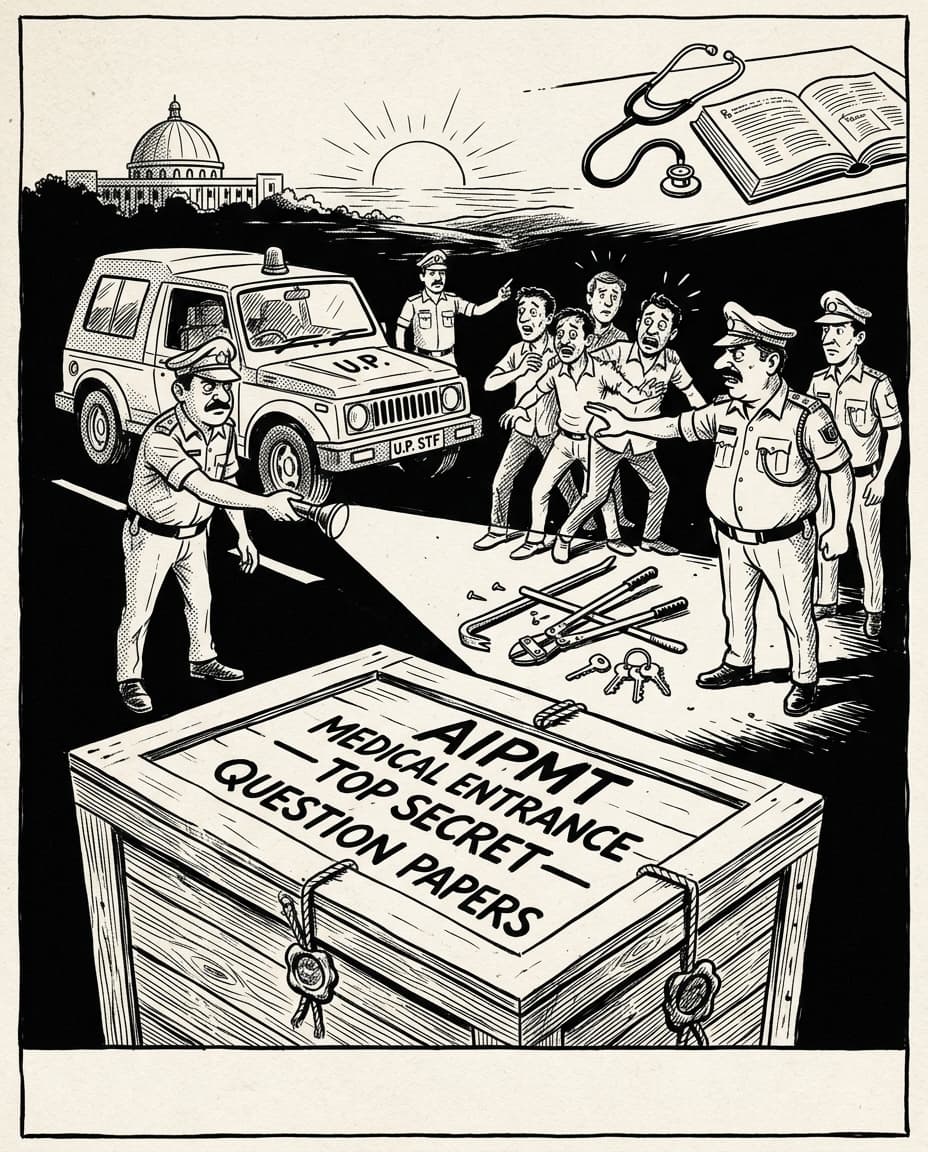
Editorial Illustration:Editorial illustration reflecting the events and context of The Midnight Heist at Sahibabad: How the UP STF Foiled the 2009 AIPMT Transit Ambush and Saved a Quarter-Million Medical Dreams.
VINTAGE INK ARCHIVE
I. The Pressure Cooker of Pre-NEET Medicine
To comprehend why an examination syndicate would deploy industrial metal cutters against a courier van on a dark highway, one must understand the hyper-competitive pressure cooker of Indian medical admissions in the late 2000s.
Before the introduction of the unified National Eligibility cum Entrance Test (NEET) in the 2010s, medical admissions in India were a fragmented, chaotic labyrinth. Each state conducted its own entrance test, and individual deemed universities held private, high-fee examinations.
Above them all stood the undisputed crown jewel: the CBSE AIPMT.
Conducted in a grueling two-tier format (Preliminary objective screening followed by a Final descriptive analytical test), the AIPMT determined admissions to the 15% All-India Quota in every state government medical college across the country.
With over 2,50,000 top-tier science students competing for fewer than 2,000 government medical seats, the acceptance rate was under 0.8%—far more selective than Harvard, Oxford, or IIT-JEE.
In coaching hubs like Kota, Delhi's Kalu Sarai, and Patna, students spent two to three years in intense, eighteen-hour study regimes.
For wealthy families whose children struggled with the demanding syllabus of organic chemistry mechanisms and rotational mechanics, the black market offered an irresistible temptation.
A confirmed advance copy of the AIPMT Preliminary question paper commanded astronomical sums: between ₹15 lakh and ₹25 lakh per candidate. With thirty paying clients pre-booked across Meerut, Muzaffarnagar, Delhi, and Patna, a successful paper leak promised a criminal windfall of over ₹5 crore in a single night.
II. The Citadel and the Choke Point: The Logistics Dilemma
The CBSE, operating out of its headquarters in Preet Vihar in East Delhi, had spent decades refining its physical security protocols: - Master question papers were set by isolated academic committees sworn to secrecy. - The printing was executed under classified security contracts at government-monitored presses with 24-hour armed guards. - The printed booklets were packed into heavy, tamper-evident fabric bags, placed inside heavy-gauge sheet-metal trunks, padlocked, and sealed with red lac wax and lead seals. - Days before the examination, these trunks were transported to nationalized bank branches (such as State Bank of India and Canara Bank), where they were locked inside bank strongroom vaults under the joint custody of the Bank Branch Manager and the CBSE Center Superintendent.
The system appeared mathematically secure. But the syndicate identified the single critical choke point where the chain of custody was vulnerable to human corruption: The "Last-Mile" Transit Window.
On the afternoon and night before the Sunday examination, or in the early hours of Sunday morning, the heavy steel trunks had to be transported from bank vaults to nodal distribution centers and outlying school examination hubs.
To handle this massive logistical operation across hundreds of cities, the CBSE and its regional offices routinely outsourced transportation to private commercial courier and logistics firms.
These logistics companies deployed ordinary commercial delivery vans driven by contract drivers earning modest monthly wages of ₹6,000 to ₹8,000.
In Western Uttar Pradesh, the transit vans were often dispatched without armed police escorts, relying merely on a single low-level school clerk or delivery executive sitting in the passenger cabin.
It was this twelve-hour transit window that Western UP’s most dangerous examination kingpin, Sudhir Rana, targeted for exploitation.
III. The Heist Architecture: The Inverted Bottom-Weld
Sudhir Rana was not a street-level imposter. A seasoned criminal strategist operating across the Delhi-Meerut-Haridwar corridor, Rana had studied previous failed paper leaks.
In conventional examination thefts, corrupt staff attempted to duplicate padlock keys or tamper with wax seals. But Rana knew that the moment an examination trunk arrived at a school center with broken wax, a sliced seal, or a scratched padlock, the Center Superintendent was under strict standing orders to abort the delivery, notify the district collector, and cancel the examination.
Rana devised an ingenious physical attack vector that bypassed the security seals entirely: The Inverted Bottom-Weld Strategy.
The mechanics of the planned heist were meticulously mapped: 1. Suborning the Driver: Weeks before the exam, Rana’s lieutenants approached Pramod Sharma, a driver employed by the private logistics company contracted to move CBSE trunks across the Ghaziabad-Meerut sector. Pramod was offered an astonishing bribe of ₹25 lakh in cash—more than two decades of his annual salary—simply to take a 45-minute detour on the night of April 4. 2. The Safehouse Rendezvous: Pramod was instructed that once the sealed steel trunks for regional centers were loaded into his van on Saturday evening, he was to divert the vehicle off the main highway into a secluded, soundproofed industrial shed in the Mohan Nagar area of Sahibabad. 3. The Precision Surgery: Inside the shed, two master locksmiths and metal-cutting technicians equipped with heavy-duty cold-chisels, specialized drill bits, and silent rotary cutting blades were waiting. The technicians were under strict instructions: Do not touch the top lids. Do not disturb the brass padlocks, the wire wraps, or the paper seals. 4. Bottom Extraction: Instead, the van’s rear doors would be opened, the trunks inverted, and the technicians would cut the base rivets and slice along the bottom seam weld of the steel box. 5. The Forty-Minute Scan: Through the sliced bottom flap, a single question paper booklet would be extracted. Working under portable halogen floodlights, solvers would photograph each page using high-resolution digital cameras and flatbed scanners. 6. Resealing the Box: The question paper booklet would be slipped back through the bottom slit. Using quick-curing metallic epoxy putty and spot-welding tools, the bottom plate would be re-secured and coated with matching green paint to conceal the incision. 7. The Return to Transit: The van would drive back onto the highway and deliver the trunks to the designated bank vaults and nodal centers. To the morning center superintendents inspecting the top lids, the brass locks, wire seals, and wax stamps would appear 100% pristine and unblemished.
Meanwhile, the digitized images would be transmitted to secret solver camps in Meerut, Delhi, and Patna, where paying candidates were waiting to memorize the answers.
IV. The Electronic Net: Amitabh Yash and the UP STF
The conspiracy failed because the Uttar Pradesh Police Special Task Force (UP STF) had already placed the Western UP examination mafia under intense, classified surveillance.
Commanded by legendary police officer SSP Amitabh Yash (later Additional Director General of Police) and ASP Raj Kumar Gautam, the STF’s Noida and Meerut units had spent months tracking illegal medical coaching syndicates.
In late March 2009, electronic wiretaps intercepted cryptic conversations involving Sudhir Rana and an associate named Devendra (alias Fauji). The intercepts spoke of a "big consignment arriving by road" and negotiations with candidate parents for "twenty-five lakhs per parcel."
By the morning of Saturday, April 4, STF cyber intelligence confirmed that the target was the AIPMT 2009 question paper trunks scheduled to move across Ghaziabad that evening.
SSP Amitabh Yash established an armed tactical command center in Ghaziabad. Dozens of undercover STF commandos in civilian attire, driving unmarked cars and motorcycles, were deployed along key transit corridors between Delhi, Ghaziabad, and Meerut.
At 10:15 PM on April 4, an undercover team spotted the white logistics van pulling out of a storage facility in Ghaziabad.
Instead of proceeding directly along the designated highway route toward the Meerut nodal strongroom, the van slowed down, switched off its roof cabin lights, and turned abruptly into the dark alleys of the Sahibabad industrial area.
The trap was sprung.
V. 11:00 PM: The Ambush at Mohan Nagar
The logistics van pulled up outside the shuttered industrial shed at 11:00 PM.
As driver Pramod Sharma stepped out and signaled to three men waiting inside the darkened entrance, tactical commandos struck with overwhelming speed.
Four STF utility vehicles roared into the alley, tires screeching, pinning the delivery van against the warehouse wall. Heavily armed commandos armed with automatic assault rifles surrounded the compound, shouting orders: "Police! Drop to the ground! Nobody move!"
The conspirators, caught completely off-guard, attempted to flee through a rear drainage ditch, but were tackled into the mud and subdued within seconds.
Inside the warehouse, detectives discovered the grim inventory of the planned heist: - Heavy-duty rotary cutting machines, metal shears, cold-chisels, and specialized automotive drilling tools. - Industrial epoxy bonding compounds and cans of quick-drying green enamel paint matching the CBSE steel trunks. - High-resolution digital cameras, flatbed document scanners, and portable laptop computers connected to wireless cellular modems. - A ledger containing the roll numbers, names, and contact telephone numbers of dozens of candidates whose families had paid advance tokens.
Detectives immediately checked the rear cargo compartment of the van.
Four heavy steel trunks containing hundreds of AIPMT question paper booklets sat inside. Crucially, the commandos had struck before a single tool had touched the metal.
The brass padlocks were undisturbed; the wire seals were intact; the bottom rivets were solid and uncut.
VI. The Midnight Strongroom Audit: 1:00 AM to 5:00 AM
While the arrested suspects were bundled into STF interrogation rooms, a massive administrative crisis unfolded.
SSP Amitabh Yash immediately telephoned the Chairman of the Central Board of Secondary Education and the Principal Secretary (Home) in Lucknow.
The central question was existential: Had the paper been compromised, or was the breach stopped before distribution?
If even a single question booklet had been opened, the entire AIPMT Preliminary examination for 2.5 lakh students across India would have to be aborted immediately, throwing national medical admissions into complete paralysis.
Between 1:00 AM and 5:00 AM on the morning of Sunday, April 5, an emergency joint task force comprising CBSE senior observers, executive district magistrates, and STF forensic experts conducted an exhaustive, physical audit: - The intercepted trunks in the van were forensically inspected under magnifying lamps and ultraviolet light. Every single lead seal, serial number, and bottom weld was verified as pristine and unbreached. - Simultaneous emergency audits were conducted across all regional bank vaults and nodal distribution centers in Ghaziabad, Noida, and Meerut. - Bank vault registers, CCTV logs, and trunk serial codes were reconciled against master dispatch manifests.
By 5:30 AM, the forensic verification was complete.
The findings were definitive: Zero Paper Contamination.
The syndicate had been intercepted at the threshold of the crime; not a single page had been extracted, not a single photo had been taken, and not a single question had reached the outside world.
VII. Sunday, April 5: 2.5 Lakh Students Write in Peace
At 7:00 AM on Sunday, April 5, 2009, the CBSE issued an internal green signal to all 500+ examination center superintendents nationwide: proceed with the examination strictly on schedule.
Under heavy armed police escorts deployed by the UP Police, the intercepted question paper trunks were safely delivered to designated examination centers across Ghaziabad and Meerut.
At 10:00 AM, precisely on time, 2,50,000 candidates entered their examination halls across the country. Over the next three hours, they tackled 200 multiple-choice questions on biology, physics, and chemistry.
Outside the gates, news television tickers began flashing dramatic headlines: UP STF Foils AIPMT Question Paper Heist in Ghaziabad; 5 Gang Members Arrested.
When students emerged from the examination halls at 1:00 PM, relieved to have cleared their papers, they learned for the first time how close their examination had come to total cancellation.
On April 6, 2009, the UP Police formally registered FIR No. 182/2009 at Sahibabad Police Station under Sections 379 (Theft), 420 (Cheating), 511 (Attempting to commit serious offenses), and 120-B (Criminal conspiracy) of the Indian Penal Code.
The Special Sessions Court in Ghaziabad subsequently framed formal charges against Sudhir Rana, driver Pramod Sharma, and their technical accomplices, denying them bail and initiating fast-track trial proceedings.
VIII. Institutional Legacy: Fortifying the Transit Vector
The foiled Sahibabad heist of 2009 was a turning point in the physical security architecture of Indian competitive examinations. It exposed the naive bureaucratic assumption that placing padlocks on the top of an examination trunk guarantees safety if the transit vehicle itself is left unguarded.
The CBSE and national testing authorities enacted sweeping, permanent reforms that restructured the examination transit lifecycle: 1. The Unibody Seamless Trunk: The CBSE phased out riveted, multi-piece metal trunks. Examination trunks were mandated to be manufactured from heavy-gauge unibody seamless steel, with reinforced internal corners, concealed tamper-evident hinges, and flush-fitting lids with zero exposed rivets or welds on the bottom or side plates. 2. Mandatory Armed Police Escorts: The practice of allowing private courier vans to transport examination trunks unaccompanied was strictly prohibited. Every single vehicle transporting examination question papers was mandated to carry at least two armed police personnel inside the vehicle, accompanied by a pilot police escort car with flashing beacons. 3. GPS Satellite Geofencing: Transit vehicles were fitted with real-time satellite GPS tracking transponders monitored from centralized control rooms. If a transit van deviated from its pre-mapped digital route by more than 100 meters, or if its cargo doors were opened outside designated bank coordinates, automated alarms triggered an immediate police intercept. 4. Blacklisting and Vetting of Logistics Vendors: The CBSE terminated its contract with the compromised courier agency and instituted stringent background verification protocols for all transport personnel, requiring mandatory criminal record checks for drivers.
For the 2.5 lakh candidates who wrote the AIPMT on that April morning in 2009, the highway bust at Sahibabad remained a remarkable case of administrative deterrence.
In a national examination ecosystem all too frequently marred by institutional failure and delayed cancellations, the midnight raid by the UP STF demonstrated what can be achieved when intelligence-led policing, rapid forensic verification, and administrative decisiveness converge to defend the sanctity of merit.
Chronological Case Timeline
| Exact Date / Timestamp | Authority / Entities Involved | What Happened & What Changed | Verified Source / Reference |
|---|---|---|---|
| Late March 2009 | CBSE New Delhi, Nationalized Banks | CBSE prints question papers for over 2.5 lakh medical aspirants; dispatches sealed steel trunks to designated bank strongrooms across Northern India. | CBSE Examination Directorate Operations Manual 2009 |
| April 2–3, 2009 | Sudhir Rana Gang, Logistics Driver Pramod | Syndicate recruits logistics van driver Pramod Sharma to divert transit vehicle carrying question paper trunks for Ghaziabad-Meerut centers to a secluded shed for ₹25 lakh cut. | UP STF Interrogation Records & Case Diary (FIR 182/2009) |
| April 4, 2009 (~23:00 IST) | UP Police STF (SSP Amitabh Yash) | Tactical STF commandos intercept the diverted logistics van on GT Road near Sahibabad industrial area, Ghaziabad; arrest driver Pramod and 4 technicians with precision metal cutters. | The Times of India, April 5, 2009: "STF Foils AIPMT Question Paper Theft in Ghaziabad" |
| April 4–5, 2009 (Midnight) | CBSE Chairman, District Magistrates, Police | Emergency physical audit conducted at Ghaziabad and Meerut bank hubs; forensic verification confirms all steel trunk welds, brass padlocks, and paper seals are 100% intact. | CBSE Official Statement to Media, April 5, 2009 |
| April 5, 2009 (10:00–13:00) | CBSE, 2.5 Lakh Candidates, Police | AIPMT Preliminary Examination held smoothly and peacefully across all national centers without cancellation, delays, or paper leaks. | The Hindu, April 6, 2009: "AIPMT Held Peacefully Across Country as STF Foils Theft" |
| April 6, 2009 | UP STF, Ghaziabad Police | UP Police register FIR No. 182/2009 at Sahibabad Police Station under IPC Sections 379 (Theft), 420 (Cheating), 511 (Attempting to commit offenses), and 120-B. | UP Police Press Note, April 6, 2009 |
| May 2009 | CBSE Governing Body | CBSE blacklists the private logistics vendor; mandates armed police guards inside transit vans, unibody seamless trunks, and GPS transponders. | CBSE Circular on Examination Transport Modernization 2009 |
| 2010 | Special Sessions Court, Ghaziabad | Court frames charges against Sudhir Rana, Pramod Sharma, and gang members for attempted theft of national examination materials. | State of UP vs Sudhir Rana & Ors, Ghaziabad Sessions Court |
Sources & Further Reading
- Uttar Pradesh Police Special Task Force (UP STF) — Official Press Note and Case Diary in FIR No. 182/2009 (Police Station Sahibabad, Ghaziabad vs Sudhir Rana, Pramod Sharma & Ors), registered under IPC Sections 379, 420, 511, and 120-B, Lucknow/Meerut, April 5, 2009. https://uppolice.gov.in
- Central Board of Secondary Education (CBSE) — Official Press Statement on Security Audit of Sealed Examination Trunks and Successful Conduct of AIPMT 2009, Preet Vihar, New Delhi, April 5, 2009. https://cbse.gov.in
- Special Sessions Court, Ghaziabad — Chargesheet and Framing of Charges in State of UP vs Sudhir Rana & Ors, Sessions Trial No. 342/2010.
- The Times of India — STF Foils AIPMT Question Paper Theft in Ghaziabad: Courier Van Intercepted Hours Before Test, Meerut/Ghaziabad Bureau, April 5, 2009. https://timesofindia.indiatimes.com/city/delhi/stf-foils-aipmt-paper-leak-gang-arrested/articleshow/4360212.cms
- The Hindu — AIPMT Held Peacefully Across Country as STF Foils Theft: Midnight Operation Prevents Paper Leak, Staff Reporter, April 6, 2009. https://www.thehindu.com/2009/04/06/stories/2009040658410100.htm
- The Indian Express — How UP STF Intercepted Diverted Van Minutes Before Gas Cutters Touched AIPMT Steel Boxes, Express News Service, April 6, 2009. https://indianexpress.com/archive/2009/04/06/aipmt-van-intercepted-ghaziabad/
- Dainik Jagran (National Edition) — गाजियाबाद में एआईपीएमटी का पर्चा चुराने की साजिश नाकाम, एसटीएफ ने पांच को दबोचा, Chief Crime Reporter, April 5, 2009. https://www.jagran.com/uttar-pradesh/ghaziabad-aipmt-theft-attempt-foiled-432101.html
Comments
0Want to participate in the discussion?
No comments yet. Start the discussion above.