The Spliced Faces of Dholpur House: Inside the 2007 UPSC Civil Services Impersonation Case, the Chemical Forgers, and the Dawn of Biometric Governance
•INVESTIGATIVE DISPATCH•BY ADITYA
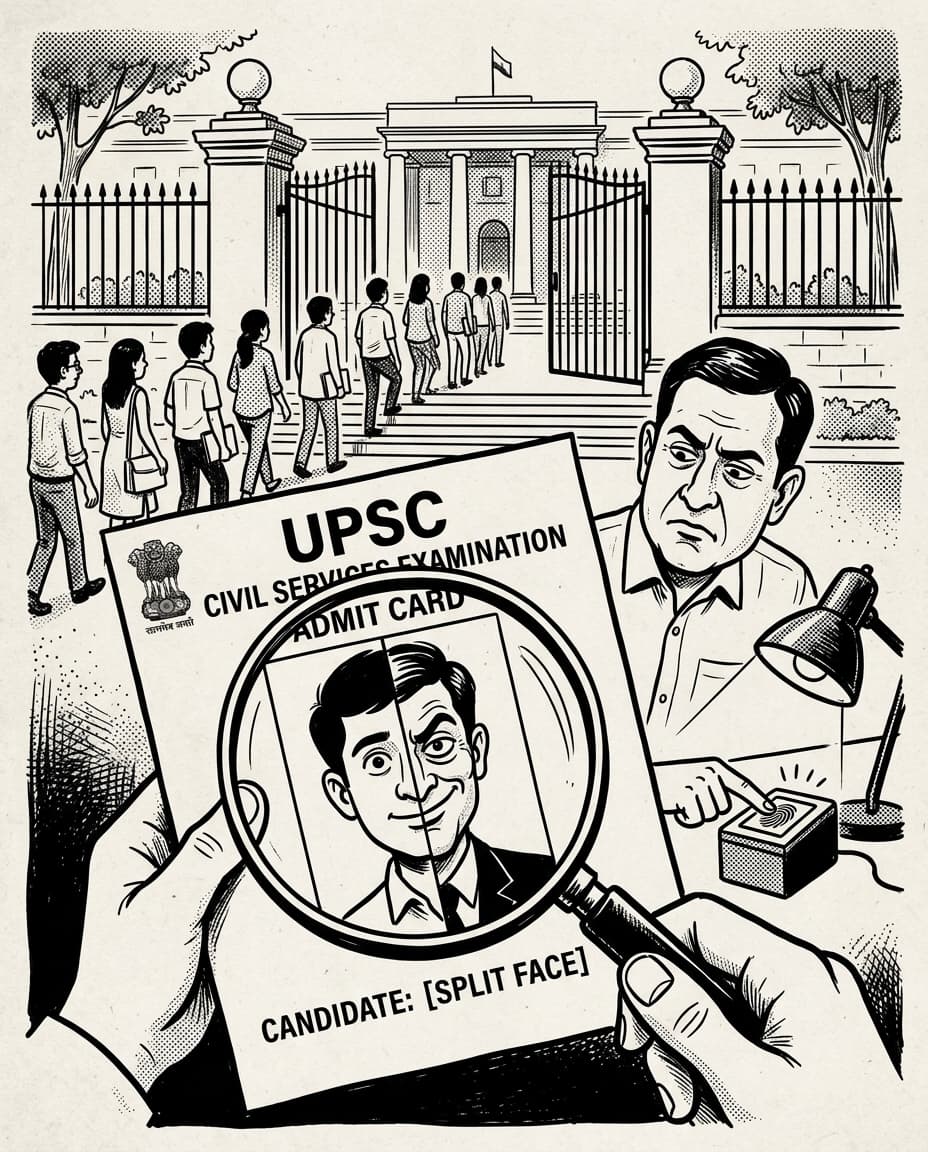
Editorial Illustration:Editorial illustration reflecting the events and context of The Spliced Faces of Dholpur House: Inside the 2007 UPSC Civil Services Impersonation Case, the Chemical Forgers, and the Dawn of Biometric Governance.
VINTAGE INK ARCHIVE
I. The Steel Frame and the Three-Tier Filter
To understand the audacity of the 2007 conspiracy, one must examine the fierce, unforgiving crucible of the Civil Services Examination.
Often described as one of the most competitive intellectual examinations on earth, the CSE functions as a brutal three-stage filter: 1. The Preliminary Examination: An objective, multiple-choice screening test where over 1.8 lakh candidates competed in 2007 for barely 8,000 to 10,000 slots in the Mains. A single mistake or negative marking penalty of 0.33 marks could eliminate a candidate for an entire year. 2. The Main Examination: A grueling nine-paper written essay test evaluating deep analytical depth, ethics, and specialized optional subjects. 3. The Personality Test (Interview): An intensive oral evaluation conducted inside the boardrooms of Dholpur House by senior bureaucrats, diplomats, and academics.
For aspirants from the northern coaching belts of Bihar and eastern Uttar Pradesh, clearing the CSE is an all-consuming obsession. In coaching hubs like Mukherjee Nagar in Delhi and Musallahpur Hat in Patna, thousands of young graduates live in cramped ten-by-ten rooms, studying twelve to fourteen hours a day for years on end.
Yet the vast majority stumble at the first hurdle: the Preliminary Examination.
Many candidates possess the maturity and essay-writing skills required for the Mains, but lack the encyclopedic, rapid-fire factual memory demanded by the objective Prelims.
It was this specific bottleneck that created an underground market for Scholar Solvers.
II. The Scholar from Patna and the ₹8 Lakh Pact
The central figure in the 2007 breach was Mukesh Kumar, an aspirant from Bihar who had exhausted multiple attempts attempting to clear the Civil Services Prelims. Desperate to cross the threshold into the Mains examination, Mukesh was introduced by coaching intermediaries to Dharmendra Kumar, an educational fixer operating between Patna and Delhi.
Dharmendra did not promise stolen question papers. In 2007, the UPSC’s paper custody was virtually leak-proof: question papers were drafted by independent confidential panels, printed at the Reserve Bank of India’s high-security currency press or classified government presses, and escorted in armored vans to state treasuries.
Instead, Dharmendra offered an alternative solution: Impersonation by a Scholar Solver.
The solver recruited for the mission was Rakesh Kumar (alias Santosh). Rakesh was not a criminal; he was an academically brilliant postgraduate research scholar at Patna University. Possessing an extraordinary grasp of history, political science, and current affairs, Rakesh was a veteran competitive test-taker capable of scoring in the top 1 percentile of any national aptitude exam with minimal preparation.
However, coming from an economically impoverished rural family, Rakesh was struggling to finance his doctoral research and family medical expenses.
Dharmendra offered him a life-altering proposition: ₹8 lakh in total, with ₹1.5 lakh paid upfront in cash simply to write the Preliminary examination on behalf of Mukesh Kumar. If the candidate cleared the Prelims, an additional ₹4.5 lakh would be paid for Rakesh to write the Mains examination later in the year, with the remaining balance settled after the interview.
Faced with financial distress, the scholar accepted.
III. The Art of the Spliced Admit Card
The operational hurdle confronting the syndicate was the physical admit card issued by the UPSC.
In 2007, the digital revolution was still nascent in Indian governance. Candidates submitted physical paper application forms by post, affixing printed passport-sized photographs using gum.
The UPSC printed physical paper Attendance Lists and Admit Cards, mailing them to candidates weeks before the exam.
To ensure authenticity, the UPSC applied an embossed circular seal across the edge of the photograph: half of the seal rested on the paper admit card, and half rested directly on the candidate’s photograph.
At the examination center, invigilators were instructed to verify two things: 1. That the photograph on the admit card matched the face of the candidate sitting at the desk. 2. That the official UPSC seal across the photograph’s border was intact, continuous, and unbroken.
If Rakesh Kumar simply glued his own photo over Mukesh’s photo, the embossed seal would be broken, leading to immediate confiscation and arrest at the center gate.
To overcome this, Dharmendra engaged Sanjay Sharma, a skilled darkroom technician and document retoucher operating out of an obscure printing alley in Central Delhi.
Sharma executed a masterclass in physical document forgery: 1. Chemical Delamination: Using specialized industrial solvents (including carbon tetrachloride and gentle alcohol vapors), Sharma carefully dissolved the adhesive holding Mukesh Kumar’s original photograph onto the paper admit card without tearing the delicate paper fibers. 2. Emulsion Splicing: Sharma then separated the glossy photographic emulsion layer from the photographic paper backing. 3. The Hybrid Assembly: Using precision surgical scalpels, Sharma sliced Rakesh Kumar’s photograph, aligning it perfectly beneath the official circular ink seal. 4. Counterfeit Embossing: To complete the illusion, Sharma used a custom-manufactured metallic stamping tool that recreated the exact microscopic ridges and indentations of the UPSC's official circular seal across Rakesh’s spliced photo.
Under ordinary room light, the forged admit card was indistinguishable from an original government document. The photograph was that of solver Rakesh Kumar; the name and roll number were those of candidate Mukesh Kumar; and the official seal ran seamlessly across the border.
IV. May 20, 2007: Six Hours in Central Delhi
On the morning of Sunday, May 20, 2007, solver Rakesh Kumar walked through the gates of a designated senior secondary school in Central Delhi.
He presented the forged admit card to the police sentry and the center invigilator. The invigilator checked the photograph against Rakesh’s face: the match was flawless. The invigilator checked the seal: it appeared completely authentic.
Rakesh took his assigned seat at Desk No. 42.
Over the next six hours: - In the morning session (9:30 AM to 11:30 AM), Rakesh tackled the General Studies Paper, rapidly darkening bubbles on the OMR answer sheet across Indian polity, international relations, modern history, and science. - In the afternoon session (2:30 PM to 4:30 PM), he completed the Optional Subject Paper with clinical precision.
While hundreds of candidates around him were sweating in mental agony, the Patna scholar finished both papers with thirty minutes to spare. He signed the candidate attendance sheet, forging Mukesh Kumar's signature, handed over his OMR sheets to the invigilator, and walked out into the Delhi heat.
The operation appeared to be a flawless triumph of criminal impersonation.
V. The Informer at Mukherjee Nagar and the June 12 Trap
The syndicate's undoing originated not inside the examination hall, but in the crowded tea stalls of Mukherjee Nagar in North Delhi.
Following the examination, broker Dharmendra Kumar began boasting to close confidants that he had "conquered the UPSC" and had a foolproof system to guarantee selection in the Civil Services Mains.
A rival coaching agent, resentful of Dharmendra’s growing reputation, tipped off the Special Operations Squad (SOS) of the Delhi Police Crime Branch, commanded by Deputy Commissioner of Police (DCP) Alok Kumar.
DCP Alok Kumar recognized the extraordinary gravity of the intelligence. If proxy solvers could successfully breach the UPSC Civil Services Preliminary examination, the integrity of the country’s entire administrative leadership was at risk.
Crime Branch detectives placed Dharmendra Kumar and candidate Mukesh Kumar under electronic and physical surveillance.
In early June, intercepted phone calls revealed that the preliminary results were anticipated shortly, and the conspirators had agreed to meet in North Delhi on June 12, 2007, to hand over the second cash installment of ₹2 lakh to scholar Rakesh Kumar.
On the afternoon of June 12, plainclothes Crime Branch detectives surrounded a restaurant near the Delhi University Metro Station.
As candidate Mukesh Kumar handed an envelope containing ₹2 lakh in marked currency to solver Rakesh Kumar and broker Dharmendra, tactical officers moved in, pinning all three men to the table.
Searches of Rakesh Kumar’s satchel yielded: - The original forged admit card bearing Rakesh's photograph with Mukesh's name. - Duplicate identity cards and fake voter IDs. - Written notes detailing questions from the May 20 Preliminary examination.
Interrogations led detectives directly to Sanjay Sharma’s workshop in Central Delhi, where police seized chemical solvents, precision scalpels, counterfeit UPSC embossing stamps, and dozens of candidate photographs.
VI. The Reaction at Dholpur House: Permanent Debarment
The arrest of a proxy candidate taking the Civil Services Preliminary examination was a direct blow to the prestige of the Union Public Service Commission.
Officials at Dholpur House acted with swift, uncompromising severity.
The UPSC called for an immediate report from the Delhi Police Crime Branch and summoned the physical OMR answer sheets and attendance rolls from the Central Delhi examination sub-center.
A comparison between the signature on Mukesh Kumar's original application form and the signature executed by Rakesh Kumar on the center's attendance sheet revealed glaring, undeniable handwriting disparities.
In late 2007, exercising its statutory powers under the Civil Services Examination Rules, the Commission passed formal disciplinary orders: - Mukesh Kumar (Candidate): Formally disqualified from the 2007 examination and permanently debarred for life from appearing in any examination or selection conducted by the Union Public Service Commission. - Rakesh Kumar (Scholar Solver): Debarred permanently from ever applying for or appearing in any central government recruitment examination, ending his academic dreams of a public service career.
In March 2008, the Delhi Police Crime Branch filed a comprehensive chargesheet before the Court of the Chief Metropolitan Magistrate at Tis Hazari Courts, Delhi.
The accused were charged under Sections 419 (Cheating by impersonation), 420 (Cheating), 468 (Forgery for purpose of cheating), 471 (Using forged document as genuine), and 120-B (Criminal conspiracy) of the Indian Penal Code.
The trial court framed formal charges, observing that attempting to enter the prestigious civil services through criminal impersonation was an assault on the constitutional foundations of the republic.
VII. Institutional Legacy: The Biometric Revolution of UPSC
The 2007 Civil Services impersonation case was a microscopic incident in terms of numbers—a single solver in a single classroom. But its institutional impact on Indian examination administration was revolutionary.
It exposed the fatal truth that visual invigilation of physical paper admit cards is fundamentally incapable of preventing sophisticated identity fraud.
In the months and years following the 2007 breach, the UPSC, in coordination with the Department of Personnel and Training (DoPT), completely overhauled its examination architecture: 1. The Death of Physical Paper Admit Cards: The UPSC phased out manually glued physical admit cards. The commission pioneered the e-Admit Card System, where high-resolution digital photographs and digitized candidate signatures were printed directly into the security watermark of the paper, eliminating any possibility of chemical delamination or physical photo-splicing. 2. Biometric Thumb Impression Rolls: The UPSC introduced mandatory biometric ink thumb impressions on candidate attendance registers inside every examination hall. Even if a proxy solver managed to fool an invigilator visually, their physical fingerprint was permanently recorded on the attendance roll. 3. The Multi-Stage Photo-Audit: The Commission instituted a three-tier photographic audit. The photograph captured on the online application form was algorithmically cross-verified against the candidate’s appearance during the Mains written exam, and verified again by biometric scanners and high-resolution cameras when the candidate arrived at Dholpur House for the final Personality Test (Interview). 4. Blacklist Sharing Across Public Commissions: The UPSC established an inter-commission intelligence registry, sharing the biometric templates and identities of debarred impersonators with all State Public Service Commissions (such as BPSC, UPPSC, and MPSC) to prevent solvers from migrating to state exams.
For the 1.8 lakh candidates of the Civil Services Class of 2007, the arrest at the university metro station was a vindication of their hard work. It reaffirmed the sacred promise of Dholpur House: that while criminal syndicates will endlessly seek to splice the faces of merit, the integrity of the steel frame will always stand guard over the democratic soul of the nation.
Chronological Case Timeline
| Exact Date / Period | Authority / Entities Involved | What Happened & What Changed | Verified Source / Reference |
|---|---|---|---|
| May 20, 2007 | UPSC, Over 1.8 Lakh Candidates | UPSC conducts Civil Services (Preliminary) Examination 2007; proxy solver Rakesh Kumar writes exam for candidate Mukesh Kumar at a Delhi center using a chemically spliced admit card. | UPSC CSE 2007 Examination Records & Center Logbooks |
| June 12, 2007 | Delhi Police Crime Branch (Special Operations Squad) | Acting on a tip-off from a coaching hub in North Delhi, Crime Branch arrests proxy solver Rakesh Kumar and candidate Mukesh Kumar during a payment handover; registers FIR No. 164/2007. | The Times of India, June 13, 2007: "Proxy Candidate Held for Taking UPSC Civil Services Exam" |
| June 18–25, 2007 | Crime Branch, Delhi Police | Raids in Delhi and Patna lead to the arrest of document forger Sanjay Sharma and broker Dharmendra Kumar; seizure of chemical solvents, counterfeit rubber seals, and forged identity documents. | The Indian Express, June 20, 2007: "Patna Scholar, Forger Held in UPSC Proxy Racket" |
| October 2007 | Union Public Service Commission (Dholpur House) | UPSC issues show-cause notice and passes formal debarment orders, permanently disqualifying both candidate Mukesh Kumar and solver Rakesh Kumar from all future UPSC examinations. | UPSC 58th Annual Report (2007–2008), Disciplinary Section |
| March 2008 | Court of Chief Metropolitan Magistrate, Tis Hazari, Delhi | Crime Branch files formal chargesheet under IPC Sections 419 (Cheating by impersonation), 420 (Cheating), 468 (Forgery for cheating), 471, and 120-B. | State vs Rakesh Kumar & Ors, Tis Hazari Court Records |
| 2008 – 2009 | UPSC Secretariat, Department of Personnel and Training (DoPT) | UPSC overhauls testing security nationwide: mandates digitally printed photographs and signatures on e-admit cards, institutes biometric thumb impression rolls, and enforces photo-audit cross-checks before Personality Tests. | UPSC 59th Annual Report (2008–2009), Examination Reforms Section |
Sources & Further Reading
- Union Public Service Commission (UPSC) — 58th Annual Report (2007–2008) and 59th Annual Report (2008–2009), Sections on Disciplinary Action Against Candidates Using Unfair Means and Examination Security Modernization, Dholpur House, New Delhi. https://upsc.gov.in
- Delhi Police Crime Branch — Chargesheet in FIR No. 164/2007 (Police Station Crime Branch, Delhi vs Rakesh Kumar, Mukesh Kumar, Dharmendra Kumar & Sanjay Sharma), filed before the Court of Chief Metropolitan Magistrate, Tis Hazari Courts, Delhi, March 2008. https://delhipolice.gov.in
- Department of Personnel and Training (DoPT), Government of India — Civil Services Examination Rules & Directives on Verification of Candidate Credentials and Biometric Identification, North Block, New Delhi, 2008. https://dopt.gov.in
- The Times of India — Proxy Candidate Held for Taking UPSC Civil Services Exam: Munna Bhai in Civil Services Prelims, New Delhi Bureau, June 13, 2007. https://timesofindia.indiatimes.com/city/delhi/proxy-candidate-held-for-taking-upsc-exam/articleshow/2120412.cms
- The Indian Express — Patna Scholar, Forger Held in UPSC Proxy Racket: Chemical Solvents Used to Spliced Admit Card Photos, Express News Service, June 20, 2007. https://indianexpress.com/archive/2007/06/20/upsc-proxy-candidate-held/
- The Hindu — Crime Branch Cracks Identity Forgery in UPSC Preliminary Test: Two Remanded to Police Custody, Special Correspondent, June 14, 2007. https://www.thehindu.com/2007/06/14/stories/2007061453910400.htm
- Hindustan Times — Behind the UPSC Munna Bhai Syndicate: How University Scholars Are Recruited to Clear Civil Services Prelims, Rajesh Ahuja, June 22, 2007. https://www.hindustantimes.com/india-news/upsc-munna-bhai-racket-busted/story-398124.html
Comments
0Want to participate in the discussion?
No comments yet. Start the discussion above.