The Steel Almirah of Rajni Sibal: Inside the Haryana JBT Teacher Scam, the Forged Guest House Lists, and the Ten-Year Incarceration of Om Prakash Chautala
•INVESTIGATIVE DISPATCH•BY ADITYA
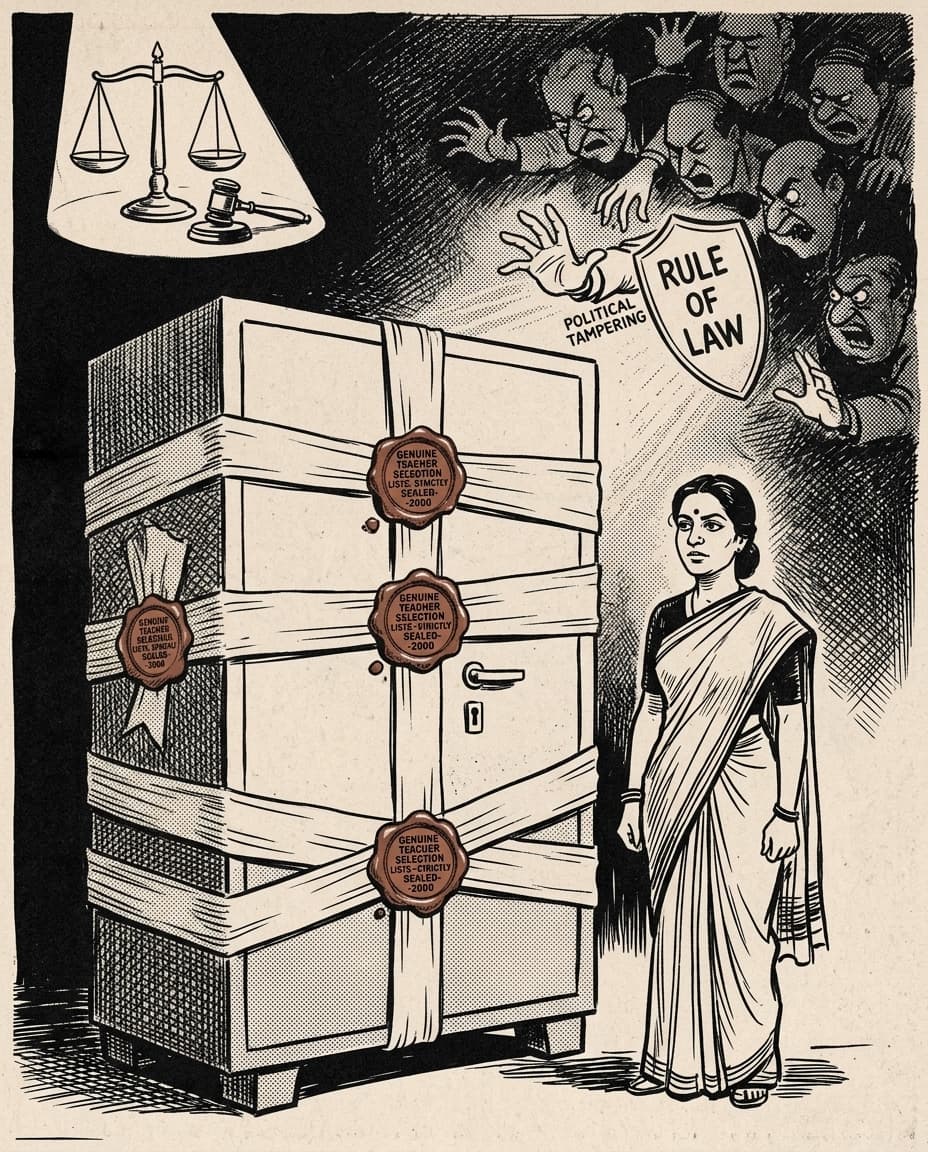
Editorial Illustration:Editorial illustration reflecting the events and context of The Steel Almirah of Rajni Sibal: Inside the Haryana JBT Teacher Scam, the Forged Guest House Lists, and the Ten-Year Incarceration of Om Prakash Chautala.
VINTAGE INK ARCHIVE
I. The Feudal Fiefdom: Haryana in the Year 2000
To comprehend how a Chief Minister could orchestrate the wholesale forgery of 3,206 public appointments, one must understand the political culture of Haryana at the turn of the millennium.
In the late 1990s, the Chautala political dynasty, founded by former Deputy Prime Minister Chaudhary Devi Lal, exercised immense, patriarchal authority across the state. In rural Haryana, government employment—particularly as a Junior Basic Training (JBT) teacher in village primary schools—was the supreme currency of rural political patronage.
A primary school teacher enjoyed a secure government salary, minimal physical labor compared to agrarian farming, and high social respect. More importantly, in Haryana's rural social fabric, a government teacher’s appointment letter was a valuable matrimonial and economic asset.
In November 1999, the Haryana government advertised 3,206 JBT teacher posts across 18 districts. Over 20,000 qualified young men and women applied.
The selection process was designed around two components: 1. Academic Merit: Accounting for 80% of the total score, based on high school, senior secondary, and JBT diploma marks. 2. Viva-Voce (Interview): Accounting for 20 marks, evaluated by five-member District Selection Committees comprising the District Primary Education Officer (DPEO) and senior headmasters.
Between May and June 2000, the 18 district committees conducted thousands of interviews across the state, meticulously recording the marks awarded to each candidate on official sheets known as Award Lists.
The committees complied with the rules: each member signed the award sheets, sealed them in envelopes, and submitted them to the Directorate of Primary Education in Chandigarh.
Merit had had its say. But the Chief Minister had other plans.
II. The Wax and the Bandage: The Stand of Rajni Sekhri Sibal
In July 2000, Chief Minister Om Prakash Chautala summoned Director of Primary Education Rajni Sekhri Sibal to his official residence in Chandigarh.
Chautala made his directive unmistakably clear: the interview marks compiled by the district committees were to be altered to ensure that candidates on a confidential list prepared by the Indian National Lok Dal (INLD) were appointed. The quotas were divided among party MLAs, ministers, and influential local satraps.
Sibal, an officer of unimpeachable integrity, respectfully but firmly refused to comply with the illegal order. She pointed out that thousands of genuine candidates from humble backgrounds had scored top marks on academic merit and performed brilliantly in the interviews; overriding their scores would be a criminal subversion of the Constitution.
Recognizing that her defiance would trigger immediate retaliation, Sibal returned to her office at the New Secretariat building. She called her trusted personal assistant and administrative staff.
In a scene that would later become legendary in CBI courtrooms: - Sibal took all 18 authentic district interview award lists. - She wrapped the heavy paper bundles in thick white cotton cloth. - She wound medical bandage tape tightly around the cloth in intersecting cross-patterns. - She heated red lac wax over a spirit burner and applied thick, molten wax seals across every single fold, knot, and seam of the package, stamping each wax circle with her official brass seal. - She placed the parcel inside a heavy steel Godrej almirah in her office, locked the dual doors, and dripped sealing wax directly into the keyholes, imprinting her personal seal over the iron apertures. - She recorded a formal office memorandum noting that the confidential records were sealed under her personal supervision and could not be opened without her written authorization.
Within forty-eight hours, an executive order was issued from the Chief Minister’s Secretariat: Rajni Sekhri Sibal was summarily transferred out of the Primary Education Department.
III. The Replacement: Sanjiv Kumar and the New Delhi Conclave
To replace Sibal, Chautala appointed Sanjiv Kumar, an IAS officer known for his political ambition and willingness to accommodate executive directives.
What unfolded between August and October 2000 was an administrative conspiracy of staggering proportions: 1. The Retrieval and Destruction: The sealed Godrej almirah in the Directorate was forcibly opened. While the conspirators initially attempted to manipulate the numbers on Sibal’s sealed sheets, they realized that altering hundreds of handwritten entries with different pens would look crude and obvious under visual scrutiny. 2. The New Delhi Guest House Conclave: Instead, Sanjiv Kumar, working in close coordination with Chautala’s Officer on Special Duty (OSD) Vidya Dhar (IAS) and political secretary Sher Singh Badshami, summoned the chairpersons and members of all 18 District Selection Committees to New Delhi. 3. The Forgery Assembly Line: In August 2000, district education officers were brought into rooms at Haryana Bhavan on Copernicus Marg in New Delhi, as well as the Haryana Tourism guest house at Dabchick (Hodal) and private suites in Chandigarh. Under direct intimidation from political operatives who warned them of immediate dismissals, transfers to remote desert borders, or disciplinary action, the committee members were provided fresh, blank award list sheets. 4. The Dictated Marks: Dictating from master recommendation lists prepared by Om Prakash Chautala and his son Ajay Singh Chautala, the officials spent hours systematically forging fresh award lists: - Genuine, high-scoring academic candidates were awarded failing interview marks—typically between 2 and 5 out of 20. - Low-scoring, unqualified candidates on the Chief Minister's political quota were awarded near-perfect interview scores—18, 19, or 20 out of 20. - The committee members were forced to sign their names across every page of the forged lists.
In October 2000, the Department of Primary Education officially published the selection list. Exactly 3,206 candidates nominated on the political lists received appointment letters, while thousands of brilliant, qualified young teachers across Haryana were discarded.
IV. The Machiavellian Whistleblower: Sanjiv Kumar’s Fatal Gamble
For nearly two years, the scam remained buried beneath the weight of state power. The newly appointed teachers took charge of primary school classrooms, and the INLD celebrated the recruitment as a triumph of rural youth empowerment.
Then, in 2002, an unexpected fissure cracked the conspiracy open.
Sanjiv Kumar had a bitter personal and financial falling out with Om Prakash Chautala and Ajay Chautala over subsequent administrative postings and kickback distributions. Fearing that Chautala would scapegoat him if an inquiry were ever launched, Sanjiv Kumar decided to play an audacious double-game.
In 2003, posing as a righteous, crusading whistleblower, Sanjiv Kumar filed a sensational writ petition (Writ Petition (Criminal) No. 93 of 2003) directly before the Supreme Court of India.
In his petition, Kumar claimed that he had uncovered a massive recruitment fraud orchestrated by Chief Minister Om Prakash Chautala, producing what he claimed were the "original" award lists and alleging that Chautala had forced the department to appoint fake teachers.
Kumar believed that by approaching the Supreme Court first under the cloak of a public-spirited whistleblower, he would secure absolute judicial immunity while politically destroying the Chautala regime.
It was a fatal miscalculation.
The Supreme Court, alarmed by the gravity of the allegations, refused to let the Haryana State Police investigate its own political master. On November 25, 2003, a bench of the Supreme Court transferred the entire investigation to the premier federal agency: the Central Bureau of Investigation (CBI).
V. Forensic Science Unmasks the Double Forgery
When CBI detectives seized the physical records and interrogated the district education officers, the investigation took a sensational turn.
Detectives recovered not two, but three separate sets of award lists: 1. Set 1: The original, authentic award lists prepared by the district committees in June 2000—which Rajni Sekhri Sibal had preserved and whose chain of custody remained documented. 2. Set 2: The forged award lists prepared at Haryana Bhavan in August 2000 under Chautala and Sanjiv Kumar's supervision, on the basis of which the 3,206 appointments had actually been made. 3. Set 3: A third set of forged lists that Sanjiv Kumar had secretly fabricated in 2002 to frame Chautala while protecting himself!
The CBI submitted all three sets of documents to the Central Forensic Science Laboratory (CFSL) in New Delhi for exhaustive forensic document and handwriting examination.
The laboratory findings were devastating: - Paper Age and Watermarks: Forensic analysis of the paper fibers, chemical inks, and watermark manufacturers proved that the sheets submitted by Sanjiv Kumar to the Supreme Court were manufactured in 2002—two years after the recruitment had concluded. - Handwriting Discrepancies: CFSL handwriting experts established that while Set 1 contained the genuine, spontaneous signatures of the committee members, Set 2 contained their signatures executed under duress, and Set 3 contained outright forgeries. - The Bandage Tape Imprint: Forensic examiners confirmed that the packaging marks and red lac impressions on Sibal’s original files matched her official brass seal, establishing that her preserved records were the only authentic reflection of candidate merit.
Instead of securing immunity, Sanjiv Kumar found himself unmasked not as a whistleblower, but as a primary co-conspirator.
On June 6, 2008, the CBI filed a comprehensive chargesheet before the Special CBI Court at Rohini, New Delhi, formally indicting 62 individuals, including: - Former Chief Minister Om Prakash Chautala - Member of Parliament Ajay Singh Chautala - 1985-batch IAS officer Sanjiv Kumar - 1983-batch IAS officer Vidya Dhar - Political aide Sher Singh Badshami - Dozens of district education officers and interview committee members.
VI. January 2013: The Special CBI Court Judgment
The trial, conducted before Special Judge Vinod Kumar at the Rohini District Courts in New Delhi, spanned nearly five years of intense legal combat.
Top criminal defense counsels argued that there was no direct money trail linking Chautala to individual candidates, that the Chief Minister had not physically signed the forged award lists, and that the prosecution was a politically motivated witch-hunt.
The CBI, however, dismantled the defense piece by piece: - The Testimony of Rajni Sekhri Sibal: Sibal stepped into the witness box and delivered a calm, devastating eyewitness account of how the Chief Minister had directly pressured her to discard merit, and how she had sealed the authentic records with red wax to protect the truth. - The Confessions of Committee Members: Several district education officers turned approvers or gave testimony describing the terrifying atmosphere inside Haryana Bhavan, where they were coerced into signing blank award lists under political supervision. - Forensic Science Certificates: The CFSL reports provided scientific, irrefutable proof that the lists used for recruitment were forged.
On January 16, 2013, Special Judge Vinod Kumar delivered his historic verdict: convicting 55 individuals, including Om Prakash Chautala (then 78 years old), his son Ajay Chautala, and both IAS officers, under Sections 120-B, 420, 467, 468, and 471 of the Indian Penal Code, read with Section 13(1)(d) and 13(2) of the Prevention of Corruption Act.
On January 22, 2013, the Special Judge pronounced sentence: - Om Prakash Chautala: 10 years of rigorous imprisonment. - Ajay Singh Chautala: 10 years of rigorous imprisonment. - Sanjiv Kumar (IAS): 10 years of rigorous imprisonment. - Vidya Dhar (IAS) & Sher Singh Badshami: 10 years of rigorous imprisonment.
In his sentencing order, Special Judge Vinod Kumar addressed the catastrophic societal impact of the crime: > "When teachers who are entrusted with molding the character, morality, and intellect of primary school children are selected through forgery and corruption, the foundation of the nation is compromised. A Chief Minister who subverts the Constitution to distribute public jobs as personal favors strikes a fatal blow at the heart of the rule of law."
Outside the court complex, thousands of INLD supporters clashed with Delhi Police, throwing stones and teargas shells. But the law held firm.
Om Prakash Chautala and his son were handcuffed and transported under armed guard to Tihar Central Jail.
VII. August 3, 2015: The Supreme Court Landmark Verdict
Following an appeal before the Delhi High Court that affirmed their convictions in March 2015, the convicts approached the apex court of the land: the Supreme Court of India.
On August 3, 2015, a bench comprising Justice F.M. Ibrahim Kalifulla and Justice Shiva Kirti Singh delivered the final, unanimous judgment in Om Prakash Chautala & Ors v. Central Bureau of Investigation (2015) 8 SCC 188).
The Supreme Court dismissed every single appeal, unequivocally upholding the 10-year prison sentences for Om Prakash Chautala, Ajay Chautala, and all co-conspirators.
In a blistering assessment of political corruption, Justice Kalifulla wrote: > "The appellants who held high constitutional and public offices acted in total disregard of their constitutional duties. The systematic manipulation of award lists to appoint favored candidates while depriving thousands of deserving youth of their livelihood was an organized assault on meritocracy. Corruption in public recruitment, especially in the educational sphere, cannot be viewed with any leniency, as it poisons the very wellspring of society."
The Court specifically commended the integrity and courage of Rajni Sekhri Sibal, noting that had she not preserved the authentic records with her red wax seals, the conspiracy would have succeeded in erasing all traces of the genuine merit list.
VIII. Institutional Legacy: The Fall of an Empire
The Haryana JBT teacher recruitment scandal stands as a watershed moment in the constitutional history of modern India.
Prior to 2013, political satraps across the country operated under the comforting assumption that while lower-level clerks and touts might be arrested for examination fraud, the political masters who commissioned the crime enjoyed de-facto immunity.
The JBT case permanently destroyed that illusion.
It demonstrated that: 1. The Political Executive Can Serve Hard Time: A sitting former Chief Minister, an MP, and senior IAS officers spent years behind the bars of Tihar Jail for recruitment fraud. Om Prakash Chautala served his full ten-year sentence, walking out of Tihar only in July 2021 at the age of 86. 2. The Power of Documentary Chain of Custody: It established the critical importance of bureaucratic record-keeping. The simple bureaucratic integrity of Rajni Sekhri Sibal—preserving original documents with wax and bandage tape—became the silver bullet that brought down a political dynasty. 3. The End of Subjective Interview Weightage: The scandal accelerated the national push to eliminate or drastically curtail subjective interview marks in non-gazetted group-C and group-D government recruitments, leading the Union Government in 2016 to formally abolish interviews for all non-gazetted posts to eliminate political discretion.
For the thousands of honest teachers who were cheated on that summer afternoon in 2000, the verdict arrived after years of economic struggle. But the legacy of the steel almirah in Chandigarh remains an enduring beacon of Indian public administration: proving that when a dedicated civil servant chooses duty over subservience, the truth can survive the most powerful rulers of the day.
Chronological Case Timeline
| Exact Date / Period | Authority / Entities Involved | What Happened & What Changed | Verified Source / Reference |
|---|---|---|---|
| November 1999 – Mid 2000 | Haryana Primary Education Dept, 18 District Committees | Haryana advertises 3,206 JBT teacher posts; 18 District Selection Committees interview candidates and compile authentic award lists. | Haryana Primary Education Recruitment Records 1999–2000 |
| July – August 2000 | CM Om Prakash Chautala, Rajni Sekhri Sibal (IAS) | CM Chautala orders Director Rajni Sekhri Sibal to replace authentic merit lists with his party list; Sibal refuses, seals authentic lists in steel almirah, and is transferred. | Testimony of Rajni Sekhri Sibal before Special CBI Court Rohini |
| August – October 2000 | Sanjiv Kumar (IAS), Vidya Dhar (IAS), Ajay Chautala | Sanjiv Kumar takes over as Director; committee members summoned to Haryana Bhavan; authentic lists replaced with forged award lists to appoint 3,206 hand-picked candidates. | CBI Chargesheet in RC 3(A)/2004-ACU.IX (New Delhi) |
| 2002 – 2003 | Sanjiv Kumar (IAS), Supreme Court of India | Following falling out, Sanjiv Kumar files WP (Crl.) No. 93/2003 in Supreme Court posing as whistleblower; Supreme Court detects criminality and orders CBI enquiry. | Supreme Court Order in WP (Crl.) No. 93/2003, Nov 25, 2003 |
| November 25, 2003 | Supreme Court of India | Supreme Court transfers entire investigation to the Central Bureau of Investigation (CBI), directing registration of regular criminal cases against all involved. | Supreme Court Order in Sanjiv Kumar v. State of Haryana (2003) |
| June 6, 2008 | Central Bureau of Investigation (CBI) | CBI files comprehensive chargesheet naming 62 accused, including CM Om Prakash Chautala, MP Ajay Chautala, two IAS officers, and 58 education department officials. | State (CBI) vs Om Prakash Chautala & Ors, Special Court Rohini |
| January 16, 2013 | Special CBI Court, Rohini, New Delhi | Special Judge Vinod Kumar convicts former CM Om Prakash Chautala, Ajay Chautala, Sanjiv Kumar, and 52 others; sentences all key conspirators to 10 years rigorous imprisonment. | Special CBI Court Judgment in CC No. 01/2012, Jan 16, 2013 |
| March 5, 2015 | Delhi High Court | High Court upholds 10-year prison sentences for Chautala and co-conspirators, observing that political executive subverted merit to operate a private patronage fiefdom. | Delhi High Court Judgment in Crl. Appeal No. 192/2013, March 2015 |
| August 3, 2015 | Supreme Court of India (Bench: F.M.I. Kalifulla & Shiva Kirti Singh, JJ.) | Supreme Court delivers landmark verdict in Om Prakash Chautala & Ors v. CBI ((2015) 8 SCC 188); dismisses all appeals and affirms 10-year prison terms. | Supreme Court of India Judgment in Criminal Appeal No. 356 of 2013 |
| July 2, 2021 | Tihar Jail Authorities, Delhi Government | Former Chief Minister Om Prakash Chautala, aged 86, completes his 10-year sentence and is formally released from Tihar Jail. | The Indian Express, July 3, 2021: "OP Chautala Walks Out of Tihar After 10 Years" |
Sources & Further Reading
- Supreme Court of India — Om Prakash Chautala & Ors vs Central Bureau of Investigation (2015) 8 SCC 188, Criminal Appeal No. 356 of 2013 with connected appeals, Bench of Justices F.M. Ibrahim Kalifulla and Shiva Kirti Singh, August 3, 2015. https://main.sci.gov.in/judgment/judis/42831.pdf
- Delhi High Court — Om Prakash Chautala vs Central Bureau of Investigation, Criminal Appeal No. 192/2013 and connected appeals, Judgment of Justice Siddharth Mridul affirming conviction and 10-year rigorous imprisonment, March 5, 2015. https://delhihighcourt.nic.in
- Special CBI Court, Rohini, New Delhi — State (CBI) vs Om Prakash Chautala, Ajay Singh Chautala, Sanjiv Kumar & Ors (CC No. 01/2012), Judgment and Order on Sentence of Special Judge Vinod Kumar, January 16 and January 22, 2013.
- Supreme Court of India — Orders in Writ Petition (Criminal) No. 93 of 2003 (Sanjiv Kumar vs State of Haryana & Ors), transferring the JBT recruitment case to the CBI, November 25, 2003.
- The Hindu — Chautala, Son Handed 10-Year Jail Terms in JBT Teachers Scam: Special CBI Court Sentences 55 Accused, Staff Reporter, January 23, 2013. https://www.thehindu.com/news/national/other-states/chautala-son-get-10-years-in-jail-for-teachers-scam/article4331454.ece
- The Indian Express — How an Honest IAS Officer Rajni Sekhri Sibal Saved the Truth with Red Lac and Bandage Tape, Maneesh Chhibber, January 17, 2013. https://indianexpress.com/article/cities/delhi/how-an-ias-officer-saved-the-truth-with-red-lac-and-bandage-tape/
- Frontline Magazine — The Chautala Conviction: A Historic Blow Against Political Corruption and Recruitment Patronage, T.K. Rajalakshmi, Vol. 30, Issue 03, February 9–22, 2013. https://frontline.thehindu.com/the-nation/article30164284.ece
- The Tribune (Chandigarh Edition) — Supreme Court Upholds 10-Year Jail for Chautala and Ajay in Teachers' Scam: Crime Against Society, Satya Prakash, August 4, 2015. https://www.tribuneindia.com/news/archive/haryana/sc-upholds-10-yr-jail-for-chautalas-in-teachers-scam-115312
Comments
0Want to participate in the discussion?
No comments yet. Start the discussion above.