The Chairman on the Tracks: Inside the 2010 Railway Recruitment Board Mega Leak, the Hyderabad Hotel Raids, and the Arrest of S.M. Sharma
•INVESTIGATIVE DISPATCH•BY ADITYA
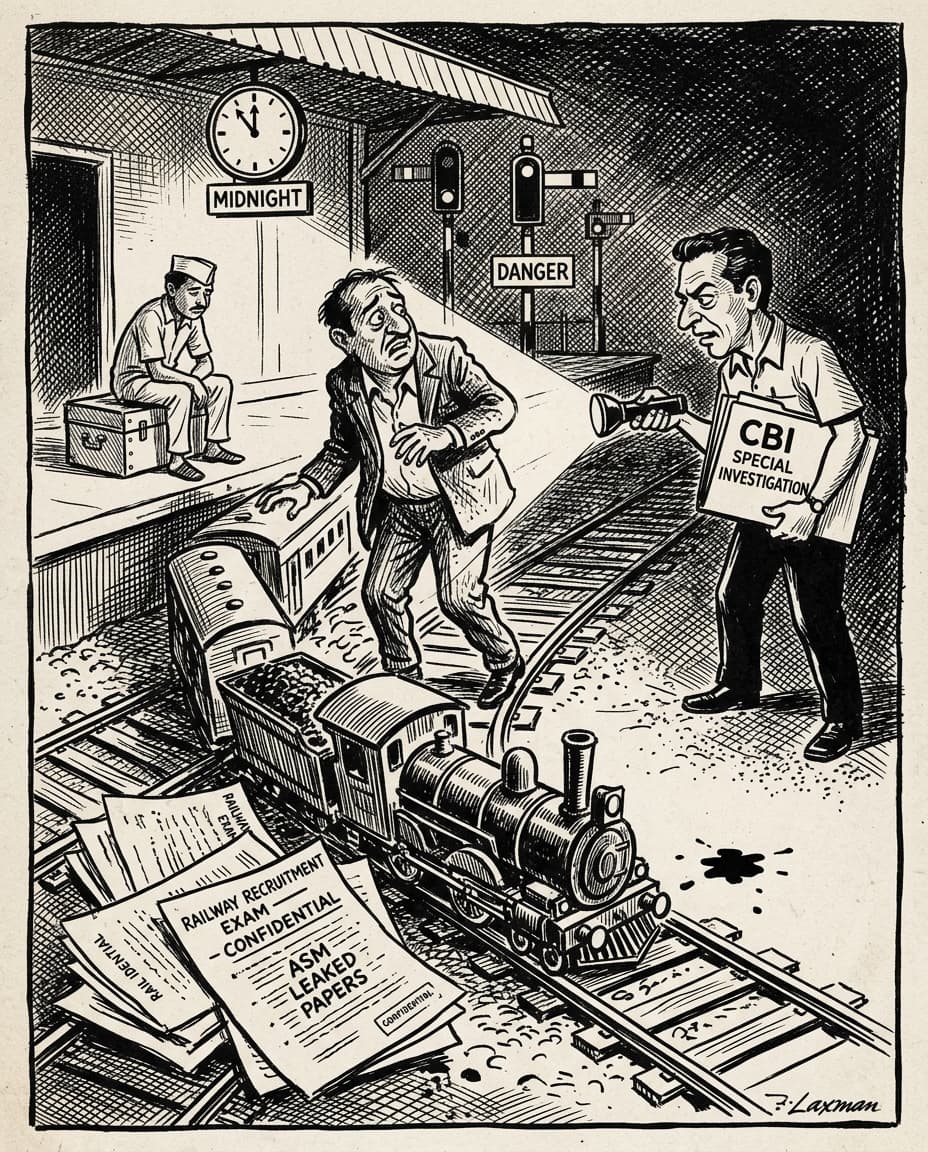
Editorial Illustration:Derailment of merit: an editorial cartoon depicting the 2010 Railway Recruitment Board mega paper leak scandal and subsequent CBI investigation.
VINTAGE INK ARCHIVE
I. The Anatomy of Railway Recruitment
With over 1.4 million employees operating across 65,000 kilometers of track, the Indian Railways had long decentralized its non-gazetted recruitment through 21 autonomous Railway Recruitment Boards (RRBs) situated in major zonal hubs including Mumbai, Kolkata, Chennai, Delhi, Secunderabad, and Patna.
Each RRB was headed by a Chairman—typically a senior railway administrative officer carrying the rank of Joint Secretary or Senior Administrative Grade (SAG). The Chairman enjoyed extraordinary discretionary power: - Selecting the confidential printing presses where question papers were manufactured. - Overseeing the formatting of question banks and determining which reserve set would be deployed on test morning. - Managing the logistical transport of sealed trunks containing question paper packets to hundreds of examination centers across multiple states.
In 2010, RRB Mumbai, headquartered inside the heritage premises of the Divisional Railway Manager’s office at Mumbai Central, was tasked with conducting one of the largest technical recruitment drives of the decade. The examination aimed to fill thousands of critical vacancies: - Assistant Loco Pilots (ALP): Frontline locomotive drivers directly responsible for passenger train safety, signaling compliance, and emergency braking protocols. - Senior Section Engineers (SSE) & Junior Engineers (JE): Technical supervisors responsible for track maintenance, overhead electrical lines, and rolling stock maintenance.
For these posts, technical competence is literally a matter of life and death. An unqualified driver who does not understand pneumatic braking systems or signal aspects risks catastrophic derailments.
Yet in the spring of 2010, the executive tasked with safeguarding that technical merit decided to convert the examination into a private auction.
II. S.M. Sharma and the Family Enterprise
S.M. Sharma was a veteran bureaucrat of the Indian Railway Personnel Service. Having spent decades navigating railway administration, Sharma knew the systemic loopholes of the recruitment architecture intimately.
In early 2010, Sharma realized that the sheer volume of applicants—over 4.5 lakh candidates competing for technical posts—created an insatiable black market.
To insulate himself from direct contact with street-level candidates and local police vigilance, Sharma constructed a sophisticated, multi-tiered syndicate: 1. The Family Conduit: Sharma’s son, Vivek Bhardwaj Sharma, acted as the family’s trusted financial manager and primary liaison. It was Vivek who received the master question papers directly from his father’s office in Mumbai Central weeks before the examination. 2. The Kingpin Manager: Vivek partnered with A.K. Jagannathan, a retired Additional Divisional Railway Manager (ADRM) formerly posted at Raipur. Jagannathan possessed deep operational knowledge of railway networks and an extensive web of contacts across central and southern India. 3. The Southern Conduit: Jagannathan’s son, S. Sridhar, operated out of Hyderabad, coordinating with local brokers, private tutorial operators, and parallel college agents across Andhra Pradesh, Maharashtra, and Chhattisgarh. 4. The Banking Facilitator: G. Sethi, a senior official at a nationalized bank in Raipur, helped manage the laundering of cash deposits and structured demand drafts into fictitious accounts.
The commercial terms established by the syndicate were ruthless: - Assistant Loco Pilot (ALP) Post: ₹3.5 lakh per candidate. - Senior Section Engineer (SSE) Post: ₹5 lakh per candidate.
To guarantee payment, candidates were required to pay an advance of ₹50,000 to ₹1 lakh in cash. Crucially, the syndicate also seized the candidates' original academic degree certificates, Class 10 marks cards, and signed blank bank cheques as physical collateral. The original documents were returned only after the candidate saw their roll number on the final selection list and paid the remaining balance in cash.
III. The Hyderabad Solver Camps: The Night at the Lodges
During the second week of June 2010, as RRB Mumbai finalized its logistics for the June 19 examination, the syndicate activated its field machinery.
Brokers in Vijayawada, Guntur, Nagpur, Bilaspur, and Mumbai gathered dozens of paying aspirants. The candidates were instructed to pack a single change of clothes, leave their mobile phones and pagers behind, and board overnight trains to Hyderabad.
Upon arrival at Secunderabad and Nampally stations on June 17, candidates were met by Jagannathan’s couriers and whisked away in private vehicles to discreet lodges and budget hotels scattered across Hyderabad, including locations in Begumpet, Lakdikapul, and Abids.
The operation reached its climax on the evening of Friday, June 18, 2010—less than fourteen hours before the nationwide examination.
Inside the locked banquet halls and private rooms of these hotels: - More than 100 candidates were assembled and placed under physical quarantine by syndicate bouncers. - A.K. Jagannathan and S. Sridhar distributed photocopies of the master question paper that S.M. Sharma had leaked from Mumbai. - A panel of hired engineering lecturers and railway technical tutors sat at the front of the room, working through the technical diagrams, mechanical engineering formulas, and general cognitive reasoning questions. - Throughout the night, candidates were drilled on the answers. They were made to memorize the sequential answer key—1-B, 2-C, 3-A, 4-D—rehearsing until the early hours of Saturday morning.
The conspirators believed they were untouchable. But they were unaware that they had been walking inside a trap laid by the premier investigative agency of the republic.
IV. The CBI Operation: Midnight at Lakdikapul
Weeks earlier, confidential human intelligence had alerted the Central Bureau of Investigation (CBI) Anti-Corruption Branch (ACB) in Mumbai to suspicious movements surrounding the upcoming RRB technical examinations.
Supervised by Joint Director Rishi Raj Singh and DIG Pravin Salunke, the CBI placed key phone numbers under lawful electronic interception. The wiretaps quickly revealed frantic negotiations between Vivek Bhardwaj Sharma in Mumbai, A.K. Jagannathan in Raipur, and S. Sridhar in Hyderabad, detailing candidate headcounts, advance payments, and hotel rendezvous points.
On the evening of Friday, June 18, as the candidates were being ushered into the Hyderabad lodges, the CBI struck.
Coordinating seamlessly between Mumbai and Hyderabad branches, dozens of armed CBI sleuths surrounded several hotels simultaneously. Raiding teams breached the conference halls, catching Jagannathan, Sridhar, and over thirty candidates red-handed around conference tables.
The evidence seized was overwhelming: - Exact photocopies of the question paper for the June 19 Assistant Loco Pilot exam. - ₹60 lakh in liquid Indian currency bundled in suitcases on the premises. - Over 100 original academic marksheets and degree certificates belonging to candidates across three states. - Laptops, portable printers, and ledger books recording candidate payments and balance dues.
A forensic comparison between the seized hotel papers and the master question paper held under seal by the Ministry of Railways in New Delhi revealed an absolute, 100 percent match.
V. June 19: The Nationwide Abort
At 5:00 AM on Saturday, June 19, senior CBI officials contacted the Chairman of the Railway Board and the Ministry of Railways in Rail Bhavan, New Delhi. The evidence was irrefutable: the integrity of the examination had been shattered across multiple states.
At 7:00 AM—barely two hours before 4,50,000 candidates were scheduled to take their seats—the Ministry of Railways issued an emergency red bulletin: The Assistant Loco Pilot and Technical Grade examinations scheduled for today, June 19, 2010, have been cancelled nationwide due to a paper leak.
Outside examination centers in Mumbai, Pune, Nagpur, Hyderabad, and Bangalore, crowds of candidates erupted in disbelief and anger. Many had traveled twelve hours on unreserved train compartments, sleeping on railway platforms, only to be turned away at the gates.
In New Delhi, Union Railway Minister Mamata Banerjee publicly commended the CBI for uncovering the racket before tainted drivers could enter the railway network, and ordered the immediate suspension of all officials implicated in the breach.
VI. The Arrest of S.M. Sharma: Raiding the Chairman
While Jagannathan and his southern network were being transported to CBI lockups in Hyderabad, detectives in Mumbai moved against the apex of the pyramid.
On the afternoon of Saturday, June 19, CBI teams detained Vivek Bhardwaj Sharma in Mumbai. Interrogation of the son unraveled the paper trail directly to his father’s official residence.
On Sunday, June 20, 2010, CBI ACB sleuths formally placed RRB Mumbai Chairman S.M. Sharma under arrest.
Simultaneous raids executed across Sharma’s official residence in Mumbai, ancestral properties, and bank vaults revealed the astounding dimensions of the family's accumulation: - Bank passbooks and fixed deposit certificates showing unaccounted balances running into crores of rupees. - Multiple luxury apartments and commercial plots in Mumbai, Raipur, and Delhi. - Evidence of hawala transfers used to disguise cash inflows from syndicate touts.
On June 21, the Railway Board issued formal executive orders placing S.M. Sharma under suspension and dismantling the confidential operations wing of RRB Mumbai.
VII. The Chargesheet and Legal Reckoning
In 2011, following an exhaustive inter-state investigation spanning Maharashtra, Andhra Pradesh, Chhattisgarh, and Delhi, the CBI filed a comprehensive chargesheet before the Court of the Special Judge for CBI Cases in Greater Mumbai.
The chargesheet formally indicted: - S.M. Sharma (Suspended RRB Chairman) - Vivek Bhardwaj Sharma (Son/Financial Conduit) - A.K. Jagannathan (Ex-ADRM/Syndicate Kingpin) - S. Sridhar (Logistics Head) - G. Sethi (Senior Bank Manager) - Multiple regional touts, tuition teachers, and candidate recruiters.
The accused were charged under Sections 120-B (Criminal Conspiracy) and 420 (Cheating) of the Indian Penal Code, read with Sections 7, 8, 12, and 13(2) read with 13(1)(d) of the Prevention of Corruption Act, 1988.
The Special CBI Court framed formal charges, rejecting repeated discharge applications from Sharma, who attempted to argue that as an administrative head he had no direct knowledge of how the papers reached Hyderabad.
The CBI dismantled this defense by demonstrating that the leaked papers bore confidential typographical errors that existed exclusively on the master copy held in Sharma’s personal custody.
VIII. Institutional Legacy: The Shift to Computer-Based Testing
The 2010 RRB Mumbai scandal was a watershed moment that permanently altered how Indian Railways recruits its workforce.
The realization that an Assistant Loco Pilot—a professional entrusted with the lives of thousands of train passengers—could purchase their qualification for ₹3.5 lakh in a Hyderabad hotel room sent a shiver through the railway safety establishment. Had the CBI not raided those lodges on June 18, dozens of mathematically illiterate and technically incompetent drivers would have taken control of express trains across the country.
The scandal accelerated three monumental structural reforms across the Railway Recruitment Boards: 1. The Death of Pen-and-Paper Testing: The physical printing, transport, and vault storage of paper question booklets was recognized as an irredeemable security risk. Indian Railways initiated a multi-year transition toward Computer-Based Testing (CBT). Today, railway recruitment examinations are conducted entirely online, with questions encrypted and decrypted on candidate computer terminals seconds before the start of the test. 2. Centralized Randomization Algorithms: Question banks are no longer formatted by individual zonal Chairmen. Instead, centralized, automated algorithms assemble unique permutations of questions for each candidate from vast, encrypted servers. 3. Decentralization of Custodial Monopoly: The unilateral authority of RRB Chairmen over confidential operations was abolished. Confidential examination cells were placed under tripartite administrative control, requiring multi-layered cryptographic authentication from Rail Bhavan.
For the 4.5 lakh candidates who were turned away from exam centers on June 19, 2010, the cancellation was a day of bitter disappointment. But the re-examination conducted months later under fortified security ensured that those who eventually earned their place in the locomotive cabs did so on the strength of genuine knowledge and discipline.
The downfall of S.M. Sharma remains a historic lesson in the annals of Indian anti-corruption history: proving that even within the mightiest public enterprise in the republic, the track of corruption eventually leads to a dead end.
Chronological Case Timeline
| Exact Date / Period | Authority / Entities Involved | What Happened & What Changed | Verified Source / Reference |
|---|---|---|---|
| May – June 2010 | RRB Mumbai, Ministry of Railways | RRB Mumbai prepares nationwide written examinations for Assistant Loco Pilots and Technical cadres, scheduled for June 19, 2010. | Railway Recruitment Board Mumbai Examination Notification 2010 |
| Early June 2010 | S.M. Sharma (RRB Chairman), A.K. Jagannathan (Ex-ADRM) | Chairman Sharma provides master confidential question papers to his son Vivek, who transfers them to Jagannathan’s syndicate for ₹3.5–5 lakh per candidate. | CBI Chargesheet in Special Case No. 34/2011 (CBI ACB Mumbai) |
| June 17–18, 2010 | Syndicate Brokers, 100+ Candidates | Jagannathan and associates assemble dozens of candidates in hotels and lodges across Hyderabad, Bangalore, and Nagpur for overnight answer memorization camps. | The Indian Express, June 19, 2010: "CBI Busts Multi-Crore Railway Recruitment Racket in Hyderabad" |
| June 18, 2010 (Night) | CBI Anti-Corruption Branch Mumbai & Hyderabad | CBI raids hotels in Hyderabad and Mumbai, seizing original question papers, ₹60 lakh in cash, and impounded candidate certificates; arrests Jagannathan, Sridhar, and middlemen. | CBI Press Release, June 19, 2010: "CBI Busts Massive Railway Paper Leak Syndicate" |
| June 19, 2010 (Morning) | Ministry of Railways, Railway Board | Ministry cancels Assistant Loco Pilot examination nationwide minutes before scheduled commencement for over 4.5 lakh candidates. | The Hindu, June 20, 2010: "Railway Board Cancels Exam After Mega Paper Leak Bust" |
| June 20, 2010 | Central Bureau of Investigation (CBI) | CBI ACB Mumbai formally arrests sitting RRB Mumbai Chairman S.M. Sharma and his son Vivek Bhardwaj Sharma; raids uncover bank accounts with crores in unaccounted deposits. | The Times of India, June 20, 2010: "CBI Arrests RRB Mumbai Chairman S.M. Sharma in Exam Scam" |
| June 21, 2010 | Railway Board, Government of India | Railway Board places Chairman S.M. Sharma under immediate suspension and disbands confidential operations at RRB Mumbai. | Ministry of Railways Executive Suspension Order, June 2010 |
| 2011 | Special CBI Court, Mumbai | CBI files comprehensive chargesheet naming S.M. Sharma, Vivek Sharma, A.K. Jagannathan, and 12 others under Prevention of Corruption Act and IPC 120-B/420. | State (CBI) vs S.M. Sharma & Ors, Special Court Mumbai |
| Late 2010 – 2012 | Railway Recruitment Boards (Pan-India) | Indian Railways successfully re-conducts Assistant Loco Pilot exam under armed security, initiating the structural transition to online Computer-Based Tests (CBT). | Railway Board Administrative Review on Recruitment Modernization 2012 |
Sources & Further Reading
- Central Bureau of Investigation (CBI) — Official Press Release and FIR Records in Special Case No. 34/2011 (RC 0262010A0019 - CBI ACB Mumbai vs S.M. Sharma & Ors), Press Information Bureau (PIB) / CBI New Delhi & Mumbai, June 19–20, 2010. https://cbi.gov.in
- Ministry of Railways, Government of India — Executive Notification on Immediate Cancellation of Assistant Loco Pilot and Technical Exams Scheduled for June 19, 2010 and Suspension of RRB Mumbai Chairman, Rail Bhavan, New Delhi, June 19, 2010. https://indianrailways.gov.in
- Special CBI Court, Greater Mumbai — Chargesheet and Framing of Charges in State (CBI) vs S.M. Sharma, Vivek Bhardwaj Sharma, A.K. Jagannathan & Ors, under Sections 120-B, 420 IPC and Sections 7, 12, 13(2) read with 13(1)(d) of Prevention of Corruption Act, 2011.
- The Times of India — CBI Arrests RRB Mumbai Chairman S.M. Sharma in Exam Scam: Cash, Properties and Question Papers Seized, S. Ahmed, June 20, 2010. https://timesofindia.indiatimes.com/city/mumbai/cbi-arrests-rrb-mumbai-chairman/articleshow/6068213.cms
- The Hindu — Railway Board Cancels Exam After Mega Paper Leak Bust: CBI Raids in Hyderabad and Mumbai Uncover Massive Racket, Special Correspondent, June 20, 2010. https://www.thehindu.com/news/national/cbi-unearths-railway-recruitment-scam/article473210.ece
- The Indian Express — CBI Busts Multi-Crore Railway Recruitment Racket: RRB Chairman’s Son, Ex-ADRM Caught with Over 100 Candidates in Hyderabad Hotels, Express News Service, June 19, 2010. https://indianexpress.com/article/cities/mumbai/cbi-busts-rrb-recruitment-scam-recovers-cash/
- Deccan Chronicle — How Hyderabad Became the Nerve Center of the RRB Question Paper Leak: Behind the Midnight Hotel Raids, Crime Bureau, June 21, 2010. https://www.deccanchronicle.com/archives/rrb-paper-leak-hyderabad-cbi-investigation
- India Today — Tracks of Corruption: How a Sitting RRB Chairman Sold Train Drivers' Jobs for Crores, Dhaval Kulkarni, July 5, 2010. https://www.indiatoday.in/magazine/states/story/20100705-tracks-of-corruption-railway-scam-743329-2010-06-25
Comments
0Want to participate in the discussion?
No comments yet. Start the discussion above.