The Chairman's Quota: Inside the 2017 Bihar BSSC Paper Leak and the Fall of a Senior IAS Officer
•INVESTIGATIVE DISPATCH•BY ADITYA
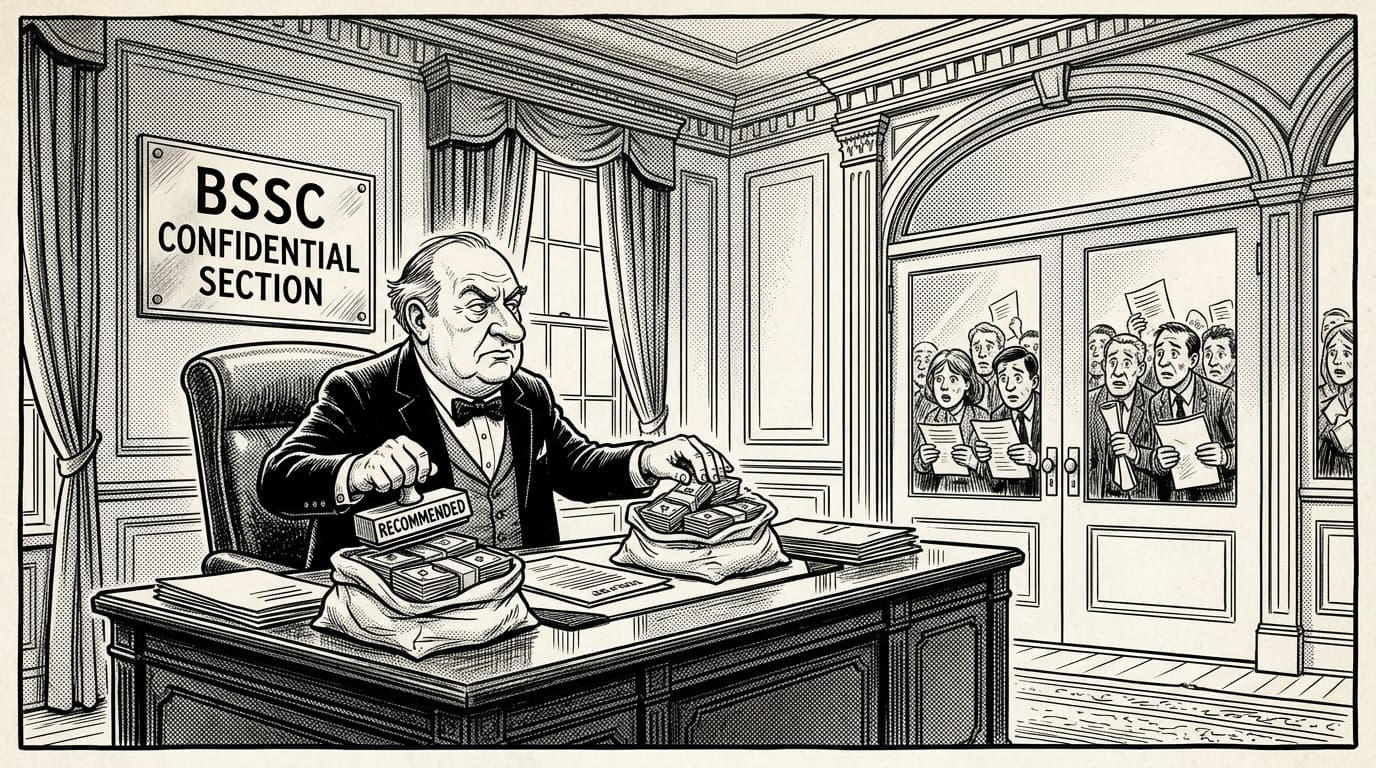
Editorial Illustration:Editorial illustration reflecting the events and context of The Chairman.
VINTAGE INK ARCHIVE
By Newsroom Editorial Desk
Published February 28, 2017 (Archived in the National Examination Integrity Repository) | Archival Incident INC-2014-BR-PATNA-030
At dawn on Friday, February 24, 2017, a convoy of unmarked police vehicles pulled up outside a private residence in the quiet town of Hazaribagh in neighboring Jharkhand.
Stepping out of the lead vehicle was a tactical squad from the Patna Police Special Investigation Team (SIT), led by a senior superintendent of police. Inside the house, preparing for his morning tea, was Sudhir Kumar, a member of the elite 1987 batch of the Indian Administrative Service (IAS), who was currently serving as the Chairman of the Bihar Staff Selection Commission (BSSC).
In the rigid hierarchy of Indian governance, senior IAS officers of three decades' standing are treated with near-regal deference. They preside over ministries, command vast district administrations, and are virtually never subjected to criminal handcuffs without protracted judicial sanctions.
That morning, the protocol of the republic ceased to apply.
Within fifteen minutes, Sudhir Kumar was placed under arrest. Along with four members of his immediate family—including his nephew, brother, and sister-in-law—the constitutional chairman of Bihar’s largest staff recruitment commission was bundled into a police car and driven across the state border to Patna under armed escort.
The crime that precipitated this unprecedented institutional arrest was the 2017 BSSC First Inter-Level Combined Competitive Examination scandal. It was a multi-crore criminal enterprise that had auctioned off 13,120 clerical and revenue posts across the state, shattering the hopes of over 17.5 lakh young men and women—the largest single pool of public job aspirants in the modern history of Bihar.
1. The Desperation of Seventeen Lakhs: The 2014 Backlog
To understand why the BSSC Inter-Level examination was a social tinderbox, one must examine the reality of youth unemployment in Bihar in the mid-2010s.
In a state with virtually no private corporate sector, no major manufacturing plants, and severe agrarian distress, a permanent government clerical job is perceived as the only permanent escape from generational poverty. A post as a Panchayat Secretary, Revenue Clerk (Rajaswa Karamchari), or Lower Division Clerk guarantees a stable salary, social standing, and lifelong economic security for an entire extended family.
When the BSSC issued Advertisement No. 06060114 in September 2014 for 13,120 posts, an astonishing 17.5 lakh candidates applied.
For more than two years, the commission delayed conducting the preliminary test. By late 2016, under growing public pressure, the BSSC announced a massive logistical undertaking: the examination would be conducted in four separate phases across hundreds of testing centres in all thirty-eight districts of Bihar:
- Phase 1: Sunday, January 29, 2017
- Phase 2: Sunday, February 5, 2017
- Phase 3: Sunday, February 19, 2017
- Phase 4: Sunday, February 26, 2017
Over seven hundred and fifty examination centres—mostly dilapidated government schools and rural colleges—were mobilized. Millions of youths boarded crowded train roofs and sleeper coaches, spending their meager savings to reach examination centers.
The commission assured the state that the test was impregnable.
In reality, the master keys to the examination had already been sold before the printing presses had even finished packing the bundles.
[17.5 LAKH REGISTERED APPLICANTS ACROSS BIHAR]
                     │
                     ▼
[13,120 Permanent Clerical & Revenue Posts]
                     │
                     ▼
[BSSC CHAIRMAN SUDHIR KUMAR, IAS & SECRETARY PARMESHWAR RAM]
- Bypass government security printing presses
- Secretly award printing contract to private commercial press in Ahmedabad
                     │
                     ▼
[THE MASTER QUESTION LEAK (JANUARY 2017)]
- Question sets delivered to Chairman's family members & brokers
- Rates: ₹6 Lakh to ₹8 Lakh per candidate
                     │
                     ▼
[PHASE 1 & PHASE 2 WHATSAPP DETONATION]
Complete solved question papers circulate on WhatsApp hours before exam start
                     │
                     ▼
[FEBRUARY 8, 2017: NITISH KUMAR CANCELS ALL 4 PHASES]
2. The Ahmedabad Press Heist: Bypassing the Fortress
The roots of the BSSC scandal lay in an extraordinary decision made within the confidential chambers of the commission at the Veterinary College campus in Patna.
Under standard administrative operating procedures, question papers for massive state recruitments must be printed at designated, highly secure government facilities or certified security presses governed by the Reserve Bank of India or central testing boards.
Instead, BSSC Chairman Sudhir Kumar and Commission Secretary Parmeshwar Ram bypassed these vetted channels. They awarded the multi-crore printing contract to RMS Techno Solutions / a commercial printing facility owned by Vineet Kumar Agarwal located in an industrial zone in Ahmedabad, Gujarat.
The private press in Ahmedabad was not a high-security vault. It was a commercial shop with minimal physical perimeter controls.
According to chargesheets later filed by the Patna Police SIT:
- Master question manuscripts compiled by BSSC academic panels were transferred to Ahmedabad in digital format.
- Days before the first phase was scheduled to run, printing press director Vineet Agarwal—colluding directly with BSSC leadership—extracted master printed proof sheets of all four sets.
- The printed questions were handed over to conduits, including relatives of Chairman Sudhir Kumar and candidate brokers linked to Secretary Parmeshwar Ram.
- Solvers stationed in private rooms in Patna, Nawada, and Gaya wrote out complete objective answer keys on ruled paper notebooks.
- Recovered from his WhatsApp chats and SMS inboxes were hundreds of messages sent by serving state ministers, sitting Members of the Legislative Assembly (MLAs), and senior IAS and IPS officers.
- Each message contained candidate roll numbers, centre names, and seat numbers, accompanied by direct instructions to ensure their selection.
- In his custodial confession, Ram revealed that a "VIP quota" was routinely maintained within the commission, where each prominent politician was allocated a quota of candidates whose answer sheets would be manipulated or who would receive advance question sets.
- The Bihar IAS Officers’ Association held an emergency general body meeting at the Patna Club, passing an extraordinary resolution condemning the arrest of a senior bureaucrat by district police.
- Over fifty IAS officers marched to the Raj Bhavan wearing black armbands, demanding that the investigation be stripped from the state police and transferred to the CBI, claiming that Sudhir Kumar was being framed by political masters.
- However, Chief Minister Nitish Kumar and the Patna Police stood firm. SSP Manu Maharaaj released undeniable forensic evidence: question papers seized from Kumar's relatives' mobile phones, digital transmission logs linking his family to brokers, and bank transfer receipts.
- The preliminary examination was finally re-conducted twenty-two months later, in December 2018, under heavy police protection and biometric scanning.
- The mains examination took another two years, conducted in December 2020.
- Counseling and physical verification were dragged through multiple rounds of litigation in the Patna High Court.
- Special Investigation Team (SIT), Patna Police: First Information Report No. 45/2017 (PS Agamkuan / Special Cell) & Comprehensive Chargesheets in BSSC Examination Paper Leak (Patna Police Headquarters). Bihar Police Portal.
- Government of Bihar (Information & Public Relations Department): Executive Order: Cancellation of All Four Phases of BSSC First Inter-Level Combined Competitive Examination 2014 (Dated February 8, 2017, Patna). Government of Bihar Portal.
- Special Vigilance Court, Patna: State through SIT v. Sudhir Kumar, IAS, Parmeshwar Ram, Vineet Agarwal & Ors. (Case Proceedings, Remand Applications, and Chargesheet Records). Patna District Court eCourts Portal.
- Bihar Staff Selection Commission (BSSC): Official Notifications on the Reconduct of First Inter-Level Preliminary Examination (December 2018) and Final Result Declaration (June 2022) (Veterinary College, Patna). BSSC Official Portal.
- The Indian Express: Bihar BSSC Paper Leak: How an IAS Chairman and an Ahmedabad Press Rigged Jobs for 17 Lakh Aspirants (February 25, 2017). Indian Express Investigation.
- The Hindu: BSSC Paper Leak: Bihar Staff Selection Commission Chairman Sudhir Kumar Arrested; IAS Officers Protest (February 24, 2017). The Hindu Patna Coverage.
- The Times of India: BSSC Cash-for-Jobs: Secretary Parmeshwar Ram's Phones Reveal VIP Quota of Ministers and Bureaucrats (February 9, 2017). Times of India Patna Archives.
- NDTV: Inside the 50-Crore Bihar Exam Scam: Why Nitish Kumar Scrapped BSSC Exam for 17.5 Lakh Youths (February 8, 2017). NDTV National Desk.
The going rate for guaranteed selection was fixed between ₹6 lakh and ₹8 lakh per candidate. Families mortgaged agricultural plots, sold cattle, and took high-interest loans from local moneylenders to pay the required cash advances.
3. The Sunday Morning Leaks: When WhatsApp Exploded
The syndicate planned to run a quiet, controlled operation where only paying candidates would receive the answers in closed solver rooms.
However, in the digital era of end-to-end encrypted messaging, criminal secrets possess zero half-life.
On the morning of Sunday, January 29, 2017 (Phase 1), handwritten question sheets began appearing on student WhatsApp groups in Patna, Nawada, and Jehanabad at 8:30 AM—ninety minutes before the 10:00 AM exam bell.
When examinees walked out at 12:15 PM and compared the forwarded sheets with their question booklets, they discovered an absolute, word-for-word match.
When reporters confronted BSSC Secretary Parmeshwar Ram that afternoon, he arrogantly dismissed the reports as "mischievous rumors spread by failed candidates," insisting that the exam had concluded with complete integrity.
Seven days later, on the morning of Sunday, February 5, 2017 (Phase 2), the dam broke completely.
At 7:30 AM—two and a half hours before Shift 1—not only handwritten solutions, but high-resolution photographs of the actual printed question booklets were blasted across social media. Local television news channels in Patna began broadcasting the leaked questions live on television screens while candidates were still standing in security queues outside test centres.
Inside examination halls, invigilators watched in horror as candidates finished 150 complex objective questions in twenty minutes, having memorized the answer sequences that morning.
The streets of Patna exploded into fury. Thousands of candidates marched toward the state assembly, clashing with police along Bailey Road, burning effigies of BSSC administrators, and demanding immediate criminal action.
4. Chronological Case Timeline: The Collapse of BSSC
The following verified chronological timeline details the investigative breakthroughs, political convulsions, high-level arrests, and eventual retest of the BSSC Inter-Level recruitment:
| Exact Date / Timestamp | Authority / Entities Involved | What Happened & What Changed | Verified Document / Official Order |
|---|---|---|---|
| September 1, 2014 | BSSC, Patna | BSSC issues notification for 13,120 Inter-Level clerical and panchayat posts; over 17.5 lakh youths apply across Bihar. | BSSC Advt No. 06060114 |
| January 29, 2017 | BSSC & Candidates | Phase 1 of written examination conducted across 750 centres; handwritten question papers and answer keys circulate on WhatsApp before exam start, but commission dismisses reports as rumors. | Patna Police Diary Entry Jan 29, 2017 |
| February 5, 2017 (Morning) | Candidates & Media | Phase 2 written examination commences; exact photographs of question paper booklets and solved objective keys flood WhatsApp groups across Bihar hours before morning bells. | Patna Police SIT FIR No. 45/2017 |
| February 6, 2017 | Government of Bihar | Chief Minister Nitish Kumar orders a high-level probe by a Special Investigation Team (SIT) headed by Patna SSP Manu Maharaaj. | Bihar Home Department Notification |
| February 7, 2017 | Patna Police SIT | SIT raids BSSC Secretary Parmeshwar Ram’s residence in Patna, arresting him and seizing cell phones containing messages recommending 500+ candidates from politicians and bureaucrats. | SIT Press Release on Ram Arrest |
| February 8, 2017 | Government of Bihar | Chief Minister Nitish Kumar officially cancels all four phases of the BSSC Inter-Level examination, ordering thorough investigation. | Bihar Government Cancellation Notification |
| February 14, 2017 | Patna Police SIT | SIT raids an unaccredited commercial printing press in Ahmedabad, Gujarat, arresting printing firm director Vineet Agarwal who printed the BSSC question papers. | Patna SIT Ahmedabad Raid Docket |
| February 24, 2017 | Patna Police SIT | In an unprecedented constitutional development, SIT arrests serving 1987-batch IAS officer and BSSC Chairman Sudhir Kumar from his in-laws' home in Hazaribagh along with five relatives. | Patna Police Press Communique Feb 24, 2017 |
| February 26, 2017 | Bihar IAS Officers' Association | Bihar IAS Association holds emergency meeting at Patna Club, wearing black badges in protest against the arrest of Chairman Sudhir Kumar and demanding CBI takeover. | Bihar IAS Association Resolution |
| May 2017 | Patna Police SIT | SIT files monumental 3,000-page chargesheet before Special Vigilance Judge in Patna against 32 accused including IAS Sudhir Kumar and Secretary Parmeshwar Ram. | Special Vigilance Court Patna Docket |
| December 8–10, 2018 | Reconstituted BSSC | BSSC reconducts the Inter-Level preliminary examination cleanly for 17.5 lakh candidates across Bihar under multi-tier biometric security and police protection. | BSSC Retest Notification 2018 |
| June 2022 | BSSC | BSSC finally publishes the final merit list for 13,120 clerical posts, concluding an eight-year recruitment ordeal for Bihar's youth. | BSSC Final Recommendation Gazette 2022 |
5. The Phones of Parmeshwar Ram: The VIP Extortion Diary
On February 6, 2017, Chief Minister Nitish Kumar constituted a high-level Special Investigation Team (SIT) headed by Patna Senior Superintendent of Police (SSP) Manu Maharaaj.
The SIT wasted no time. On the night of February 7, armed detectives raided the official residence of BSSC Secretary Parmeshwar Ram in Patna.
When digital forensic experts analyzed Ram's smartphones, they unlocked a horrifying catalog of systemic political patronage:
On February 8, 2017, faced with mounting evidence from the SIT, Chief Minister Nitish Kumar cancelled all four phases of the examination.
The cancellation was an admission that the entire administrative apparatus had been rotten to the core.
6. The Arrest That Shook the Bureaucracy
Following the arrest of printing press director Vineet Agarwal in Ahmedabad, investigators discovered that the paper had not leaked through workers on the factory floor; it had been released with the explicit knowledge of BSSC Chairman Sudhir Kumar, IAS.
Detectives discovered that Sudhir Kumar had given advance copies of the question paper to his own family members, including his nephew, who had established a candidate distribution ring charging lakhs per set.
When the SIT arrested Sudhir Kumar on February 24 in Hazaribagh, it ignited an unprecedented civil war within the Bihar government:
In May 2017, the SIT filed a monumental 3,000-page chargesheet before the Special Vigilance Court in Patna, naming thirty-two accused under the Prevention of Corruption Act and criminal conspiracy. Sudhir Kumar spent months behind bars in Beur Central Jail, his distinguished administrative career ruined.
7. The Eight-Year Ordeal
While the powerful fought over legal sanctions and administrative pride, the real victims were the seventeen-and-a-half lakh young men and women of Bihar.
The cancellation plunged their lives into an eight-year bureaucratic nightmare:
It was not until June 2022—nearly eight full years after the original notification was issued in 2014—that the BSSC finally published the final merit list and issued appointment letters for 13,120 clerical posts.
By the time young men and women finally received their appointment letters, an entire decade of their youth had been consumed by the greed of an unvetted printing press and an IAS chairman who forgot the sanctity of his oath.
Comments
0Want to participate in the discussion?
No comments yet. Start the discussion above.