The Dharamshala Question: Inside the Himachal Police Constable Paper Leak and the Delhi Printing Press Heist
•INVESTIGATIVE DISPATCH•BY ADITYA
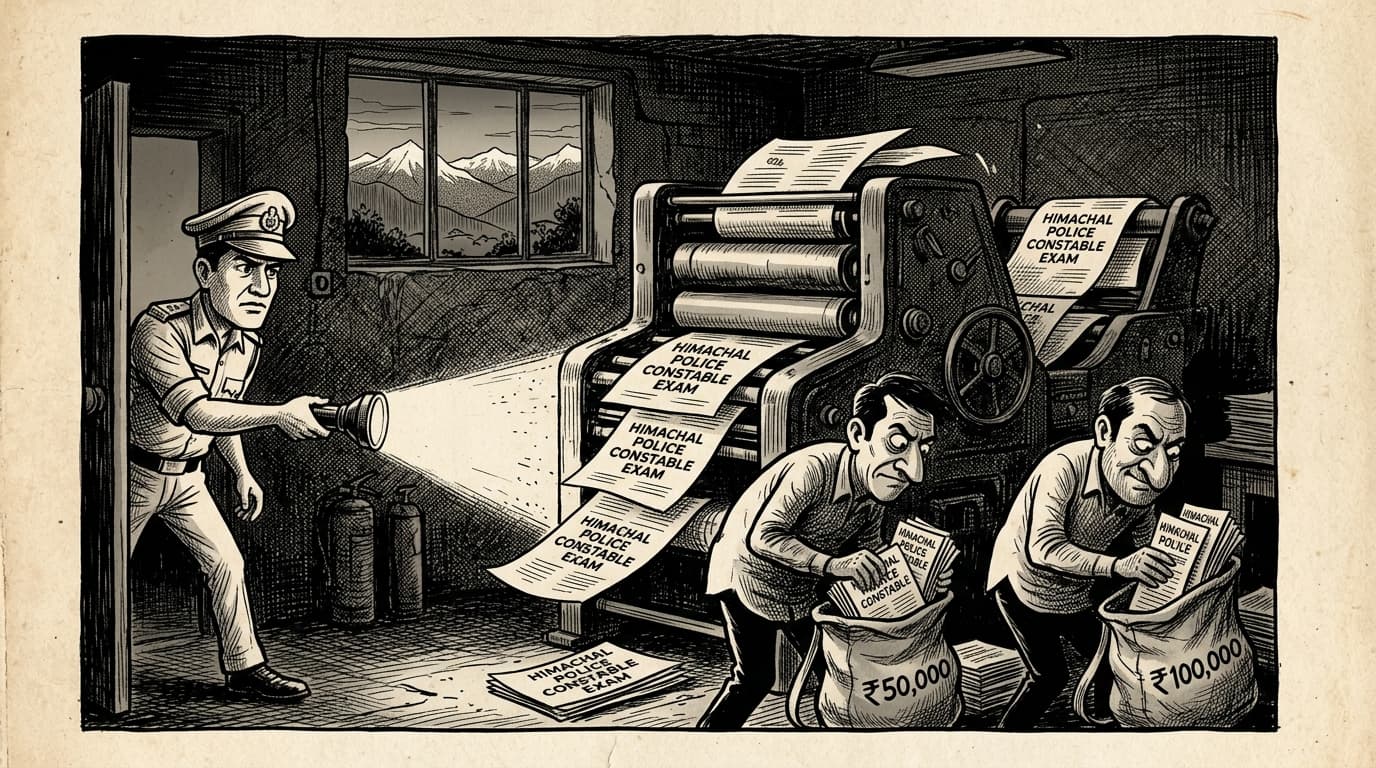
Editorial Illustration:Editorial illustration reflecting the events and context of The Dharamshala Question: Inside the Himachal Police Constable Paper Leak and the Delhi Printing Press Heist.
VINTAGE INK ARCHIVE
By Newsroom Editorial Desk
Published May 18, 2022 (Archived in the National Examination Integrity Repository) | Archival Incident INC-2022-HP-SHIMLA-036
On the sunny morning of Thursday, May 5, 2022, inside the police lines at Dharamshala in Kangra district, an evaluation committee headed by senior Himachal Pradesh police officers was conducting routine physical verification and document scrutiny.
Seated before them was a twenty-two-year-old candidate from a rural village in Kangra. On paper, the young man was an academic prodigy: in the written examination held on March 27 for the recruitment of 1,334 Police Constables, he had achieved a near-impossible score of 70 out of 80 marks, placing him among the topmost rankers across the entire state.
The officer presiding over the desk flipped through the candidate's folder. His Class 10 and 12 school board marksheets told an entirely different story: he had barely passed high school mathematics and English with third-division grades, scoring in the low thirties.
Curious, the officer leaned forward and asked a simple, friendly introductory question in English:
"Can you tell us the name of the President of India?"
The candidate blinked in silence. His hands began to tremble.
The officer switched to Hindi, asking for the capital of Himachal Pradesh. The candidate muttered an incoherent response.
The officer then handed the candidate a printed page containing five elementary questions from the very English comprehension and reasoning sections he had supposedly mastered forty days earlier. The candidate was asked to read the first sentence aloud.
He could not pronounce the words.
Within an hour, two other candidates who had secured near-identical astronomical scores—72 and 74 marks—were summoned to the room. When presented with the very test paper they had supposedly conquered, they broke into tears. They could not solve a single linear arithmetic equation; they could not identify basic grammatical nouns.
By 5:00 PM that afternoon, the three young men were sitting inside the interrogation room of the Gaggal Police Station. The confession they delivered to Kangra Superintendent of Police Dr. Khushal Sharma tore down the illusion of security surrounding Himachal Pradesh's public recruitment: they had never solved the test.
Two days before the examination, they had been driven across the state border to a highway motel in Zirakpur, Punjab, where an interstate syndicate handed them the complete question paper with solved multiple-choice keys in exchange for ₹6 lakh to ₹8 lakh in cash.
1. The Shock of the Peaceful State: The Illusion of Himalayan Integrity
For decades, the hill state of Himachal Pradesh had enjoyed an enviable reputation as an island of administrative probity.
While recruitment across neighboring northern states—Uttar Pradesh, Haryana, Rajasthan, and Punjab—was chronically plagued by solver gangs, paper leaks, and high-tech electronic malpractice, Himachal’s examination system was widely perceived as peaceful, disciplined, and insulated from organized crime.
When the State Level Police Recruitment Board announced vacancies for 1,334 constables in late 2021, the response was overwhelming. In a state of seventy lakh people, 1,87,476 young men and women applied.
Public employment in the police force is fiercely competitive in Himachal: it offers not only a stable government pension and medical security, but deep social status in rural agrarian communities across Kangra, Mandi, Hamirpur, and Shimla.
[1,87,476 APPLICANTS ACROSS 12 DISTRICTS]
                     │
                     ▼
[75,803 Cleared Exhaustive Physical Endurance Tests]
                     │
                     ▼
[Written Examination Conducted: March 27, 2022]
- 81 Centres across 12 Districts
- 80 Multiple-Choice Questions (Math, Reasoning, English, GK)
                     │
                     ▼
[MAY 5, 2022: THE KANGRA SCRUTINY DISASTER]
Top scorers cannot answer basic questions in Dharamshala
                     │
                     ▼
[MAY 6, 2022: CM JAI RAM THAKUR CANCELS EXAM]
Statewide re-test ordered for 75,000 candidates
The selection process was rigorous. Nearly seventy-six thousand candidates survived months of grueling physical endurance trials—clearing 1,500-meter track runs, high jumps, and chest measurements in high-altitude grounds—to qualify for the final 80-mark written test on Sunday, March 27, 2022.
The written examination was conducted across eighty-one centres under strict police supervision. When results were declared on April 5, the department celebrated a flawless exercise.
The Dharamshala cross-examination on May 5 destroyed that confidence overnight.
On Friday, May 6, 2022, Chief Minister Jai Ram Thakur held an emergency cabinet meeting in Shimla. Recognizing the mortal damage to the state's credibility, the Chief Minister took the podium to deliver the humiliating announcement: the entire examination was cancelled, the merit lists were revoked, and all seventy-five thousand candidates would have to retake the test.
2. The Delhi Breach: The Heist at the Commercial Press
The immediate question confronting the Himachal Police Special Investigation Team (SIT), headed by Deputy Inspector General (DIG) Madhu Sudan Sharma, was terrifying: Where did the paper originate?
Initially, investigators suspected that question packets had been unsealed at a district treasury vault in Kangra or stolen by a corrupt sub-inspector during road transit.
However, forensic analysis of the question papers seized from candidates' mobile phones revealed that the leaked document was not a photograph of a printed, stapled examination booklet distributed to exam centres. It was a digital PDF proof—an uncropped, high-resolution master proof originating from the typesetting computer of the confidential printing facility.
The trail led the SIT out of the Himalayan foothills and into the industrial heart of New Delhi.
The HP Police Department, like many state agencies, had contracted a specialized commercial security printing press in Delhi to format, print, and package the confidential question booklets. Under binding contractual terms, the press was mandated to enforce multi-tier physical and electronic security: no smartphones in printing halls, CCTV monitoring of typesetting terminals, and biometric turnstiles.
Yet, investigators discovered that the human barrier had collapsed.
[CONFIDENTIAL PRINTING PRESS - NEW DELHI]
                     │
         (Typesetting Room - Mid-March 2022)
                     ▼
[Virender Kumar (alias Viku) - Press Technician]
- Bypasses security checks inside printing facility
- Smuggles out master English & Hindi question sheets
                     │
                     ▼
[THE INTERSTATE OPERATIONAL CARTEL]
Bharat Yadav & Shiv Bahadur Singh (UP / Bihar / Delhi)
- Purchases paper for ₹1 Crore
- Connects with regional educational brokers across North India
                     │
         ┌───────────┴───────────┐
         ▼                       ▼
   [HARYANA / RAJASTHAN]    [HIMACHAL PRADESH]
   Candidate networks       Kangra, Mandi, Una brokers
                            (Subhash, Rajesh Kumar)
                                 │
                                 ▼
                     [ZIRAKPUR & PANCHKULA HOTELS]
                     Overnight solver camps (March 25-26)
                     Tariff: ₹6 Lakh to ₹8 Lakh per candidate
A press employee named Virender Kumar (alias Viku), working in the typesetting and layout department, had been approached weeks earlier by an interstate cartel specializing in paper procurement.
In mid-March 2022, while formatting the 80 questions across Hindi, English, Mathematics, and General Awareness, Virender Kumar bypassed internal security, printed an extra proof sheet or exfiltrated the digital text, and smuggled it out of the facility.
For this single act of betrayal, the printing press worker was paid an initial installment of ₹5 lakh, with promises of tens of lakhs more once the candidate collections materialized.
3. The Highway Solver Dens: Zirakpur and Panchkula
Once the paper was in the hands of the master brokers—led by Bharat Yadav and Shiv Bahadur Singh, veterans of paper-leak rings across Bihar and Uttar Pradesh—the syndicate sought buyers.
Himachal Pradesh was prime territory. Because the state had no prior history of major exam leaks, testing authorities did not utilize sophisticated signal jammers or comprehensive biometric verification at testing gates. The risk of detection was perceived as near-zero.
The interstate syndicate partnered with local brokers in Kangra, Mandi, and Una:
- Local touts—including coaching tutors, retired personnel, and political hangers-on—approached families whose children had passed the grueling physical tests but were academically weak.
- The tariff was fixed between ₹6 lakh and ₹8 lakh. Families paid cash advances of ₹1 lakh to ₹2 lakh, handing over original Class 10 and 12 certificates and signed blank cheques as collateral.
On March 25 and 26, 2022—forty-eight hours before the exam—the candidates were instructed to board buses and cars to the Chandigarh periphery.
Dozens of young men from Kangra and Mandi were booked into budget hotels and roadside guest houses along the national highway in Zirakpur and Panchkula.
Inside the hotel rooms, teams of professional solvers hired from Bihar and Haryana sat with standard competitive examination guides. They solved all eighty questions and prepared concise, numbered answer keys:
"Question 14: Option D. Question 15: Option B. Remember the numerical digits: seven point two percent."
The candidates were kept awake through the night of March 26, memorizing the answers under the watchful eyes of syndicate bouncers. At 5:00 AM on Sunday, March 27, the candidates were ferried back in private vehicles to their respective exam centres across Kangra, Una, and Bilaspur.
They darkened their OMR answer sheets with practiced ease, achieving scores that exceeded the performance of university graduates.
4. Chronological Case Timeline: The Avalanche of Arrests
The following verified chronological timeline details the investigative milestones, arrests across ten states, judicial orders, and the ultimate resolution of the Himachal Constable scandal:
| Exact Date / Timestamp | Authority / Entities Involved | What Happened & What Changed | Verified Document / Official Order |
|---|---|---|---|
| September 10, 2021 | HP Police Recruitment Board | HP Police issues notification for 1,334 posts of Police Constables across 12 districts; 1.87 lakh youths apply. | HP Police Recruitment Notification 2021 |
| Mid-March 2022 | Confidential Printing Press, Delhi | An employee at a security printing press in Delhi steals the finalized 80-question paper for HP Police Constable exam, transferring it to interstate brokers. | CBI Chargesheet FIR RC0032022A0012 |
| March 25–26, 2022 | Interstate Syndicate & Candidates | Brokers transport dozens of candidates from Kangra, Mandi, and Una to budget hotels in Zirakpur and Panchkula for overnight memorization drills of question-answer keys. | HP Police SIT Investigation Docket |
| March 27, 2022 | HP Police Department | Written examination conducted across 81 centres for 75,803 candidates who had cleared physical endurance tests; exam concludes peacefully. | HP Police Press Bulletin March 27, 2022 |
| April 5, 2022 | HP Police | Written examination results declared; merit lists published across 12 district headquarters. | HP Police Result Notification |
| May 5, 2022 | Kangra District Police | During physical certificate verification and evaluation in Dharamshala, three high-scoring candidates (70+/80) fail to answer basic questions, arousing suspicion. | Kangra Police Daily Diary Record |
| May 5, 2022 (Evening) | Kangra Police | Interrogation of the three candidates breaks their defense; they confess to paying ₹6 lakh to ₹8 lakh for pre-exam question papers; FIR No. 133/2022 registered at Gaggal Police Station. | FIR No. 133/2022 PS Gaggal |
| May 6, 2022 | Government of Himachal Pradesh | Chief Minister Jai Ram Thakur convenes an emergency meeting and officially cancels the written examination, ordering a Special Investigation Team (SIT) probe. | HP Government Press Release May 6, 2022 |
| May 17, 2022 | Government of Himachal Pradesh | As interstate connections to printing presses in Delhi and solver gangs in Bihar, UP, and Haryana emerge, CM Jai Ram Thakur recommends a CBI investigation. | HP Home Department Order |
| May–June 2022 | HP Police SIT | SIT arrests over 170 accused across multiple states, recovering crores in cash, luxury cars, and transaction receipts linking local middlemen to Delhi printing press workers. | HP Police SIT Press Briefing |
| July 3, 2022 | HP Police Department | Re-examination conducted successfully for over 70,000 candidates across 87 centres under heavy police deployment, biometric authentication, and mobile jammers. | HP Police Retest Bulletin July 2022 |
| November 30, 2022 | Central Bureau of Investigation (CBI) | CBI officially registers two regular cases (RC0032022A0012 and RC0032022A0013) under IPC 420, 120-B, and Prevention of Corruption Act, taking over custody of all evidence and accused. | CBI Press Release on HP Police Probe |
| 2023–2024 | CBI Special Courts, Shimla | CBI files multiple supplementary chargesheets against 180+ accused across 10 states, exposing the commercial printing press breach and interstate laundering. | CBI Special Court Shimla Registry |
5. The Avalanche Across Ten States
What began in a modest police scrutiny room in Dharamshala quickly ballooned into one of the largest interstate manhunts in Indian police history.
The Himachal Police SIT, working under continuous public and judicial pressure, tracked phone call records, UPI transactions, and hotel guest registers. Over the next forty-five days, the SIT dispatched search parties across ten Indian states: Himachal Pradesh, Punjab, Haryana, Delhi, Uttar Pradesh, Bihar, Rajasthan, Uttarakhand, West Bengal, and Maharashtra.
The numbers were staggering:
- 181 people were arrested, including 116 candidates who had purchased the paper, 55 touts and brokers, and multiple printing press employees.
- Police seized over ₹1.5 crore in cash, dozens of luxury cars bought with leak profits, and hundreds of candidate marksheets and post-dated cheques totaling over ₹10 crore.
- In Delhi, detectives raided the residence of printing press technician Virender Kumar, recovering the original proof documents and bank deposit slips confirming payoffs from the syndicate.
Recognizing the interstate ramifications and the international financial flows underpinning the cartel, Chief Minister Jai Ram Thakur formally recommended that the case be handed over to the Central Bureau of Investigation (CBI).
On November 30, 2022, the CBI registered two regular criminal cases—RC0032022A0012 and RC0032022A0013—under charges of criminal conspiracy, cheating, and public servant corruption, formally taking over the prosecution from the state police.
6. The Clean Retest: The July 3 Fortress
While detectives chased kingpins across northern India, the state faced the immediate administrative challenge of conducting a clean re-examination for over seventy thousand aspirants whose lives had been thrown into agonizing limbo.
On Sunday, July 3, 2022, the Himachal Pradesh Police re-conducted the written test across eighty-seven examination centres.
This time, the department left nothing to chance:
- Sanitized Printing Protocol: Question papers were printed under multi-tier judicial and administrative supervision, sealed in tamper-evident steel trunks with dual digital combination locks, and escorted by armed commando units.
- Biometric and Videographic Verification: Every single candidate was subjected to mandatory biometric thumbprint scanning and facial recognition matching against their initial physical endurance test records, eliminating proxy examinees.
- Electronic Warfare: Mobile signal jammers were deployed outside every examination center, and candidates were prohibited from bringing pens, belts, watches, or wallets into the hall.
- Central Bureau of Investigation (CBI): Press Release & Chargesheets in HP Police Constable Recruitment Paper Leak Cases (RC0032022A0012 and RC0032022A0013, Special Crime Branch, Chandigarh/New Delhi). CBI Official Press Release Repository.
- Government of Himachal Pradesh (Information & Public Relations): Press Communique: State Government Scraps Written Examination for Police Constables; Directs High-Level SIT and CBI Reference (Dated May 6, 2022, Shimla). Himachal Pradesh Government Portal.
- Himachal Pradesh Police Department: Special Investigation Team (SIT) Progress Reports and Chargesheets in FIR No. 133/2022 (PS Gaggal, Kangra). Himachal Pradesh Police Citizen Portal.
- High Court of Himachal Pradesh: Orders in Criminal Miscellaneous Petitions and Bail Applications relating to HP Police Constable Paper Leak (Shimla). High Court of Himachal Pradesh CIS.
- The Indian Express: HP Police Constable Paper Leak: The Clue in Dharamshala that Unraveled a 10-State Syndicate (May 15, 2022). Indian Express Investigation.
- The Tribune: Himachal Police Paper Leak: Over 170 Arrested Across 10 States as CBI Takes Over High-Profile Probe (December 1, 2022). The Tribune Chandigarh Archives.
- The Times of India: HP Constable Exam Scrapped Over Paper Leak: Solvers in Zirakpur and Press Staff in Delhi Held (May 7, 2022). Times of India Shimla Edition.
- Hindustan Times: From Delhi Printing Press to Kangra Orchards: The Anatomy of Himachal's Biggest Recruitment Scandal (May 20, 2022). Hindustan Times Special Report.
Over seventy thousand candidates appeared for the test. The examination concluded peacefully, results were declared without incident, and genuine candidates from rural farming households finally earned their khaki uniforms.
7. The Epitaph of the Dharamshala Question
The Himachal Pradesh Police Constable leak of 2022 holds a singular, cautionary place in the history of Indian public examinations.
It demonstrated that geography is no defense against criminal corruption. In the modern era of hyper-connected criminal cartels, an honest hill state cannot protect itself simply by conducting peaceful examinations within its own borders if it outsources the printing of its question papers to unvetted private commercial presses hundreds of miles away in Delhi or Lucknow.
The entire sixty-crore syndicate was brought down not by an artificial intelligence algorithm or a high-tech cybersecurity scanner, but by an alert police officer in Dharamshala who looked up from a marksheet, looked a candidate in the eye, and asked a simple, human question.
In an age of industrial-scale testing fraud, the ultimate safeguard of justice remains what it has always been: the courage of a public servant to doubt an impossible score, and the moral resolve of a state to admit the truth, scrap the lie, and start again.
Comments
0Want to participate in the discussion?
No comments yet. Start the discussion above.