The Doctored Bubbles of Srinagar: Inside the JKSSB Fast-Track OMR Infiltration and the Battle for Kashmir's Public Jobs
•INVESTIGATIVE DISPATCH•BY ADITYA
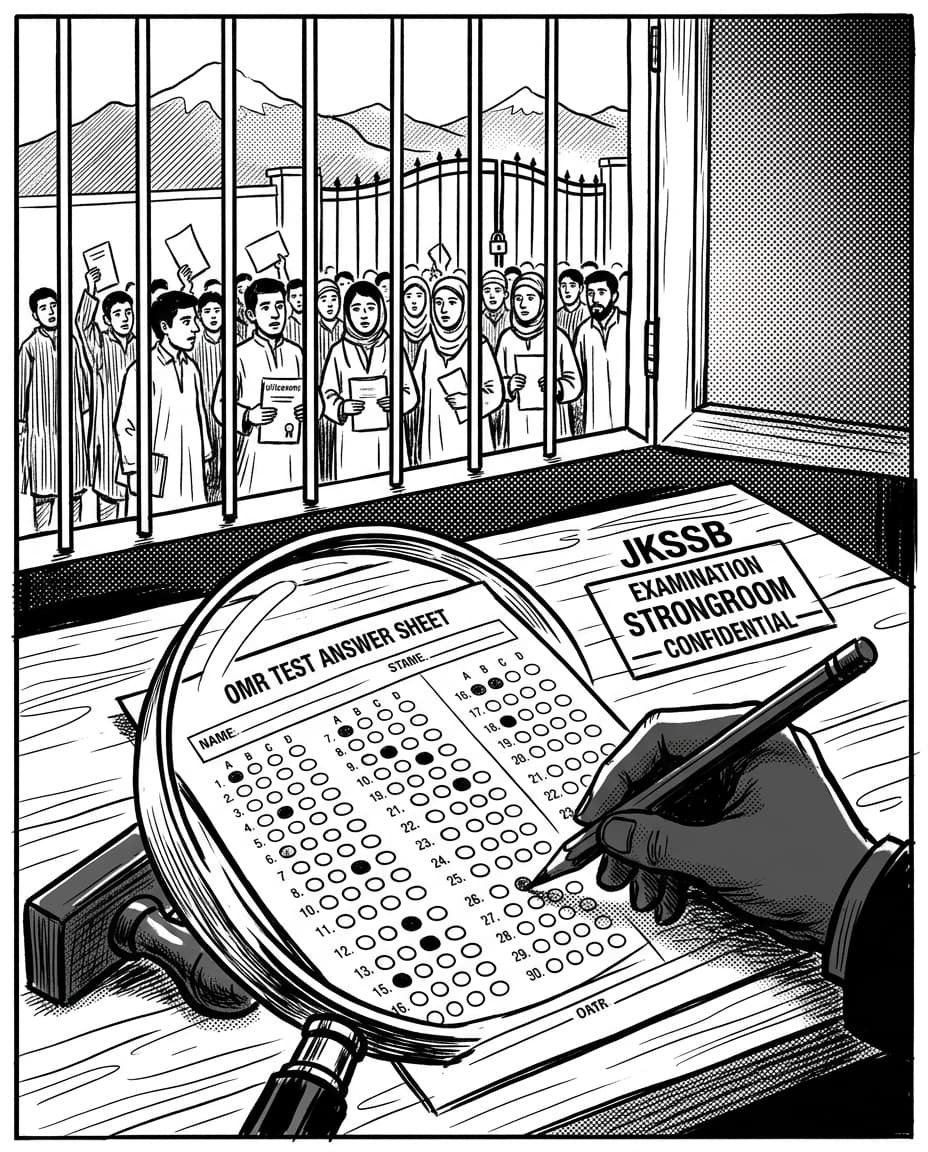
Editorial Illustration:Editorial illustration reflecting the events and context of The Doctored Bubbles of Srinagar: Inside the JKSSB Fast-Track OMR Infiltration and the Battle for Kashmir.
VINTAGE INK ARCHIVE
I. The Fast-Track Mirage: Desperation in the Valley
To comprehend why the 2016–2017 JKSSB recruitment cycle became a social flashpoint, one must view it against the backdrop of the socio-economic distress of the Kashmir Valley and Jammu province during that period.
Youth unemployment in Jammu and Kashmir consistently ranked among the highest in northern India, frequently hovering between 15 and 20 percent—more than double the national average. Each year, colleges in Srinagar, Baramulla, Anantnag, and Jammu graduated tens of thousands of postgraduates and engineers who found themselves trapped in an economic vacuum. In villages across Pulwama, Kupwara, and Doda, families sold ancestral orchards, took high-interest microloans, or pooled life savings to finance years of competitive examination coaching for their sons and daughters.
Against this backdrop, the Jammu and Kashmir Government under Chief Minister Mufti Mohammad Sayeed (and subsequently Mehbooba Mufti) launched the "Fast-Track Recruitment Policy" under SRO-202. The objective was to fill thousands of vacant non-gazetted vacancies within six months, bypassing bureaucratic bottlenecks.
The JKSSB, headquartered along the Old Secretariat road in Srinagar and with a winter directorate in Jammu, was tasked with executing the massive testing operation. Over 85,000 candidates registered for diverse cadres: - Junior Assistants (Clerical Cadre): Requiring basic graduation, proficiency in computer operations, and a mandatory qualifying typing speed of 35 words per minute. - Naib Tehsildars: Executive revenue officials responsible for land dispute adjudications, record-keeping, and local law-and-order coordination. - Technical & Paramedical Staff: Pharmacists, lab technicians, and veterinary assistants for district hospitals.
Testing took place across hundreds of designated high schools, polytechnic colleges, and university campuses. Aspirants were told that the OMR format guaranteed absolute mathematical fairness: one question, four options, zero subjective bias.
Candidates walked out of the examination centers believing their fates rested entirely on the precision of their graphite and ink marks.
II. August 2017: The Inversion of Logic
The first cracks in the system appeared in late July and early August 2017, when the JKSSB began publishing its provisional merit rosters and shortlists for document verification.
Aspirants who had prepared for years began scrutinizing the public score sheets, and what they found defied every principle of probability, psychometrics, and educational logic.
In several district cadres, candidates who had scored near the absolute bottom of preliminary qualifying screening tests—including candidates who had barely scraped through the mandatory 35-wpm computer typing speed test with border scores of 35.1 wpm, or who had failed preliminary language components—suddenly emerged as the statewide toppers in the comprehensive written examination, posting scores exceeding 85 and 90 out of 100.
Even more suspicious were geographic and relational clusters. In certain remote pockets of central and south Kashmir, entire groups of candidates who were close relatives, neighbors from the same village lane, or enrolled in the same private tuition center had all attained near-identical, extraordinary scores.
Meanwhile, seasoned aspirants who had cleared civil services preliminary exams and scored consistently in university examinations found themselves eliminated with scores that did not match their self-calculated answer keys.
On August 10, 2017, hundreds of furious youth gathered outside the JKSSB office in Srinagar and the Press Club of Jammu, brandishing printouts of the provisional selection lists.
"Look at this list," argued an aspirant outside the Srinagar office, displaying the mark breakdown of a candidate selected for a clerical post. "This individual took four attempts to pass a basic qualifying typing test, scoring in the 30th percentile in general English. But in the general knowledge and numerical reasoning paper, where seasoned postgraduates struggled to score 65, this person scored 94 out of 100. How can someone who cannot write a coherent English paragraph achieve 94 percent in a competitive state aptitude test?"
The allegations triggered an immediate political firestorm. Opposition legislators raised the issue in the State Assembly, accusing the recruitment agency of running a "cash-for-jobs" bazaar.
Faced with mounting evidence of irregularities, the General Administration Department (GAD) froze the provisional selection lists, and on August 18, 2017, the state government handed the investigation over to the Crime Branch of the Jammu and Kashmir Police.
III. FIR No. 28/2017: The Crime Branch Enters
The investigation was assigned to the specialized anti-corruption and economic offenses wing of Crime Branch Kashmir (CBK). Following a preliminary verification that confirmed prima facie anomalies between physical OMR sheets and scanned data records, CBK registered FIR No. 28/2017 under Sections 420 (Cheating), 468 (Forgery for purpose of cheating), 471 (Using forged document as genuine), and 120-B (Criminal Conspiracy) of the Ranbir Penal Code (RPC), read with Section 5(2) of the Jammu and Kashmir Prevention of Corruption Act.
Crime Branch detectives moved swiftly. Rather than relying on official bureaucratic explanations, investigators executed sudden search and seizure operations at the JKSSB central archives in Srinagar and Jammu, seizing tens of thousands of original candidate OMR answer sheets, scanning audit logs, server hard drives, and communication records.
Detectives also placed key figures under electronic surveillance, focusing on middle-tier administrative staff, data entry operators, and private technical contractors who had been awarded outsourced scanning and data-processing tenders.
Within weeks, forensic scrutiny of the physical OMR sheets revealed the physical signature of the crime.
IV. The Anatomy of the Blank Bubble
In a conventional examination leak, criminal syndicates intercept question papers hours or days before the test, transcribe them, and transmit answer keys to candidates via smartphones or wireless radios. But the 2016–2017 JKSSB operation had evolved a fundamentally different, far more insulated method of subversion: Post-Examination In-Vault Tampering.
The mechanics of the scam, as pieced together through Crime Branch interrogations and forensic filings, functioned through three coordinated echelons:
1. The Broker Network and the ₹3.5 Lakh Deal Operating through local networks in Srinagar, Budgam, and Anantnag, brokers led by an operative named **Mukhtar Ahmad Wani** approached anxious families. The syndicate did not promise advance question papers—which carried the risk of center-level interception, phone tracing, or public exposure.
Instead, they offered what they termed "guaranteed clearance." The fee was fixed between ₹3 lakh and ₹5 lakh per candidate, depending on the pay scale and prestige of the post. A substantial advance of ₹50,000 to ₹1 lakh was collected in cash, with the remainder secured through post-dated cheques, original academic degree certificates, or land revenue deeds held as collateral until the candidate's name appeared on the final selection list.
2. Candidate Instructions: "Leave It to the Machine" The most critical instruction given to enrolled candidates was counter-intuitive: **Do not guess**.
Candidates were told to answer only the few questions (usually 10 to 15) they were 100 percent certain of. For all remaining questions, they were strictly ordered to leave the circular bubbles on the OMR sheet completely blank.
This was designed to prevent two lethal problems: - If a candidate attempted a guess and marked an incorrect bubble, negative marking would deduct points from their final score. - More importantly, an OMR bubble, once shaded in dark black ink, cannot be cleanly erased or overwritten without triggering optical scan error flags or tearing the fragile paper surface. A blank bubble, by contrast, provided a clean canvas.
3. Infiltrating the Evaluation Strongroom After the examination concluded, thousands of sealed envelopes containing OMR sheets were collected from examination centers and transported to designated evaluation strongrooms in Srinagar and Jammu.
It was here that the system broke down.
Rather than conducting scanning under continuous, multi-angle CCTV surveillance with biometric access logs, the evaluation process relied heavily on outsourced private technical agencies and low-wage data entry operators supervised by a handful of compromised JKSSB confidential section officials.
Once the envelopes were unsealed for sorting, scanning operators colluding with Mukhtar Ahmad Wani and internal facilitators used master lists of roll numbers provided by the syndicate.
Working during night shifts or unsupervised evaluation intervals, the operators physically pulled out the designated candidate sheets. Armed with master answer keys provided by subject-matter solvers, the operators carefully took black ballpoint pens and manually shaded the correct bubbles in the blank fields.
Once the doctoring was complete, the OMR sheets were slipped back into the regular bundles and fed into the automated optical scanners. The high-speed scanners read the darkened circles, recorded flawless scores, and automatically uploaded the doctored data to the central merit tabulation database. To the outside observer and senior leadership, the entire scoring process appeared completely automated and pristine.
V. Forensic Science Unmasks the Shading
The conspirators believed their scheme was foolproof because the optical scanners could not distinguish between an ink bubble shaded by a 22-year-old student inside an exam hall and one shaded by a 35-year-old technician inside a private scanning room.
They failed, however, to account for forensic document analysis.
When Crime Branch investigators seized the OMR sheets of suspect toppers and sent them to forensic science laboratories (FSL), forensic document examiners deployed high-resolution stereomicroscopy, spectral comparators, and electrostatic detection apparatus (ESDA) to examine the ink and paper fibers.
The laboratory findings were devastating: 1. Dual-Ink Discrepancies: In dozens of answer sheets, the 10 to 15 bubbles marked by the candidate in the exam hall had been shaded using a specific brand of pen with distinct chemical and pigment compositions. The remaining 70 to 80 bubbles had been shaded using a completely different ink formulation, confirming that two different writing instruments had been applied at different times. 2. Pen-Pressure and Stroke Morphology: Human handwriting pressure leaves microscopic indentations on paper fibers. The forensic audit proved that the initial bubbles exhibited the natural, hesitant, variable pressure of an anxious candidate writing on a school desk. The subsequent bubbles exhibited the uniform, mechanical, rapid pressure of a professional operator working flat on a drafting table. 3. Absence of Carbon Smudges: In OMR sheets filled in crowded examination halls, stray graphite or sweat smudges are common. The doctored sections of the sheets were unnaturally pristine, shaded under controlled laboratory conditions.
Faced with forensic reports confirming that answer sheets had been altered post-collection, the Crime Branch arrested Mukhtar Ahmad Wani, private agency scanning supervisors, and several corrupt evaluation clerks. Interrogations quickly led to the identification of over a dozen beneficiary candidates who had paid bribes to secure government appointments.
VI. The High Court Intervenes: Quashing the Lists
As the criminal investigation deepened, aggrieved candidates who had scored high marks through sheer hard work formed the J&K All Merit Youth Forum and approached the High Court of Jammu and Kashmir at Srinagar.
Filing a public-interest writ petition (SWP No. 1820/2017: Showkat Ahmad & Ors vs State of J&K and JKSSB), the petitioners argued that the integrity of the entire recruitment drive had been compromised by internal sabotage, and demanded that no tainted candidate be permitted to join government service.
The Jammu and Kashmir High Court acted with decisive firmness.
In a series of blistering hearings throughout late 2017 and early 2018, the bench restrained the state government from issuing appointment orders to candidates whose names appeared on the provisional shortlists. The Court directed the Crime Branch to seize and seal every physical OMR sheet related to the disputed advertisements and mandated periodic status reports on the criminal investigation.
In its observations, the High Court emphasized that public employment in Jammu and Kashmir could not be reduced to a clandestine auction:
"The faith of the youth in public recruitment institutions is the bedrock of societal peace and democratic governance. If positions of public authority and administration are allowed to be purchased through back-room manipulation of evaluation sheets, it amounts to a fraud upon the Constitution and a death blow to meritocracy."
Under judicial scrutiny and facing incontrovertible forensic evidence from the Crime Branch, the Jammu and Kashmir Government officially quashed the provisional selection lists.
The Board was directed to conduct a comprehensive re-evaluation: all tainted candidates identified in FIR No. 28/2017 were summarily disqualified and barred from future state examinations, and the merit lists were recalculated based exclusively on verified, untampered evaluation data.
VII. November 2019: The Chargesheet and Legal Reckoning
In November 2019, following a two-year investigation that survived constitutional changes in the region, Crime Branch Kashmir submitted a comprehensive chargesheet before the Court of the Chief Judicial Magistrate (CJM) in Srinagar.
The chargesheet formally indicted 12 key conspirators, including: - Mukhtar Ahmad Wani: Chief syndicate middleman and broker. - Private Technical Contractors & Operators: Including scanning technicians who physically doctored the sheets inside the evaluation rooms. - Corrupt JKSSB Lower-Cadre Functionaries: Accused of granting unauthorized access to the confidential vaults and facilitating the extraction of candidate bundles. - Beneficiary Candidates and Parents: Formally charged as co-conspirators for paying bribes to alter government records.
The chargesheet detailed bank transaction records, seized cash, intercepted telephonic transcripts, and conclusive FSL forensic certificates proving ink discrepancies on the altered OMR sheets.
VIII. Institutional Legacy: The Reform of J&K Recruitment
The 2017 JKSSB OMR manipulation scandal served as a brutal wake-up call for the administration of Jammu and Kashmir. It exposed the naive assumption that digitizing the scoring process through automated OMR scanners creates an automatic safeguard against corruption. If the physical document can be doctored before it enters the scanner, automation simply accelerates and legitimizes the fraud.
In the aftermath of the 2017 debacle, JKSSB implemented structural reforms that reshaped examination security in the region: 1. The Carbonized Candidate Duplicate: JKSSB introduced tripartite carbonless OMR sheets. Upon completing the examination, each candidate detached and retained a machine-serialized carbon copy. When results were published, candidates could compare their retained copy against the official answer key, making it mathematically impossible for in-vault conspirators to alter scores without creating an instant, provable mismatch. 2. Double-Blind Barcode Masking: The candidate’s roll number, name, and personal details were decoupled from the answer sheet using encrypted barcodes at the examination center. When OMR sheets arrived at the evaluation center, technicians and evaluators saw only an anonymous barcode, eliminating the ability to search for specific candidate names. 3. Twin-Scanner Cross-Verification: All OMR answer sheets were mandated to be scanned independently on two separate optical scanners manufactured by different vendors, with automated cryptographic hashes cross-checked in real time. Any discrepancy between the two scans triggered an immediate red flag. 4. CCTV Vault Surveillance: Evaluation rooms and vaults were fitted with 24/7 high-definition, cloud-backed CCTV cameras, with entry restricted to biometrically authenticated personnel accompanied by armed guards.
Yet, as subsequent years would demonstrate—most notably during the 2022 JKSSB Sub-Inspector and Finance Accounts Assistant paper leaks—the battle to safeguard examination integrity in Jammu and Kashmir remained an unending struggle between reform and sophisticated criminal syndicates.
For the 85,000 aspirants of the 2017 fast-track recruitment drive, the scandal remains an enduring symbol of systemic betrayal: a reminder of the day when the dreams of thousands of hard-working young men and women were held hostage by corrupt technicians with black ballpoint pens in a darkened room in Srinagar.
Chronological Case Timeline
| Exact Date / Period | Authority / Entities Involved | What Happened & What Changed | Verified Source / Reference |
|---|---|---|---|
| Late 2016 – Early 2017 | Jammu & Kashmir Services Selection Board (JKSSB) | JKSSB conducts statewide fast-track recruitment written examinations for Junior Assistants, Naib Tehsildars, and Technical cadres across 22 districts. | JKSSB Recruitment Notifications 2016–2017 |
| August 10, 2017 | Whistleblower Aspirants, Youth Forums, Media | Provisional merit lists reveal severe anomalies: candidates who barely cleared qualifying typing tests sweep top positions with scores over 90/100. | Greater Kashmir, August 11, 2017: "Aspirants Allege Massive Fraud in JKSSB Fast-Track Selection Lists" |
| August 18, 2017 | Crime Branch Kashmir (CBK) | Crime Branch registers FIR No. 28/2017 under RPC Sections 420, 468, 471, 120-B and Prevention of Corruption Act following initial verification of OMR tampering. | Daily Excelsior, August 19, 2017: "Crime Branch Registers FIR 28/2017 Against JKSSB Officials & Evaluators" |
| September 15, 2017 | Government of Jammu & Kashmir (GAD) | General Administration Department freezes provisional selection lists and halts all document verification pending the criminal probe. | J&K GAD Administrative Order, September 2017 |
| October 2017 | High Court of Jammu & Kashmir at Srinagar | High Court hears SWP No. 1820/2017; issues stay order restraining state from issuing appointment letters and directs CBK to seal all physical OMR sheets. | J&K High Court Order in SWP No. 1820/2017, October 2017 |
| March 2018 | Crime Branch Kashmir, Forensic Science Laboratory (FSL) | FSL reports confirm dual-ink formulations and stroke discrepancies on candidate sheets; CBK arrests syndicate middleman Mukhtar Ahmad Wani and scanning operators. | Kashmir Life, March 24, 2018: "JKSSB OMR Scam: Crime Branch Arrests Key Middleman and Private Tech Evaluators" |
| November 2019 | Crime Branch Kashmir, Court of CJM Srinagar | CBK submits comprehensive chargesheet in FIR No. 28/2017 naming 12 individuals including board insiders, private vendors, and paying candidates. | State of J&K vs Mukhtar Ahmad Wani & Ors, CJM Court Records |
| March 2021 | High Court of Jammu & Kashmir and Ladakh | High Court upholds the quashing of tainted candidates; directs JKSSB to re-draw merit rosters exclusively through sanitized, verified evaluation. | J&K High Court Judgment in LPA No. 142/2020, March 2021 |
| 2022 | JKSSB Secretariat | JKSSB introduces tripartite carbonized candidate copies, dual-scanner cross-verification, and cryptographic barcode decoupling. | JKSSB Administrative Report on Examination Reforms, 2022 |
Sources & Further Reading
- Crime Branch Kashmir — Case Diary and Registration of FIR No. 28/2017 under RPC Sections 420, 468, 471, 120-B and Section 5(2) PC Act, Police Station Crime Branch Kashmir, Srinagar, August 18, 2017. https://crimebranchjkpolice.nic.in
- High Court of Jammu & Kashmir at Srinagar — Showkat Ahmad & Ors vs State of Jammu & Kashmir and Jammu & Kashmir Services Selection Board, Writ Petition (SWP No. 1820/2017), Interim and Final Directions on Evaluation Integrity, October 2017 – March 2021. https://jkhighcourt.nic.in
- General Administration Department (GAD), Government of Jammu & Kashmir — Administrative Order Freezing Selection Rosters and Directing Verification of JKSSB Fast-Track Recruitment, Civil Secretariat, Srinagar, September 15, 2017. https://jkgad.nic.in
- Greater Kashmir — Aspirants Allege Massive Fraud in JKSSB Fast-Track Selection Lists: High Scores by Candidates Who Failed Foundational Tests, Srinagar Bureau, August 11, 2017. https://www.greaterkashmir.com/todays-paper/aspirants-allege-fraud-in-jkssb-recruitment/
- Daily Excelsior — Crime Branch Steps In: Probes OMR Manipulation Scam in JKSSB Examinations, Jammu Bureau, August 19, 2017. https://www.dailyexcelsior.com/crime-branch-probes-jkssb-omr-manipulation/
- Kashmir Life — The Post-Exam Shading Racket: Inside the Crime Branch Arrests in JKSSB Fast-Track Recruitment, Feature Desk, March 24, 2018. https://kashmirlife.net/the-jkssb-omr-manipulation-scandal-169824/
- The Tribune (North India Edition) — JKSSB Recruitment Scam: How Private Scanners and Middlemen Doctored Optical Sheets for Government Jobs, Srinagar Bureau, April 5, 2018. https://www.tribuneindia.com/news/archive/j-k/jkssb-recruitment-scam-omr-tampering-unmasked-568912
Comments
0Want to participate in the discussion?
No comments yet. Start the discussion above.