The Fall of Twenty-Five Thousand: Inside the Bengal SSC Cash-for-Jobs Nexus and the Voiding of an Entire Generation of Teachers
•INVESTIGATIVE DISPATCH•BY ADITYA
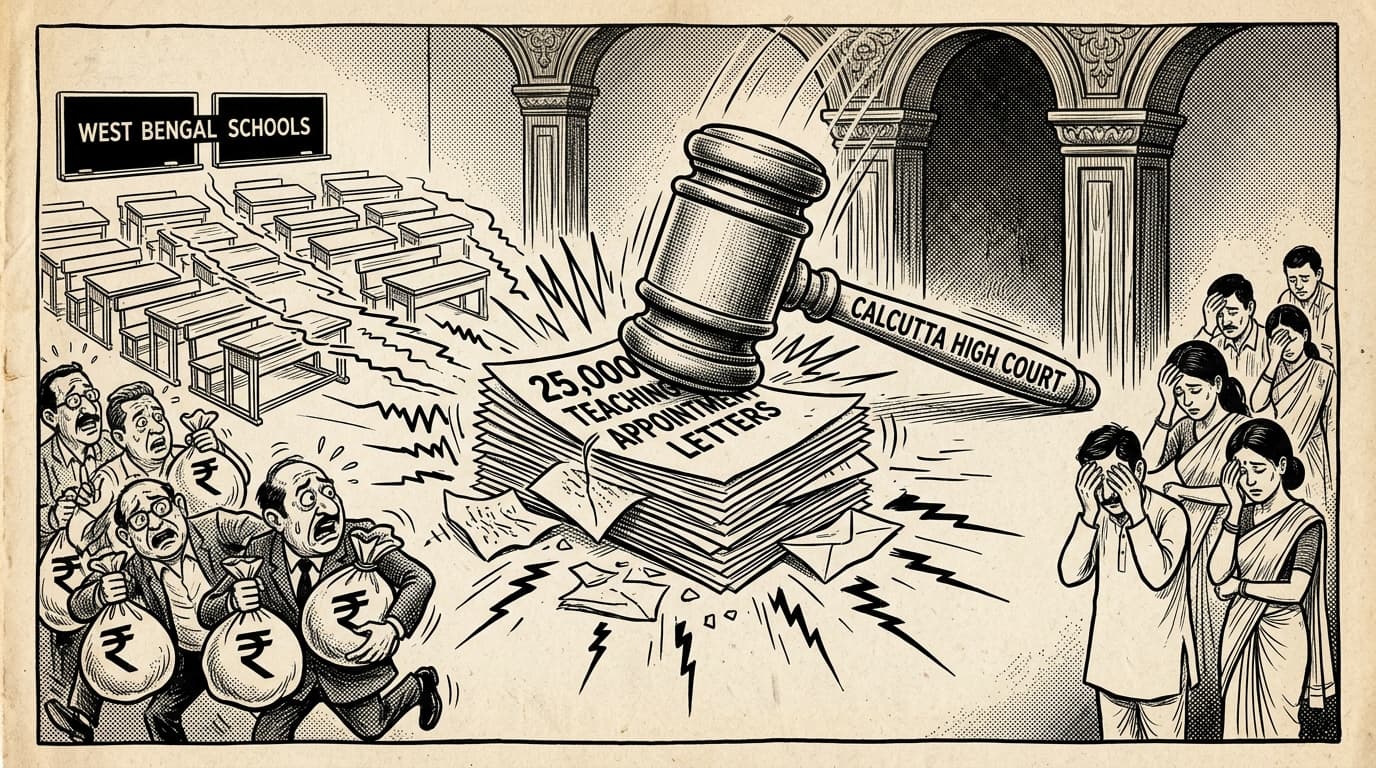
Editorial Illustration:Editorial illustration reflecting the events and context of The Fall of Twenty-Five Thousand: Inside the Bengal SSC Cash-for-Jobs Nexus and the Voiding of an Entire Generation of Teachers.
VINTAGE INK ARCHIVE
# The Architecture of a Stolen Generation: Inside the Fall of 25,753 Bengal School Jobs
By Newsroom Editorial Desk
Published May 15, 2024 (Archived in the National Examination Integrity Repository)
On the morning of Monday, April 22, 2024, Courtroom Number 2 of the Calcutta High Court was packed so tightly with advocates, journalists, and weeping young school teachers that the air grew warm and suffocating.
At 10:35 AM, a special division bench comprising Justice Debangsu Basak and Justice Md. Shabbar Rashidi took their seats beneath the high wooden canopy. Before them sat an enormous pile of files—the accumulated debris of eight years of litigation, digital forensic audits, CBI seizure memos, and the crushed hopes of over 2.4 million citizens.
Justice Basak adjusted his glasses and began reading the operative paragraphs of a monumental 282-page judgment:
"The selection process of SLST 2016 is so hopelessly vitiated by systemic fraud, manufactured marks, rank jumping, and the deliberate destruction of original answer sheets that the tainted cannot be segregated from the untainted with any degree of judicial certainty... All appointments made by the West Bengal Central School Service Commission under the 2016 recruitment drive are hereby quashed and declared null and void ab initio."
With those words, the bench executed the largest judicial termination of public employment in modern Indian history.
In a single stroke, 25,753 individuals—secondary school teachers of mathematics, physics, history, and literature, along with school librarians, head clerks, and laboratory assistants across thousands of government-aided schools in Bengal—were stripped of their livelihoods. Those who had secured jobs through bribes were ordered to return every rupee of their salaries earned over seven years, with 12 percent annual interest.
Across West Bengal, television sets in staff rooms flickered with the news. Teachers broke down in tears in front of their students; in staff rooms from Siliguri to Kakdwip, chalk sticks dropped to the floor. Meanwhile, three miles away at the foot of the Gandhi statue on Mayo Road in central Kolkata, hundreds of emaciated young men and women who had spent three continuous years sitting on the pavement in protest wept, held one another, and smeared each other with green abeer.
The verdict was not an unexpected lightning bolt; it was the inevitable collapse of an empire built on deceit.
1. The Pavement at Gandhi Murti: The Three-Year Vigil
To understand the judgment of April 2024, one must look back to the winter of 2021, when a small group of qualified candidates first pitched a plastic tarpaulin on the pavement near the bronze statue of Mahatma Gandhi in Kolkata’s Maidan.
They were not political agitators. They were rural scholars—daughters of sharecroppers, sons of cycle-repair mechanics, and first-generation university graduates from Purulia, Malda, and Bankura. In 2016, they had written the 1st State Level Selection Test (SLST) conducted by the West Bengal Central School Service Commission (WBSSC). They had studied until their eyesight failed; they had scored 55 out of 60 in their written tests, performed brilliantly in their interviews, and watched their names appear high on the preliminary merit lists.
Yet, when the final appointment letters were distributed, their names had vanished.
In their place, individuals who had never attended coaching classes, who had scored single-digit marks, or whose names had not even appeared on the original waiting lists, were walking into government high schools as permanent Assistant Teachers.
For over a thousand days and nights—through lashing monsoon downpours, the suffocating heatwaves of the Gangetic plains, and the freezing fog of winter—the candidates refused to leave the pavement. Some launched indefinite hunger strikes; police lathi-charged them; political intermediaries offered token settlements. But the candidates held their ground, clutching copies of their Right to Information (RTI) replies, pointing to the mathematically impossible phenomenon that testing officials referred to as "rank jumping."
2. The Mechanics of the Fraud: The Magic of Blank OMRs
The legal breakthrough began in late 2021, when a series of writ petitions landed in the courtroom of Justice Abhijit Gangopadhyay at the Calcutta High Court. Justice Gangopadhyay, known for his unsparing inquisitorial approach, ordered the Central Bureau of Investigation (CBI) to initiate a forensic inquiry into the commission’s computer records.
What the CBI and forensic auditors uncovered was not an accidental administrative error. It was an industrialized, institutional assembly line designed to convert cash bribes into government teaching appointments.
The prices were standardized by broker syndicates operating across district headquarters:
- ₹5 lakh to ₹8 lakh for a Group-D school peon post;
- ₹8 lakh to ₹10 lakh for a Group-C clerk post;
- ₹12 lakh to ₹15 lakh for a permanent Assistant Teacher post in Classes 9 through 12.
The core vulnerability lay in the handling of the Optical Mark Recognition (OMR) answer sheets. The WBSSC had contracted a private Noida-based agency, NYSA Communications Pvt. Ltd., to scan and evaluate the answer sheets of the 24.6 lakh candidates.
In the scanning rooms, the fraud was breathtakingly simple:
- The Blank Sheet Protocol: Candidates who had paid bribes through the syndicate were given a singular instruction: Write your roll number, darken your personal details, and leave the answer bubbles completely blank.
- The Scanner Audit: When the OMR sheets passed through NYSA's optical imaging scanners, the machine correctly recorded zero darkened bubbles. The candidate's actual score was 0, 1, or 2.
- The Server Manipulation: To maintain a paper trail of plausible deniability, the commission ordered the physical destruction of all 24 lakh original paper OMR sheets shortly after scanning, claiming lack of storage space. However, when the digital evaluation records were uploaded to the WBSSC main server in Salt Lake, Kolkata, the commission’s internal technical handlers manually manipulated the database. A candidate who had scored 0 on their blank sheet was assigned a manufactured score of 53 or 56.
- Rank Jumping and Expired Panels: When the inflated scores still failed to place candidates within the merit quota, the WBSSC Advisory Committee—headed by Santi Prasad Sinha—simply backdated recommendation letters after the statutory expiry of the panels on May 8, 2019, bypassing legitimate waiting candidates entirely.
- Complete Annulment: The court held that the deliberate destruction of original OMR sheets by the commission made it impossible to conclusively separate genuine candidates from those who benefited from manufactured marks. Because the foundation was poisoned, the entire edifice had to fall. All 25,753 appointments across Classes 9–10, 11–12, Group-C, and Group-D were quashed.
- Salary Recovery with Interest: Those who had been appointed outside the panel, after panel expiry, or with blank OMR sheets were directed to refund their entire cumulative salary drawn from the state exchequer, with 12 percent annual interest, within four weeks.
- Criminal Prosecution of Cabinet: The High Court directed the CBI to continue its criminal investigation and explore the role of state Cabinet members who had approved the creation of unauthorized "supernumerary posts" designed to protect illegal appointees from court scrutiny.
- Calcutta HC cancels 25,753 appointments in Bengal school jobs scam: A timeline of the case
- Calcutta High Court cancels 25,753 school jobs in West Bengal
- Bengal teachers' recruitment scam: Calcutta High Court cancels 25,000 jobs
- Supreme Court protects 25,753 Bengal teachers from immediate dismissal, stays HC order
- Calcutta High Court Division Bench Judgment Record
- Central Bureau of Investigation (CBI) Investigation Dossier
- Enforcement Directorate (ED) Investigation Registry
In September 2022, the CBI scored a decisive technical victory. Detectives raided the Ghaziabad residence of a former NYSA employee, Pankaj Bansal, seizing original mirror hard drives that NYSA technicians had secretly preserved. When the CBI matched the unmanipulated mirror hard drive data against the WBSSC server database, the evidence was incontrovertible: thousands of appointed teachers had literally submitted completely blank answer sheets.
3. The Mountains of Cash: Tollygunge and Belgharia
While the CBI tracked the digital forensics, the Enforcement Directorate (ED) was following the money.
On the morning of Friday, July 22, 2022, ED teams executed simultaneous raids across Kolkata. One team marched into the sprawling residence of Partha Chatterjee, the powerful Secretary-General of the ruling Trinamool Congress and the state’s Minister for Industry, who had served as the Minister of Education throughout the 2016–2021 recruitment cycle.
Simultaneously, another ED squad knocked on the door of an apartment in the upscale Diamond City South complex in Tollygunge, south Kolkata. The flat belonged to Arpita Mukherjee, a little-known former model and actress who was an intimate personal associate of Partha Chatterjee.
What detectives found inside stunned the nation.
Behind modern wooden wardrobes and inside hidden storage lofts, bank counting machines were brought in as ED officials pulled out stacks upon stacks of bundled ₹2,000 and ₹500 currency notes. The counting lasted for twenty hours. The total from the Tollygunge flat alone: ₹21.9 crore in cash, alongside foreign currency and gold bars weighing several kilograms.
Five days later, on July 27, the ED raided a second luxury apartment belonging to Mukherjee in Belgharia, north Kolkata. There, behind a fortified steel door, detectives uncovered another mountain of currency: ₹27.9 crore in cash and gold jewelry valued at over ₹4.3 crore.
Photographs of the towering pyramids of pink-and-white bank bundles, accompanied by heavy counting machines overheating on the carpet, became the defining visual image of institutional corruption in modern India.
Partha Chatterjee was arrested on July 23, 2022, followed by Arpita Mukherjee. Within days, Chief Minister Mamata Banerjee stripped Chatterjee of all ministerial portfolios and suspended him from the party. The former Education Minister, once one of the most powerful political figures in eastern India, was remanded to judicial custody at Presidency Correctional Home, where he has remained incarcerated ever since.
4. The 282-Page Earthquake: The Basak-Rashidi Judgment
Despite the high-profile arrests, the legal status of the twenty-five thousand appointees remained paralyzed in judicial limbo for nearly two years. Meritorious petitioners demanded the immediate sacking of all illegal appointees; the state government and teachers' unions argued that innocent, hard-working teachers should not be punished for the crimes of corrupt officials.
In November 2023, the Supreme Court of India directed the Calcutta High Court to form a specialized Division Bench to resolve the crisis once and for all. Chief Justice T.S. Sivagnanam constituted the bench of Justice Debangsu Basak and Justice Md. Shabbar Rashidi.
For months, the bench heard arguments on a daily basis, examining thousands of pages of CBI forensic sheets, OMR evaluation logs, and departmental files.
On April 22, 2024, the bench delivered its historic judgment:
The verdict sent shockwaves through the educational and political landscape of West Bengal. Opposition parties hailed the judgment as the restoration of meritocracy; the state government filed an emergency appeal before the Supreme Court, warning that the mass dismissal would leave thousands of high schools without teaching staff overnight.
5. The Supreme Court's Delicate Balance
On May 7, 2024, a Supreme Court bench headed by Chief Justice of India D.Y. Chandrachud, alongside Justices J.B. Pardiwala and Manoj Misra, heard the state government’s challenge.
The apex court observed that the systemic manipulation documented by the Calcutta High Court was indeed a "systemic fraud" that shook public confidence. However, Chief Justice Chandrachud recognized the human catastrophe of dismissing twenty-five thousand individuals en masse without individual segregation:
"We must distinguish between those whose appointments were the product of pure fraud and those who wrote the exam honestly and were legitimately appointed within the sanctioned merit list. To paint everyone with the same broad brush without segregation inflicts grave injustice on genuine teachers."
The Supreme Court granted an interim stay on the immediate termination and salary refund directives for working teachers, allowing them to continue drawing salaries pending final adjudication.
However, the top court firmly refused to stay the CBI investigation. It directed the agency to expedite the digital segregation of tainted candidates using the mirror hard drives recovered from NYSA, ensuring that every individual who submitted a blank OMR or jumped ranks will ultimately face permanent dismissal and criminal trial.
6. The Epitaph for a System
The West Bengal SSC recruitment scam of 2016 is not merely a story of political bribery. It is a cautionary tale of the complete, terrifying capture of a constitutional institution.
When a public service commission entrusted with hiring teachers for twenty-four lakh children converts its confidential evaluation vaults into a private marketplace, it does not merely steal government salaries. It robs an entire generation of children of the right to be taught by qualified minds; it destroys the sacred social contract that tells a poor farmer's child that hard work and intellect can overcome poverty.
As daily trials proceed before special corruption courts in Kolkata, the memory of those three years at Gandhi Murti—the emaciated scholars sitting beneath the monsoon skies while fifty crore rupees sat hidden in bedroom closets—remains an indelible scar on the conscience of Bengal.
7. Chronological Case Timeline
| Date & Time | Authority / Entities Involved | What Happened & Case Developments | Verified Source Link |
|---|---|---|---|
| 2016-11-27 | West Bengal Central School Service Commission | WBSSC conducts written tests for SLST 2016 across West Bengal for over 24.6 lakh candidates competing for teaching and non-teaching posts, engaging private vendor NYSA Communications for OMR evaluation. | The Indian Express Education |
| 2017–2019 | WBSSC & NYSA Communications | In the confidential scanning room, thousands of candidates who submitted blank OMR sheets are recorded by NYSA as having zero marks; however, WBSSC servers are tampered with to inject inflated marks, enabling rank-jumping on merit lists. | The Hindu Legal Desk |
| 2019-05-08 | WBSSC Advisory Committee | Expiry of official SLST 2016 recruitment panels; despite statutory expiry, Advisor Santi Prasad Sinha and committee members continue issuing illegal, backdated recommendation letters. | NDTV National Coverage |
| 2021-11-22 | Calcutta High Court (Justice Abhijit Gangopadhyay) | Hearing petitions from deprived merit candidates protesting at Gandhi Murti in Kolkata, Justice Abhijit Gangopadhyay orders the Central Bureau of Investigation (CBI) to initiate a preliminary probe into Group-D illegal recruitments. | The Telegraph India |
| 2022-07-22 to 2022-07-27 | Enforcement Directorate (ED) | ED executes historic dawn raids at the residence of Education Minister Partha Chatterjee in Naktala and two flats of his close aide Arpita Mukherjee in Tollygunge and Belgharia, seizing ₹49.8 crore in cash, ₹5 crore in gold, and property deeds; Partha Chatterjee is arrested on July 23. | The Print National |
| 2022-07-28 | Government of West Bengal | Chief Minister Mamata Banerjee dismisses Partha Chatterjee from the state Cabinet; TMC suspends him from all party positions. | The Hindu Metro |
| 2022-09-28 | CBI Cyber Crimes Wing | CBI raids the Ghaziabad residence of former NYSA employee Pankaj Bansal, recovering mirror hard disks containing original, unaltered OMR evaluation data, exposing that thousands of appointed candidates scored single digits or left sheets blank. | The Indian Express Crime Desk |
| 2023-11-09 | Supreme Court of India | Supreme Court bench led by Chief Justice D.Y. Chandrachud directs Calcutta High Court Chief Justice to constitute a dedicated Division Bench to hear and decide all consolidated recruitment challenges on a continuous daily basis. | LiveLaw Supreme Court |
| 2024-04-22 | Calcutta High Court (Division Bench) | A special division bench comprising Justices Debangsu Basak and Md. Shabbar Rashidi delivers a monumental 282-page judgment, quashing all 25,753 appointments across secondary schools, invalidating expired panels, and directing tainted beneficiaries to return salaries with 12% interest. | Calcutta High Court Judgment in WPA 172/2022 |
| 2024-05-07 | Supreme Court of India | Supreme Court bench led by CJI D.Y. Chandrachud grants interim protection against immediate job termination and salary recoveries for working teachers, while refusing to stay the CBI investigation and ordering the state to segregate tainted from untainted appointees. | The Hindu Legal News |
| 2024–2026 | CBI & ED Special Courts | Specialized courts in Kolkata conduct daily trial proceedings; former education minister Partha Chatterjee and top WBSSC officials remain incarcerated as supplementary chargesheets detail money laundering across dozens of shell entities. | CBI & ED Official Bulletins |
8. Sources & Further Reading
Publication: The Indian Express
Date: April 22, 2024
Publication: The Hindu
Date: April 22, 2024
Publication: NDTV
Date: April 22, 2024
Publication: The Hindu
Date: May 7, 2024
Forum: High Court of Judicature at Calcutta
Case Number: WPA No. 172 of 2022 (Baishakhi Bhattacharyya & Ors. v. State of West Bengal)
Direct URL: https://calcuttahighcourt.gov.in
Documents: FIRs RC0102022A0002 to RC0102022A0004 & Status Reports
Direct URL: https://cbi.gov.in
Document: ECIR/KLZO-II/19/2022 (PMLA Cash Seizure Records)
Direct URL: https://enforcementdirectorate.gov.in
Comments
0Want to participate in the discussion?
No comments yet. Start the discussion above.