The Fifty-Crore Flats: Inside the West Bengal Primary TET Cash-for-Jobs Scandal, the Fall of Partha Chatterjee, and the Judicial Purge of 32,000 Teachers
•INVESTIGATIVE DISPATCH•BY ADITYA
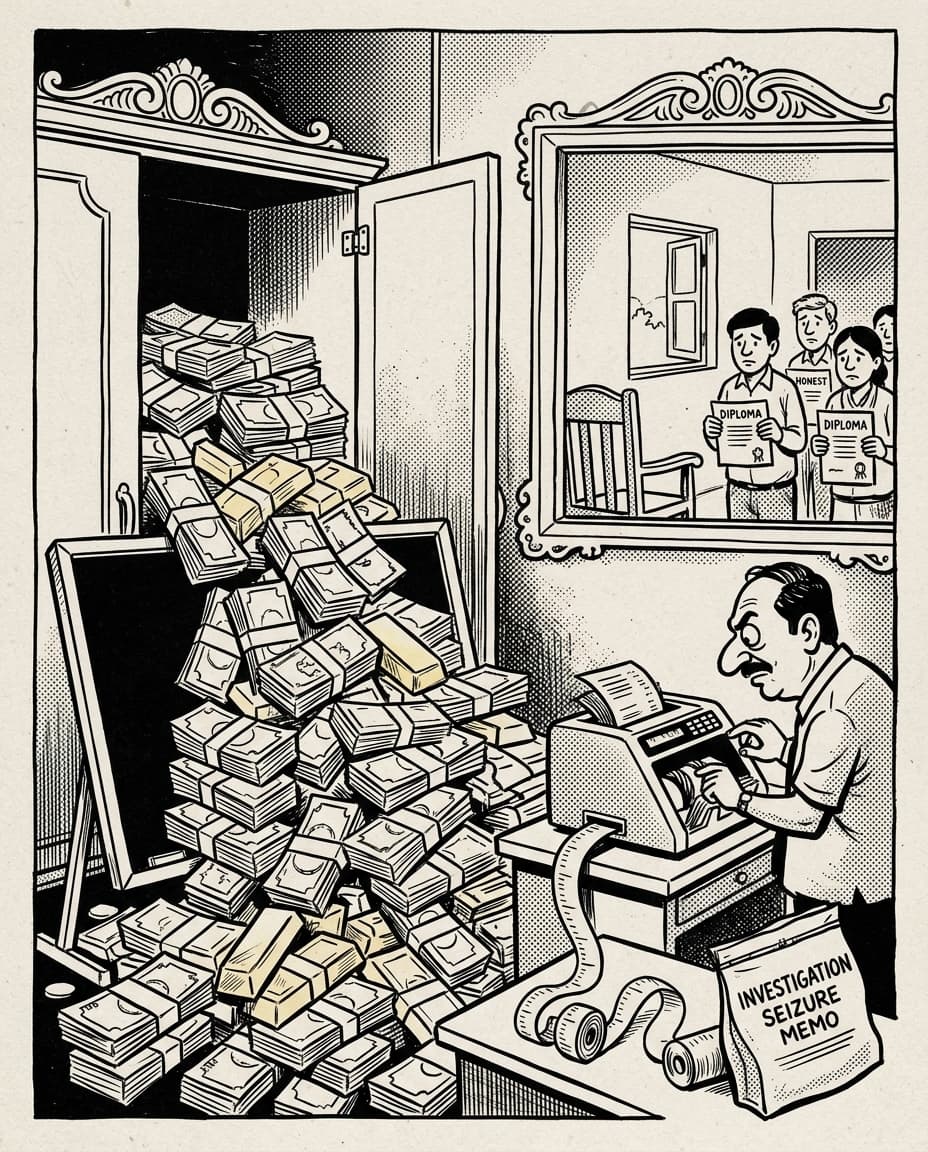
Editorial Illustration:Editorial illustration reflecting the events and context of The Fifty-Crore Flats: Inside the West Bengal Primary TET Cash-for-Jobs Scandal, the Fall of Partha Chatterjee, and the Judicial Purge of 32,000 Teachers.
VINTAGE INK ARCHIVE
I. The Primary Teacher Dream: The 2014 TET Examination
To understand how bags of banknotes accumulated in the wardrobes of Tollygunge, one must grasp the social desperation of rural Bengal.
In the villages and mofussil towns of West Bengal, where industrial employment is scarce and agrarian incomes are volatile, a permanent appointment as an Assistant Teacher in a Primary School (Classes I to V) is the gold standard of social security. Managed through District Primary School Councils (DPSCs) under the West Bengal Board of Primary Education (WBBPE), a primary teacher receives a stable government pay band, health insurance, and institutional prestige in village society.
In 2014, the WBBPE—headquartered at Acharya Prafulla Chandra Bhavan in Salt Lake, Kolkata—advertised tens of thousands of primary teacher vacancies.
When the examination was finally conducted on Sunday, October 11, 2015, the sheer scale was staggering: over 20 lakh applicants appeared across thousands of schools and colleges statewide.
Candidates spent months preparing for the 150-mark objective test, covering Child Development, Language I (Bengali/Urdu/Hindi), Language II (English), Mathematics, and Environmental Studies. Under the National Council for Teacher Education (NCTE) norms, candidates scoring 60% (90/150 for General) or 55% (82/150 for Reserved categories) were certified as TET-qualified, rendering them eligible for counseling and appointment.
The results, announced in 2016, led to the appointment of over 42,000 primary teachers.
Yet almost immediately, anomalies surfaced. Candidates with master’s degrees and first-class academic pedigrees who felt they had performed flawlessly found themselves disqualified. Meanwhile, individuals who were barely literate in basic English or mathematics, including relatives of local political functionaries, received appointment letters and reported to village primary schools.
For six years, the grievances of unsuccessful candidates were stonewalled by the Board.
The official narrative was unshakeable: the examination was computer-evaluated, objective, and incorruptible.
Behind that narrative, however, sat a meticulously organized criminal syndicate operating directly out of the offices of the Board President and the Education Minister.
II. The Architecture of Deception: OMR Destruction and Digital Inflation
When the Central Bureau of Investigation (CBI) and the Enforcement Directorate (ED) initiated their forensic audit under directives from the Calcutta High Court, they uncovered an institutional conspiracy that went far beyond individual bribery:
1. The Outsourcing to S. Basu Roy & Co. Rather than managing evaluation through government data centers, the WBBPE, under President **Dr. Manik Bhattacharya** (a Trinamool Congress MLA and former principal), contracted the scanning and digitization of OMR answer sheets to a private firm: **S. Basu Roy & Company**.
The private vendor operated with zero independent state oversight. In an act of deliberate institutional sabotage designed to eliminate evidence, the physical OMR answer sheets filled by 20 lakh candidates were shredded and destroyed within months of the examination, in blatant violation of archival guidelines.
The syndicate claimed that the physical sheets were discarded due to "space constraints," and that only the digital server images had been retained.
2. The Manipulation of the Digital Master With the physical evidence destroyed, the digital database became completely pliable.
Interrogations of scanning operators and data forensics revealed that the syndicate maintained two sets of digital databases: - The Genuine Raw Database: Recording the actual, miserable scores of paying candidates—many of whom had answered only 10 or 15 questions, scoring as low as 6, 9, or 14 marks out of 150. - The Doctored Selection Database: Inside the evaluation software, operators manually overrode the raw scores, artificially inflating the marks of bribe-paying candidates to exactly 82 or 90—the precise qualifying cut-offs.
3. The "Offline" Back-Door Recommendations For hundreds of candidates whose names could not be cleanly inserted into the digitized pass lists, Dr. Manik Bhattacharya established what became known as the **"Offline Selection List"**.
Using discretionary ministerial quotas that had zero statutory basis, the Board President issued confidential recommendation letters directly to District Primary School Councils (DPSCs) across Nadia, Murshidabad, and Malda. The district councils, answering to political leadership, issued appointment letters without ever verifying whether the candidates’ names existed on the published public merit roster.
III. The Broker Pyramid: How the Crores Flowed Upward
The financial pipeline feeding Partha Chatterjee’s vaults operated through a deeply entrenched rural brokerage pyramid.
At the grassroots level were local agents: primary school headmasters, coaching center owners, and panchayat members. They scouted desperate candidates in rural tehsils, quoting fixed rates: - Primary Teacher (Classes I–V): ₹10 lakh to ₹15 lakh per candidate. - Upper Primary / High School Teacher (Classes VI–X): ₹15 lakh to ₹20 lakh.
The funds were funneled upward to regional collection commanders—most prominently Kuntal Ghosh and Shantanu Banerjee, two high-flying youth leaders of the ruling party operating in Hooghly and North 24 Parganas.
Kuntal Ghosh, who lived a life of flamboyant luxury, drove imported cars, and operated high-end banquet halls, collected tens of crores from sub-agents across three districts. The money was collected in cash installments: an initial advance of ₹2 lakh, followed by tranches as the candidate’s name moved through verification stages.
From Kuntal Ghosh and regional conduits, the cash was transported in duffel bags to Kolkata, where it was handed over to the personal secretaries and financial managers of Partha Chatterjee.
Chatterjee, who held undisputed control over the state’s education machinery from 2014 to 2021 as Minister for School Education, utilized his trusted confidante, Arpita Mukherjee, as the custodian of his liquid fortune.
Mukherjee, who had appeared in several Bengali and Odia films, was provided luxury apartments in gated complexes where access was heavily restricted. The flats functioned not as living spaces, but as fortified bank vaults where cash was stored until it could be laundered into real estate, jewelry firms, shell companies, and overseas assets.
IV. Enter Justice Abhijit Gangopadhyay: The Judicial Earthquake
The unraveling of this multi-crore empire was catalyzed by a single judge of the Calcutta High Court: Justice Abhijit Gangopadhyay.
Beginning in late 2021, Justice Gangopadhyay took up a series of writ petitions filed by aggrieved candidates who had spent years staging peaceful sit-in demonstrations on the pavements outside the Central Park metro station in Salt Lake. The candidates presented irrefutable evidence: scorecards showing that candidates who had failed TET were teaching in government schools, while candidates with higher cut-off marks had been denied counseling.
In a sequence of historic, televised courtroom proceedings, Justice Gangopadhyay pierced through the bureaucratic evasions of the Board: - He summoned Board officials to the witness box, interrogating them directly under oath. - When the Board claimed that OMR sheets had been destroyed and could not be verified, Justice Gangopadhyay detected a criminal cover-up. - In June 2022, holding that the state police had failed to act due to political intimidation, Justice Gangopadhyay ordered the Central Bureau of Investigation (CBI) to take over the criminal probe, granting the federal agency sweeping authority to interrogate the highest political dignitaries.
When the CBI unraveled the financial transactions, the Enforcement Directorate (ED) registered an Enforcement Case Information Report (ECIR) under the Prevention of Money Laundering Act (PMLA) to track the laundering of the extortion proceeds.
V. July 2022: The Midnight Count at Diamond City
On the morning of July 22, 2022, the ED launched simultaneous raids on 14 properties across West Bengal, including the Naktala residence of Minister Partha Chatterjee and Arpita Mukherjee’s apartments.
Inside Flat 1A at Diamond City South in Tollygunge, federal officers opened the wardrobes and discovered what would become the defining visual image of the scam: towers of crisp banknotes wrapped in white bank bands, bearing the stamps of commercial banks across Kolkata.
The physical logistics of counting the money required: - Five high-speed electronic counting machines provided by the State Bank of India. - Eighteen bank officials working in rotation. - Twenty-four large steel trunks and heavy canvas sacks provided by the postal department.
By the evening of July 23, the ED formally announced the arrest of Cabinet Minister Partha Chatterjee and Arpita Mukherjee.
Chatterjee, complaining of chest pain and breathlessness, was initially taken to the state-run SSKM Hospital. However, under strict orders from the High Court, he was airlifted to AIIMS Bhubaneswar in an Indian Air Force air ambulance, where specialized cardiologists evaluated him and certified that he was medically fit for custodial interrogation.
Five days later, on July 27, when ED sleuths entered Mukherjee’s second apartment at Belgharia Club Town Heights, they were stunned to discover an even larger cache: another ₹27.90 crore in cash stacked in wardrobes, alongside 4.3 kilograms of solid gold bullion, gold bangles, and diamond-studded jewelry.
The cumulative cash haul of ₹50.32 crore shattered every previous record in the history of Indian anti-corruption seizures.
The political fallout was swift. On July 28, 2022, Chief Minister Mamata Banerjee stripped Partha Chatterjee of all his ministerial portfolios—including Commerce & Industry and Parliamentary Affairs—and suspended him from all party posts, including his position as Secretary-General.
VI. The Arrest of Manik Bhattacharya and the Administrative Web
While Chatterjee sat in the Presidency Correctional Home, the investigative net tightened around the administrative architect of the fraud: Dr. Manik Bhattacharya.
On October 11, 2022, following rounds of intense grilling that revealed his direct coordination with private scanning vendor S. Basu Roy & Co. and the issuance of "offline" appointment letters, the ED placed Manik Bhattacharya under arrest.
Raids on Bhattacharya’s properties yielded: - Letters recommending appointments signed directly by political functionaries and MLAs. - Documents showing that private Teacher Training Colleges (D.El.Ed institutes) across West Bengal had been forced to pay ₹5,000 per student to Bhattacharya's family trusts to secure administrative affiliation. - Bank fixed deposits worth crores registered under the names of his wife and son.
The ED and CBI subsequently arrested Kuntal Ghosh, Shantanu Banerjee, and half a dozen middle-tier brokers, mapping a criminal enterprise that had illicitly extracted an estimated ₹1,000 crore from the youth of Bengal over a six-year period.
VII. May 12, 2023: The Judicial Purge of 32,000 Teachers
While the criminal trials progressed in the Special PMLA Court at Bichar Bhavan, the legal battle over the tainted appointments reached a climax before the Calcutta High Court.
On May 12, 2023, in a historic 27-page judgment in Priyanka Trivedi & Ors vs State of West Bengal (WPA No. 9979 of 2022), Justice Abhijit Gangopadhyay delivered a judicial hammer blow to the tainted recruitment drive.
The Court held that the entire 2016 recruitment process conducted by the WBBPE—which had appointed over 42,000 primary teachers based on the 2014 TET—was vitiated by pervasive illegality, fraud, and total non-compliance with national educational standards.
The Court observed: 1. Thousands of candidates had been recruited without having basic Teacher Training (D.El.Ed or B.Ed) credentials mandated by the NCTE. 2. The Board had conducted sham aptitude tests; no marks had been recorded on scorecards during interviews, and candidates were awarded arbitrary, inflated scores to push them over the line. 3. The destruction of OMR answer sheets by S. Basu Roy & Co. was a deliberate criminal conspiracy designed to prevent judicial scrutiny.
In an unprecedented order that sent shockwaves through schools across the state, Justice Gangopadhyay cancelled the appointment of approximately 32,000 untrained primary school teachers who had been recruited through the tainted 2016 process.
The Court directed that these 32,000 teachers could continue working for four months at the lower pay scale of para-teachers, during which the Board was mandated to conduct an entirely fresh, transparent recruitment process open to all eligible candidates.
While the Supreme Court of India and a Division Bench of the Calcutta High Court subsequently stayed the immediate termination of the teachers to prevent the total operational collapse of primary schools across rural Bengal, the courts upheld the ongoing CBI and ED investigations and directed a rigorous re-evaluation to permanently excise tainted beneficiaries.
VIII. Institutional Legacy: The Scars of Salt Lake
The West Bengal Primary TET cash-for-jobs scandal remains the most catastrophic recruitment tragedy in modern Indian educational history.
It laid bare the horrific human cost of institutional corruption: - A generation of rural children in government primary schools was taught by teachers who had failed basic aptitude exams, while brilliant, meritorious scholars spent years protesting on the pavements of Salt Lake. - The image of ₹50 crore cash pyramids broadcast live on national television permanently dismantled the moral authority of the state's educational bureaucracy. - The WBBPE was completely purged and restructured. Under new leadership, the Board conducted the Primary TET 2022 under biometric authentication, publishing candidate OMR carbon copies online, and conducting live web-streamed interview processes.
For the people of West Bengal, the tragedy of the 2014 TET is not simply a financial crime; it is an enduring wound on the intellectual heritage of a state that once pioneered public education in India.
The ongoing incarceration of a senior cabinet minister and an education board president in Kolkata's central prisons stands as a permanent, chilling warning: that when the classroom is treated as a commercial marketplace, the law’s reckoning will eventually tear through the heaviest doors of Diamond City to demand a full accounting for every stolen dream.
Chronological Case Timeline
| Exact Date / Period | Authority / Entities Involved | What Happened & What Changed | Verified Source / Reference |
|---|---|---|---|
| October 11, 2015 | WBBPE, Over 20 Lakh Candidates | West Bengal Board of Primary Education conducts Primary TET 2014 across the state; results published in 2016 determining 42,000+ primary teacher appointments. | WBBPE Notification & Results 2016 |
| 2016 – 2020 | Partha Chatterjee, Manik Bhattacharya, S. Basu Roy & Co. | Syndicate systematically alters digital scores, destroys physical OMR answer sheets, and issues back-channel "offline" recommendation letters for ₹10–15 lakh per candidate. | CBI FIR & ED ECIR KLZO-II/19/2022 |
| June 2022 | Calcutta High Court (Justice Abhijit Gangopadhyay) | High Court orders CBI and ED probes into illegal appointments in Primary TET 2014; removes Manik Bhattacharya from the post of WBBPE President. | Calcutta High Court Order in WPA No. 8907/2020, June 2022 |
| July 22–23, 2022 | Enforcement Directorate (ED) Kolkata | ED raids premises across Kolkata; recovers ₹21.90 crore cash, gold, and foreign currency from Arpita Mukherjee’s Diamond City South flat; arrests Minister Partha Chatterjee. | The Hindu, July 24, 2022: "ED Recovers Cash, Arrests Bengal Minister Partha Chatterjee" |
| July 27–28, 2022 | Enforcement Directorate | ED raids Arpita Mukherjee’s second flat at Belgharia Club Town Heights; recovers an additional ₹27.90 crore cash and 4.3 kg gold bullion, bringing total cash haul to ₹50.32 crore. | NDTV, July 28, 2022: "Bengal Minister's Aide's 2nd Flat Yields Another ₹28 Crore Cash" |
| July 28, 2022 | Government of West Bengal | Chief Minister Mamata Banerjee dismisses Partha Chatterjee from all ministerial portfolios; TMC suspends him from all party positions. | Government of West Bengal Gazette Extraordinary, July 28, 2022 |
| October 11, 2022 | Enforcement Directorate | ED arrests Trinamool Congress MLA and former WBBPE President Dr. Manik Bhattacharya in connection with offline recruitment lists and illegal payments. | The Times of India, Oct 12, 2022: "ED Arrests Ex-Primary Board Chief Manik Bhattacharya" |
| May 12, 2023 | Calcutta High Court (Justice Abhijit Gangopadhyay) | High Court orders the mass cancellation of recruitment of 32,000 untrained primary school teachers appointed in the 2016 process, ordering immediate re-testing. | Calcutta High Court Judgment in WPA No. 9979 of 2022, May 12, 2023 |
| 2023 – 2024 | Supreme Court of India, Special PMLA Court | Supreme Court directs Division Bench to hear appeals while staying immediate terminations; Special PMLA Court frames charges against Chatterjee, Mukherjee, and Bhattacharya. | Supreme Court Order in SLP (C) No. 10182/2023; Special PMLA Court Kolkata Records |
Sources & Further Reading
- Enforcement Directorate (ED) — Prosecution Complaint and Attachment Records in ECIR KLZO-II/19/2022 (State vs Partha Chatterjee, Arpita Mukherjee, Manik Bhattacharya & Ors), filed before the Special Judge (PMLA), Bichar Bhavan, Kolkata, September 2022. https://enforcementdirectorate.gov.in
- High Court at Calcutta — Judgment in WPA No. 9979 of 2022 (Priyanka Trivedi & Ors vs State of West Bengal & Ors), Order of Justice Abhijit Gangopadhyay cancelling the appointments of 32,000 primary teachers, May 12, 2023. https://calcuttahighcourt.gov.in
- High Court at Calcutta — Orders in WPA No. 8907/2020 (Ramesh Malik & Ors vs State of West Bengal), directing CBI and ED investigations into Primary TET 2014 recruitment irregularities and removing Manik Bhattacharya as WBBPE President, June 2022.
- Supreme Court of India — Orders in SLP (Civil) No. 10182 of 2023 (West Bengal Board of Primary Education vs Priyanka Trivedi & Ors), May – July 2023. https://main.sci.gov.in
- The Hindu — ED Recovers ₹50 Crore Cash, Gold from Minister's Associate; Arrests Bengal Minister Partha Chatterjee in School Jobs Scam, Shiv Sahay Singh, July 24, 2022. https://www.thehindu.com/news/national/other-states/ed-recovers-cash-in-bengal-school-jobs-probe/article65678234.ece
- NDTV — Bengal Minister's Aide's 2nd Flat Yields Another ₹28 Crore Cash: Piles of Notes Overwhelm Counting Machines, Monideepa Banerjie, July 28, 2022. https://www.ndtv.com/india-news/crores-in-cash-gold-found-in-2nd-flat-of-bengal-ministers-aide-sources-3200726
- The Times of India — ED Arrests Ex-Primary Board Chief Manik Bhattacharya in School Recruitment Scam, Kolkata Bureau, October 12, 2022. https://timesofindia.indiatimes.com/city/kolkata/ed-arrests-ex-primary-board-chief-manik-bhattacharya/articleshow/94795412.cms
- The Indian Express — Calcutta High Court Cancels Appointment of 32,000 Primary Teachers in West Bengal: Inside the Systematic Subversion of TET 2014, Ravik Bhattacharya, May 13, 2023. https://indianexpress.com/article/cities/kolkata/calcutta-hc-cancels-appointment-of-32000-primary-teachers-8605412/
Comments
0Want to participate in the discussion?
No comments yet. Start the discussion above.