The Glitched Screens of Sify: Inside the CLAT 2018 Online Collapse, the Supreme Court's Grace Marks Formula, and the Long Shadow on National Testing
•INVESTIGATIVE DISPATCH•BY ADITYA
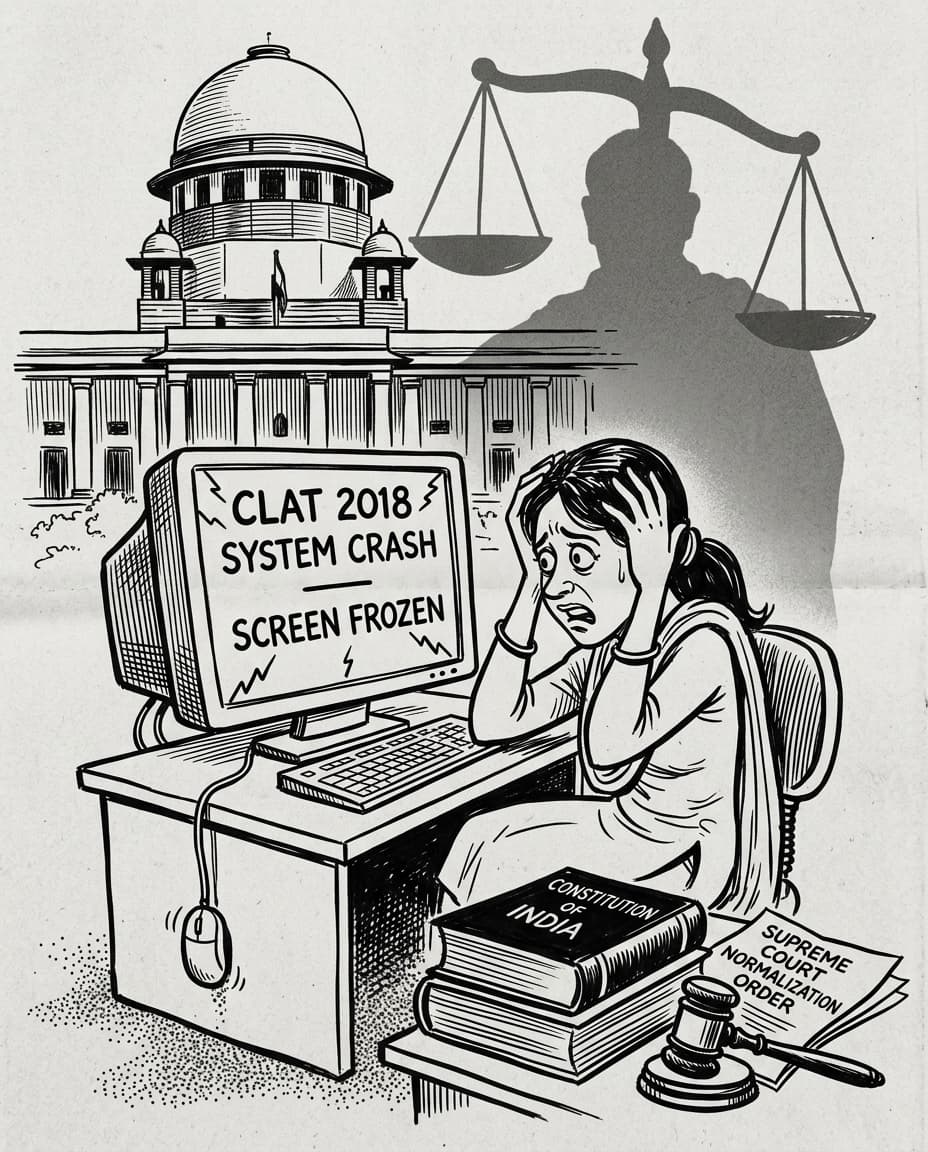
Editorial Illustration:Editorial illustration reflecting the events and context of The Glitched Screens of Sify: Inside the CLAT 2018 Online Collapse, the Supreme Court.
VINTAGE INK ARCHIVE
I. The Digital Mirage: The Outsourcing of National Testing
In the late 2010s, Indian educational administration was seized by a fervent techno-optimism. Following repeated question paper leaks in pen-and-paper board exams and recruitment tests, bureaucratic consensus swung decisively toward Computer-Based Testing (CBT). The computer terminal, policymakers believed, was the silver bullet that would eliminate leak-prone printing presses, corrupt truck drivers, and compromised treasury vaults.
The Common Law Admission Test had been conducted online since 2015. However, unlike central testing bodies with permanent administrative secretariats, the CLAT was managed on an ad-hoc, rotational basis. Each year, a different National Law University took its turn as the organizing convener.
In 2018, the responsibility fell to the National University of Advanced Legal Studies (NUALS), based in Kochi, Kerala.
Lacking in-house technical infrastructure to conduct a nationwide computer examination for over 54,000 candidates, NUALS floated a commercial tender for a managed testing service provider.
The contract was awarded to Sify Technologies Limited, a prominent information technology and network service corporation. Under the contract, Sify was responsible for end-to-end technological execution: identifying and auditing 200+ test centers across the country, providing certified server infrastructure, deploying localized LAN servers, ensuring dual uninterruptible power supply (UPS) backups, implementing biometric attendance, and executing a synchronized countdown timer interface.
The fundamental flaw in this commercial model was the practice of sub-contracting.
Rather than conducting testing in dedicated, company-owned testing centers with industrial-grade cooling and redundant power, the technical vendor outsourced the physical venues to second- and third-tier private engineering colleges, polytechnics, and computer coaching institutes on the outskirts of major cities.
Many of these private colleges possessed obsolete Pentium-generation desktop terminals, erratic broadband connections, malfunctioning ceiling fans, and unmaintained diesel generators incapable of handling sudden power surges.
II. May 13, 2018: The Blackout and the Freezing Wheel
On Sunday, May 13, 2018, temperatures across northern and western India soared past 42 degrees Celsius.
Inside crowded computer laboratories across Rajasthan, Haryana, Uttar Pradesh, and Delhi, candidates were seated shoulder-to-shoulder. Many laboratories lacked functioning air conditioning, causing server cabinets and candidate terminals to rapidly overheat.
At 3:00 PM, candidates entered their login credentials and began the 200-question test.
Almost immediately, the system began to disintegrate: - Terminal Freezing: In centers such as the Maharishi Arvind Institute of Engineering & Technology in Jaipur, the Modern Institute of Technology in Delhi, and centers in Hisar and Patna, candidate screens froze midway through questions. When students clicked "Save & Next," the interface displayed a perpetual loading wheel. Cursors became unresponsive. - Power Cuts & Generator Failures: In several centers in Rajasthan and Uttar Pradesh, municipal electricity failed. Local diesel generators either failed to kick in or tripped the circuit breakers. Whole classrooms plunged into darkness. When power was restored five to ten minutes later, candidate terminals had to be rebooted individually, requiring laboratory technicians to re-authenticate each machine manually. - The Stolen Clocks: Crucially, the testing software's internal clock did not synchronize properly with candidate reboots. While some candidate screens paused their timers during a crash, in hundreds of instances, the master server clock continued to tick away. Candidates logged back in to discover that while they had been staring at a blank screen for twenty minutes, their available testing time had shrunk from 90 minutes to 70 minutes. - Invigilator Chaos: Center invigilators—mostly contract staff or college lecturers with zero technical training—offered no coherent guidance. At some centers, invigilators refused to grant compensatory extra time at 5:00 PM, physically forcing candidates to vacate their chairs. At other centers, sympathetic supervisors granted arbitrary extensions of 10 or 15 minutes, creating gross procedural inequality across the country.
Outside examination centers, scenes of acute emotional distress unfolded. In Jaipur, dozens of students staged an immediate sit-in protest outside the college gates, refusing to leave until the Center Superintendent signed handwritten certificates confirming that candidates had lost between 15 and 45 minutes of testing time due to server and power breakdowns.
III. The Uprising of the Law Aspirants: May 14–22
For students aspiring to enter the legal profession, an administrative injustice was not met with passive resignation. Within 24 hours, law aspirants across India mobilized with extraordinary legal speed.
Candidate groups created WhatsApp and Telegram coalitions, compiling hundreds of signed affidavits, photographs of error screens, and letters from center superintendents.
Within a week, writ petitions challenging the conduct of CLAT 2018 were filed across six different High Courts: the Delhi High Court, the Punjab & Haryana High Court, the Rajasthan High Court, the Bombay High Court, the Madhya Pradesh High Court, and the Kerala High Court.
Faced with a splintered legal battle, a coalition of candidates led by aspirant Disha Panchal approached the apex court of the republic under Article 32 of the Constitution, filing Disha Panchal & Ors v. In-charge, CLAT-2018 & Ors (Writ Petition (Civil) No. 551 of 2018).
The petitioners presented a formidable constitutional argument: - The Common Law Admission Test is a hyper-competitive zero-sum examination where a single mark separates rank 50 (securing NLSIU Bengaluru) from rank 800 (missing out on top-tier NLUs). - Losing 15 to 30 minutes in a 120-minute aptitude test destroys a candidate's ability to read long legal comprehension passages, fundamentally violating their right to equality of opportunity under Article 14 of the Constitution. - The petitioners demanded that the Supreme Court scrap the May 13 examination entirely and direct the Consortium to conduct a clean, tamper-proof nationwide re-test for all candidates.
IV. The Supreme Court Vacation Bench and the Grievance Audit
The petition came before the Supreme Court Vacation Bench comprising Justice A.M. Khanwilkar and Justice Navin Sinha in late May 2018.
The Court was caught in a brutal administrative vice: - On one hand, the evidence of technological breakdown was incontrovertible. Over 4,000 candidates had formally lodged detailed complaints. Sify Technologies’ own internal incident logs conceded that multiple centers had suffered severe server interruptions and power disruptions. - On the other hand, the Consortium of NLUs, represented by senior counsel, argued vehemently against a nationwide re-test. Over 54,000 students had written the examination. Ordering a fresh test for 54,000 students would take at least two months, disrupting the start of the academic semester across twenty universities, subjecting tens of thousands of uninvolved students to acute psychological stress, and throwing international LL.M. and undergraduate calendars into chaos.
Recognizing the competing equities, the Supreme Court crafted an interim compromise on May 25, 2018.
The Court directed NUALS and the Consortium to establish an independent, high-powered Two-Member Grievance Redressal Committee comprising: 1. Justice M.R. Hariharan Nair, a retired Judge of the Kerala High Court (Chairman). 2. Prof. Dr. Santosh Kumar, a distinguished computer science academic from IIT Madras.
The mandate of the Committee was forensic and precise: - Analyze every single complaint received from candidates. - Reconcile candidate claims against the objective server audit logs and keystroke timestamp records maintained on Sify Technologies' central servers. - Determine exactly which candidates suffered genuine time deficits due to machine shutdowns or network timeouts. - Devise an equitable remedy to address the deficit without scrapping the entire examination.
V. The Committee’s Dilemma: The Birth of the Grace Marks Formula
Working around the clock in Kochi and Chennai, the Hariharan Nair Committee examined thousands of data packets and audit logs provided by Sify Technologies.
The technical findings of the Committee were damning: - The server logs proved beyond doubt that thousands of candidates across multiple centers had experienced substantial time losses. - In dozens of laboratories, systems had crashed repeatedly, logging candidates out and depriving them of between 5 and 35 minutes of testing time. - The Committee discovered that 4,690 candidates had filed formal grievances, and forensic audit confirmed that over 4,000 candidates had suffered demonstrable, systemic time deficits.
However, the Committee firmly rejected holding a re-test, concluding that conducting a second exam for a select subset of candidates would be unfair, as a different question paper would introduce new variables of difficulty and grading bias.
Instead, Prof. Dr. Santosh Kumar of IIT Madras formulated an intricate mathematical normalization model to calculate Compensatory Marks (Grace Marks).
The formula was designed on psychometric principles of answering speed and accuracy: 1. Raw Efficiency Calculation: The system analyzed the candidate’s performance during the actual active time they spent working on the system. If a candidate had an active working time of 80 minutes (having lost 40 minutes to crashes) and correctly answered a certain percentage of attempted questions, their answering rate (questions attempted per minute) and accuracy percentage (correct answers divided by attempts) were mathematically calculated. 2. Lost Time Extrapolation: The formula extrapolated this demonstrated performance over the specific quantum of lost time (verified from server logs). If a student was answering at a rate of 1.2 questions per minute with 75% accuracy, the algorithm calculated how many additional questions they would have reasonably attempted and answered correctly during the lost minutes. 3. Negative Marking Adjustment: The formula incorporated the penalty for incorrect attempts (-0.25 marks per wrong answer), discounting the gross projected score to produce a net "compensatory mark." 4. Cap on Compensation: To prevent absurd statistical windfalls, the compensatory score was strictly capped so that no candidate’s revised score could exceed the maximum theoretical marks of 200, nor could a candidate obtain marks disproportionate to their active answering performance.
On June 6, 2018, the Committee submitted its report to the Supreme Court, recommending the application of this normalization formula to redraw the all-India merit list.
VI. June 13, 2018: The Supreme Court Verdict
On June 13, 2018, Justice A.M. Khanwilkar and Justice Navin Sinha delivered the final judgment in Disha Panchal v. In-charge, CLAT-2018 (2018 SCC OnLine SC 608).
The Supreme Court formally accepted the Grievance Redressal Committee's recommendations: - The Court declined to cancel CLAT 2018 or order a re-test, holding that scrapping the entire examination would cause disproportionate injury to the vast majority of candidates and derail legal education nationwide. - The Court directed NUALS and Sify Technologies to apply the Committee's compensatory marks formula to all affected candidates whose time loss was objectively corroborated by server logs. - A revised all-India merit list was ordered to be published by June 16, 2018, and counseling for national law schools was directed to proceed strictly on the basis of these normalized scores.
In its judgment, the Supreme Court issued a scathing reprimand to the organizing university and Sify Technologies for their sheer administrative incompetence:
"It is unfortunate that an examination of this magnitude, which determines the career and aspirations of tens of thousands of young students, was conducted in such an unprofessional and callous manner. Modern technology is meant to facilitate fairness, not to become an instrument of harassment and injustice. The authorities must undertake a complete overhaul of their systems to ensure that such a fiasco is never repeated."
VII. The Aftermath: The Merit List Earthquake and the Flight to Paper
On June 16, 2018, NUALS published the revised CLAT 2018 merit list.
The application of compensatory grace marks generated an immediate statistical earthquake. Over 4,000 candidates received mark boosts ranging from +1.5 marks to +18 marks.
In a hyper-dense competitive examination where a difference of 0.25 marks separated twenty candidates: - Candidates who were originally ranked at 1,500 suddenly jumped into the top 300, securing unexpected admissions to tier-one institutions like NALSAR Hyderabad or NUJS Kolkata. - Conversely, hundreds of candidates who had experienced zero technical glitches and scored on genuine raw merit saw their all-India ranks drop by several hundred positions, pushing them out of their dream law schools to make room for students who received normalized boosts.
The resulting acrimony divided the law student community. Petitions were filed by candidates who claimed that the formula was speculative and arbitrary, arguing that a student’s answering speed in the first 60 minutes cannot assume that they would maintain the same endurance in the grueling final 30 minutes.
The Supreme Court, however, stood firm, refusing to entertain further challenges and closing the litigation to allow academic sessions to commence.
The institutional trauma of 2018 forced the National Law Universities to undergo a radical structural transformation: 1. Creation of the Permanent Consortium: The archaic practice of rotating CLAT administration to individual universities was scrapped. In late 2018, the Consortium of National Law Universities established a permanent headquarters and secretariat at NLSIU Bengaluru, led by permanent administrative officers. 2. The Permanent Reversion to Pen-and-Paper: In October 2018, the Consortium passed a unanimous, historic resolution: CLAT permanently abolished Computer-Based Testing (CBT). From CLAT 2019 onward, the examination returned to traditional physical paper question booklets and OMR answer sheets. The law schools concluded that physical paper, for all its logistical heft, was infinitely more reliable, transparent, and resilient than the fragile servers and glitched screens of commercial IT vendors.
VIII. The Ghost of 2018: How the CLAT Formula Resurfaced in NEET-UG 2024
For six years, the CLAT 2018 judgment in Disha Panchal was viewed as an eccentric, one-off legal anomaly—a peculiar compromise born of a unique technical failure in an online law entrance test.
Then came June 4, 2024.
When the National Testing Agency (NTA) announced the results of the NEET-UG 2024 medical entrance examination, the country was stunned to discover 67 candidates sharing All-India Rank 1 with perfect scores of 720/720, alongside anomalous scores of 719 and 718—mathematically impossible under NEET’s marking scheme (+4 for correct, -1 for incorrect).
Under intense public pressure, the NTA revealed that it had awarded compensatory grace marks to 1,563 candidates across centers in Haryana, Meghalaya, and Chhattisgarh who had suffered loss of examination time due to invigilator delays and administrative distribution errors.
When asked by journalists and the Supreme Court how the NTA had devised the legal authority to award grace marks in a medical entrance exam, the NTA’s lawyers produced a single legal precedent: the Supreme Court’s judgment in Disha Panchal v. In-charge, CLAT-2018.
The NTA had mechanically taken the CLAT 2018 formula—designed for an online Computer-Based Test with millisecond server keystroke logs—and applied it to an offline pen-and-paper OMR exam, based entirely on subjective, handwritten reports from local center superintendents.
The Supreme Court, hearing the NEET-UG 2024 petitions on June 13, 2024, expressed profound skepticism over this intellectual leap, forcing the central government and the NTA to revoke the grace marks entirely and offer the 1,563 candidates a choice between a re-test or retaining their raw scores.
The glitched screens of Sify Technologies on that sweltering May afternoon in 2018 had not merely derailed a law entrance test. They had spawned a legal doctrine whose unintended echoes would reverberate across Indian education for years to come—a permanent reminder that when institutions attempt to cure administrative and technical failures with mathematical band-aids, the resulting distortions can haunt the integrity of merit for a generation.
Chronological Case Timeline
| Exact Date / Period | Authority / Entities Involved | What Happened & What Changed | Verified Source / Reference |
|---|---|---|---|
| May 13, 2018 (15:00–17:00 IST) | NUALS Kochi, Sify Technologies, 54,000 Candidates | CLAT 2018 conducted online across 200+ centers; mass technical breakdown strikes centers in Jaipur, Delhi, Hisar, and Patna with terminal freezes, power cuts, and server crashes. | The Hindu, May 14, 2018: "Technical Snags Mar CLAT 2018 Across Country" |
| May 14–20, 2018 | Law Aspirants, Parents, Consortium of NLUs | Furious students form pan-India campaign; over 4,000 formal complaints filed alleging 10 to 45 minutes of lost test time; multiple High Courts flooded with writ petitions. | LiveLaw, May 16, 2018: "Massive Glitches in CLAT 2018: Aspirants Demand Retest" |
| May 22–25, 2018 | Supreme Court of India (Vacation Bench) | Supreme Court takes up Disha Panchal & Ors v. In-charge CLAT-2018; directs NUALS to form a Two-Member Grievance Redressal Committee headed by Justice M.R. Hariharan Nair. | Supreme Court of India Order in WP(C) No. 551/2018, May 25, 2018 |
| May 31, 2018 | NUALS Kochi, Grievance Committee | NUALS publishes raw CLAT 2018 results; Grievance Committee analyzes server audit logs of Sify Technologies to verify time loss for 4,000+ complainants. | NUALS Official Notification, May 31, 2018 |
| June 6, 2018 | Grievance Redressal Committee | Committee submits report confirming server audit logs proved substantial time deficits; proposes mathematical normalization formula awarding compensatory marks based on answering speed and accuracy. | Report of the High-Powered Grievance Redressal Committee on CLAT 2018 |
| June 13, 2018 | Supreme Court of India (Bench: A.M. Khanwilkar & Navin Sinha, JJ.) | Supreme Court declines to cancel the exam; directs implementation of the Committee's compensatory marks formula to redraw the all-India merit list. | Disha Panchal v. In-charge CLAT (2018) 2 SCC 145 / SCC OnLine SC 608 |
| June 16, 2018 | NUALS Kochi, Consortium of NLUs | Revised all-India merit list published with compensatory marks applied to over 4,000 candidates, reshuffling law school cut-offs nationwide. | Consortium of NLUs Revised Merit Notification, June 16, 2018 |
| October 2018 | Consortium of National Law Universities | Consortium forms permanent secretariat in Bengaluru and votes unanimously to permanently abolish online CBT mode, reverting CLAT to offline pen-and-paper OMR tests. | Consortium of NLUs Official Resolution on Exam Reforms 2018 |
| June 13, 2024 | National Testing Agency (NTA), Supreme Court | The CLAT 2018 compensatory grace marks formula is controversially revived by NTA for 1,563 NEET-UG 2024 candidates, sparking a national scandal and Supreme Court revocation. | Supreme Court of India Order in NEET-UG 2024 Petitions, June 13, 2024 |
Sources & Further Reading
- Supreme Court of India — Disha Panchal & Ors vs In-charge, CLAT-2018 & Ors (2018) 2 SCC 145 / 2018 SCC OnLine SC 608, Writ Petition (Civil) No. 551 of 2018 with connected petitions, Bench of Justices A.M. Khanwilkar and Navin Sinha, Orders dated May 25, 2018 and June 13, 2018. https://main.sci.gov.in
- High-Powered Grievance Redressal Committee — Report of the Grievance Redressal Committee (Justice M.R. Hariharan Nair & Dr. Santosh Kumar, IIT Madras) on Time Loss and Normalization Formula for CLAT 2018, submitted before the Supreme Court of India, June 6, 2018.
- Consortium of National Law Universities (NLUs) — Executive Resolution on the Permanent Return to Offline Pen-and-Paper Format for Common Law Admission Test, Bengaluru Secretariat, October 2018. https://consortiumofnlus.ac.in
- National University of Advanced Legal Studies (NUALS), Kochi — Official Notification on Revised Merit List after Normalization of CLAT 2018 Scores, June 16, 2018. https://nuals.ac.in
- The Hindu — Technical Snags Mar CLAT 2018 Across Country: Students Protest Outside Test Centres, Special Correspondent, May 14, 2018. https://www.thehindu.com/news/national/technical-snags-mar-clat-2018/article23878031.ece
- LiveLaw — Supreme Court Directs CLAT 2018 Grievance Redressal: Two-Member Committee to Examine Sify Server Logs, Ajoy Roy, May 25, 2018. https://www.livelaw.in/supreme-court-directs-clat-2018-grievance-committee/
- Bar & Bench — The CLAT 2018 Debacle: Inside the Formula That Shuffled Ranks and Forced the Consortium Back to Paper, Murali Krishnan, June 14, 2018. https://www.barandbench.com/news/clat-2018-supreme-court-normalization-formula-rank-list
- The Indian Express — How the CLAT 2018 Grace Marks Precedent Returned to Haunt the Supreme Court During NEET-UG 2024, Apurva Vishwanath, June 14, 2024. https://indianexpress.com/article/explained/explained-law/neet-ug-grace-marks-clat-2018-supreme-court-9391480/
Comments
0Want to participate in the discussion?
No comments yet. Start the discussion above.