The Air-Conditioned Solver Camps: Inside the Telangana EAMCET-II Paper Leak and the Death of State Medical Entrance Tests
•INVESTIGATIVE DISPATCH•BY ADITYA
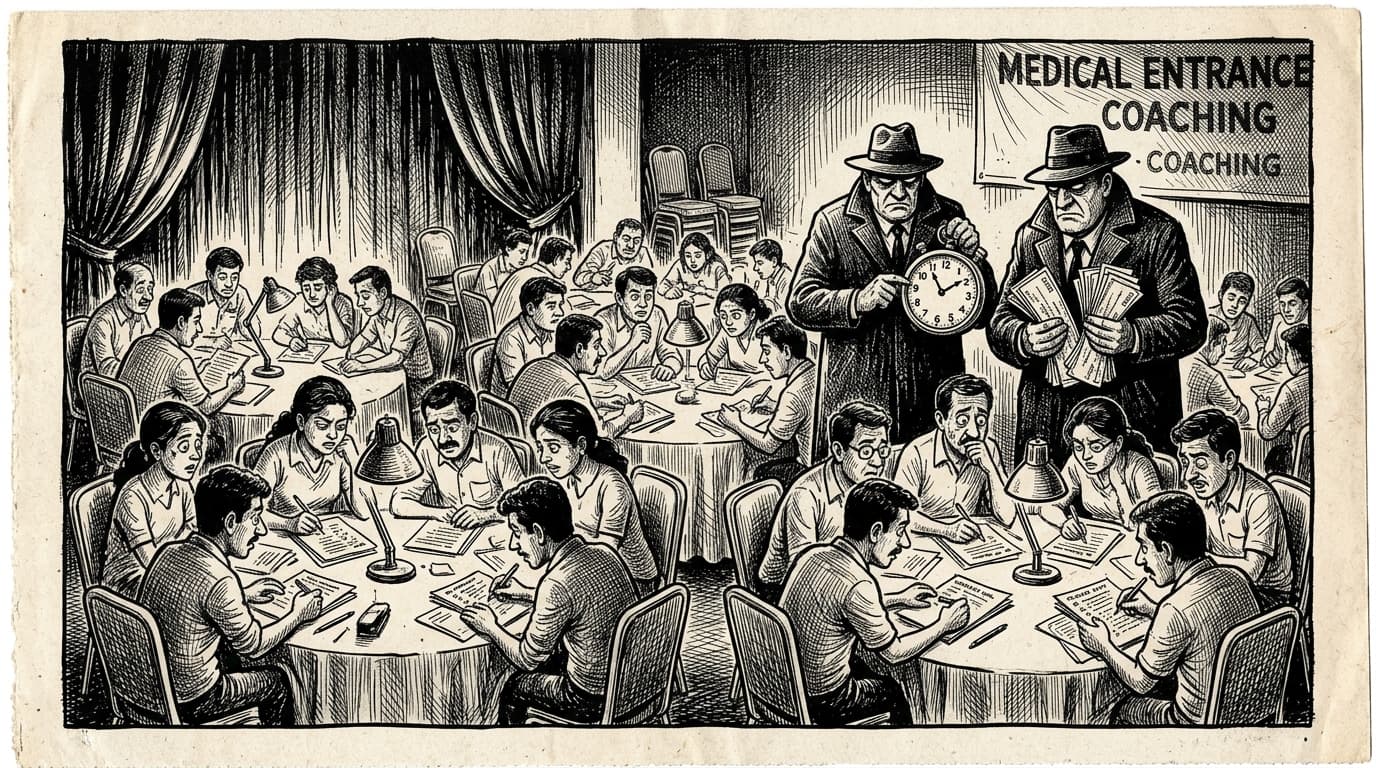
Editorial Illustration:Editorial illustration reflecting the events and context of The Air-Conditioned Solver Camps: Inside the Telangana EAMCET-II Paper Leak and the Death of State Medical Entrance Tests.
VINTAGE INK ARCHIVE
By Newsroom Editorial Desk
Published August 5, 2016 (Archived in the National Examination Integrity Repository) | Archival Incident INC-2016-TS-HYDERABAD-008
On the night of Wednesday, July 6, 2016—seventy-two hours before fifty-six thousand young men and women sat for the Telangana Engineering, Agriculture and Medical Common Entrance Test (TS EAMCET-II)—a luxury passenger bus with dark tinted windows pulled into the portico of a four-star business hotel located near Kempegowda International Airport in Bengaluru.
Disembarking from the coach were thirty-two teenagers, their faces pale with anxiety, accompanied by anxious parents carrying oversized leather briefcases. They had not traveled to the IT capital for a vacation or a hospital consultation. They had flown or boarded sleeper coaches from Hyderabad, Vijayawada, Guntur, and Karimnagar under absolute secrecy.
Upon crossing the hotel lobby, the students were escorted to the third-floor banquet wing. Their mobile phones, tablets, wristwatches, and personal notebooks were confiscated at the door and sealed in tamper-evident envelopes. Outside each hallway stood private bouncers hired by an interstate syndicate.
Inside the carpeted banquet rooms, large magnetic whiteboards had been erected. Lying on the presentation podiums were crisp, photocopied question papers bearing the confidential code TS-13 and TS-14.
For the next forty-eight hours, teams of elite biology, chemistry, and physics tutors—summoned from coaching institutions across North India—walked the students through the questions line by line. The teenagers were not taught scientific principles; they were drilled in brute rote memorization:
"Question sixteen: Option C. Question seventeen: Option A. Do not solve the stoichiometry equations. Just remember the third decimal place: point four eight two."
Across India that same week, identical "solver camps" were running simultaneously in air-conditioned hotel suites in Mumbai near the domestic airport, in scenic resorts in Goa, and in transit lodges in Cuttack and Kolkata.
The price for admittance into these secret classrooms was staggering: ₹35 lakh to ₹45 lakh per student.
When the candidates flew back on early morning flights into Hyderabad and Vijayawada on Saturday, July 9, and darkened the OMR bubbles inside examination centres, they achieved what appeared to be an academic miracle. But when the results were declared five days later, the miracle collapsed under the weight of its own statistical absurdity.
1. The Twilight of State Medicine: The 2016 Battleground
To understand the scale and desperation of the EAMCET-II leak, one must reconstruct the unique constitutional twilight in which medical admissions existed during the summer of 2016.
For decades, southern states—particularly undivided Andhra Pradesh and subsequently the newly formed state of Telangana—had conducted their own fiercely competitive entrance tests. The EAMCET was legendary in Telugu society: a sprawling cultural ritual where lakhs of families invested life savings into private coaching academies in Madhapur and Vijayawada, seeking one of the highly coveted seats in government medical colleges like Osmania and Gandhi Medical College.
However, in May 2016, the Supreme Court of India delivered a seismic ruling: all state-level medical entrance tests were declared unconstitutional, mandating the single-window National Eligibility cum Entrance Test (NEET) as the sole gateway for MBBS admissions nationwide.
The ruling sparked immediate political panic across state capitals. Regional governments argued that rural students who had studied state board syllabi in Telugu or regional languages would be decimated by the CBSE-based national syllabus.
Under intense political pressure, the Central Government promulgated an emergency Presidential Ordinance in late May 2016, granting state governments a one-year exemption. For the academic year 2016–17, states were permitted to conduct their own medical CETs for the final time.
In Telangana, this meant the state had to conduct a fresh, dedicated test: TS EAMCET-II (Medical), scheduled for July 9, 2016, managed by Jawaharlal Nehru Technological University, Hyderabad (JNTU-H).
For the criminal syndicates that specialized in selling medical seats, the message was unmistakable: this was the last harvest. After 2016, medical testing would pass into the hands of central agencies. The cartels had exactly one examination left to extract maximum wealth from desperate parents.
2. The Delhi Breach: How the Master Sets Were Stolen
The syndicate responsible for compromising EAMCET-II was an interstate consortium uniting criminal operatives from Bihar, Delhi, Uttar Pradesh, and Hyderabad.
At the apex of the procurement network were Sunil Ranjan, a veteran broker based in Delhi, and Shiv Bahadur Singh, a key operative with connections to confidential commercial printing presses. In Hyderabad, the local marketing and candidate mobilization was directed by Dr. Rajagopal Reddy and Dr. Vishnu Vardhan, two medical graduates who had abandoned clinical practice to build lucrative careers as admission conduits.
[CONFIDENTIAL PRINTING PRESS IN NEW DELHI]
                     │ (Master Sets TS-13 & TS-14 Exfiltrated by Press Insiders)
                     ▼
         [INTERSTATE LOGISTICS NEXUS]
  (Sunil Ranjan / Shiv Bahadur Singh / Dr. Vishnu)
                     │
         ┌───────────┼───────────┐
         ▼           ▼           ▼
   [BENGALURU]    [MUMBAI]     [GOA]
  Airport Hotel  Near Terminal Luxury Resort
         │           │           │
         └───────────┼───────────┘
                     ▼
   [200+ Paying Medical Aspirants]
   - ₹35 Lakh to ₹45 Lakh Tariff
   - Phones Confiscated
   - 48 Hours Rote Solver Training
                     │ (Return Flights on July 8 & 9)
                     ▼
   [EXAM CENTRES ACROSS TELANGANA]
   (July 9, 2016 - 56,153 Candidates Appear)
To prevent leaks, JNTU-H had contracted an established, high-security private printing press in New Delhi. Under standard operating protocols, four distinct sets of question papers were prepared by academic panels. The press was under contractual obligation to maintain 24-hour CCTV surveillance, armed security guards, and biometric entry controls.
Yet, as Telangana CID investigators later established, the security ring had a price tag.
An employee inside the printing facility, compromised by cash advances from Sunil Ranjan’s network, managed to smuggle out draft proofs and film plates of Set TS-13 and Set TS-14 seventy-two hours before the bundles were packaged into tamper-proof steel trunks for railway transit to Hyderabad.
Once the digital photographs of the plates reached the syndicate, the machinery mobilized with military precision. The paper was not leaked onto public messaging forums. In 2016, wholesale broadcast on WhatsApp or Telegram would have instantly triggered a cancellation before money could be collected. The syndicate operated on a bespoke, controlled-access model: candidates were brought directly to the paper, rather than the paper being sent to the candidates.
3. The Flight Manifests of Fraud
Between July 5 and July 7, 2016, parents who had agreed to the terms—paying an initial token advance of ₹5 lakh to ₹10 lakh in cash and handing over original intermediate marksheets and signed blank bank cheques—received discreet phone calls.
They were instructed to book flights immediately.
Parents and students boarded flights to Mumbai, Bengaluru, and Goa. In Bengaluru alone, CID records documented that over sixty students stayed across multiple upscale hotels near Yelahanka and the international airport. In Mumbai, students were accommodated in commercial hotels in Andheri East, minutes from the domestic terminal.
Inside these solver camps:
- Expert teachers, primarily drawn from private tuition centers in Patna and Lucknow, were sequestered in separate suites to solve all 160 multiple-choice questions across Physics, Chemistry, and Biology.
- Answer keys were compiled into structured mnemonic charts.
- Students were divided into small batches and subjected to intensive mock memory drills. Solvers tested each student repeatedly until they could mark the correct option within three seconds of reading the first three words of a question stem.
- Strict discipline was enforced: students were not allowed to leave the hotel rooms or make phone calls to friends or relatives.
On the evening of Friday, July 8, and the pre-dawn hours of Saturday, July 9, the students were ferried to the airports in chartered cabs. They boarded early morning flights back to Hyderabad, Rajiv Gandhi International Airport, or connecting trains to regional centres like Warangal and Khammam.
They walked into the examination halls rested, impeccably rehearsed, and armed with the exact questions they were about to encounter.
4. The Anomaly of the Absurd Toppers
When the examination concluded at 1:00 PM on July 9, the syndicate felt triumphant. JNTU-H officials noted that the test had concluded peacefully across all 114 centres with zero reports of disturbances or leaked papers in transit.
On Thursday, July 14, 2016, JNTU-H released the official results.
Almost immediately, the statistical algorithms designed by education analysts and coaching faculties began flashing red alerts:
- The Inverse Performance Shock: In EAMCET-I (conducted two months earlier in April 2016), a female candidate had secured a state rank beyond 35,000, scoring less than 40 marks out of 160. In EAMCET-II, the very same candidate secured a rank in the top 100, scoring an astonishing 152 marks.
- Intermediate Board Disconnect: In undivided AP and Telangana, medical admissions combined 75% entrance marks with 25% weightage from the Class 12 Intermediate Board examination. Multiple candidates who had barely passed their intermediate board exams with 55% or 60% marks in biology—and had failed the national AIPMT screening—had somehow achieved state ranks in the single digits and low double digits.
- The Cluster Effect: An extraordinary concentration of top scorers was traced back to specific, non-academic backgrounds whose previous academic trajectories showed no history of competitive scholarship.
- Aviation Data Mining: Investigators subpoenaed flight manifests from domestic airlines operating routes from Hyderabad to Mumbai, Bengaluru, and Goa between July 5 and July 9. Cross-referencing candidate names with passenger manifests revealed that hundreds of medical aspirants had traveled on the same outbound flights and returned on the same early morning return flights on the day of the exam.
- Hotel Guest Ledgers: CID teams dispatched to Bengaluru and Mumbai examined CCTV footage and hotel guest registration cards. They discovered that dozens of rooms had been booked and paid for in cash by known brokers under assumed corporate identities, with room service orders indicating thirty to forty meals delivered to single banquet halls.
- Recovery of Financial Instruments: During raids on the residences of Dr. Rajagopal Reddy and Vishnu Vardhan, detectives seized over ₹3 crore in hard cash, alongside sacks containing over 120 original Intermediate Board certificates and hundreds of post-dated bank cheques signed by parents, totaling more than ₹40 crore.
- Criminal Investigation Department (CID), Telangana Police: First Information Report & Comprehensive Investigation Chargesheets in Crime No. 24/2016 (State of Telangana through CID v. Rajagopal Reddy, Dr. Vishnu Vardhan, Sunil Ranjan & Ors.) (Registered July 20, 2016; CID Police Station, Hyderabad). Telangana CID Crime Records.
- Government of Telangana (Higher Education Department): Government Order G.O. Ms. No. 43: Cancellation of TS EAMCET-II (Medical) 2016 Examination and Conduct of EAMCET-III (Notified July 29, 2016, Secretariat, Hyderabad). Telangana Government Orders Repository.
- High Court of Judicature at Hyderabad (For Andhra Pradesh & Telangana): Common Order in Writ Petition No. 25890 of 2016 and Batch (Upholding State Government Decision to Annul EAMCET-II and Reconduct EAMCET-III). Telangana High Court Case Information.
- Jawaharlal Nehru Technological University, Hyderabad (JNTU-H): Official Notification and Tabulation Reports on Conduct of TS EAMCET-III 2016 (Examination Section, Kukatpally, Hyderabad). JNTU Hyderabad Official Archives.
- The Hindu: Telangana CM Announces Scrapping of EAMCET-II; Retest on September 11 After CID Confirms Question Paper Leak (July 30, 2016). The Hindu Hyderabad Archives.
- The Indian Express: How the EAMCET-II Paper Was Leaked: The 40-Crore Syndicate, Delhi Press Breach, and the Hotel Camps of Mumbai and Bengaluru (August 3, 2016). Indian Express Investigation.
- The Times of India: Telangana EAMCET-2 Leak: Over 200 Students Taken to 7 Cities in Secret Solver Camps, CID Reveals (July 28, 2016). Times of India Hyderabad Edition.
- Deccan Chronicle: Anatomy of a Mega Medical Scam: Inside the Flight Logs and Luxury Hotel Suites Where EAMCET-II Solvers Coached Aspirants (August 1, 2016). Deccan Chronicle Special Report.
Within forty-eight hours, outraged students and parents marched to the TSCHE headquarters in Masab Tank, Hyderabad, brandishing comparative marksheets. Opposition parties raised the issue in the state legislature, demanding an immediate criminal investigation.
5. Chronological Case Timeline: The Unraveling and the Retest
The following verified chronological timeline details the investigative breakthroughs, government orders, judicial validations, and the final reconduct of the examination:
| Exact Date / Timestamp | Authority / Entities Involved | What Happened & What Changed | Verified Direct Link / Official Order |
|---|---|---|---|
| April 29, 2016 | TSCHE & JNTU Hyderabad | TS EAMCET-I conducted across Telangana; thousands score regular percentiles. | JNTUH Notification TS EAMCET 2016 |
| May 9, 2016 | Supreme Court of India | Apex court declares NEET mandatory, but central ordinance allows states a final one-year window for state-level medical tests. | Supreme Court Order in Sankalp Charitable Trust v. UOI |
| June 1, 2016 | TSCHE | Government announces TS EAMCET-II exclusively for medical admissions, scheduled for July 9, 2016; 56,153 candidates register. | TSCHE Official Notice |
| July 5–7, 2016 | Interstate Leak Syndicate | Question papers TS-13 and TS-14 stolen from Delhi press; 200+ students flown to hotel camps in Mumbai, Bengaluru, and Goa for intensive memorization drills. | Telangana CID Case Diary FIR 24/2016 |
| July 9, 2016 | JNTU-H | TS EAMCET-II conducted peacefully across 114 test centres; hotel-camp students appear and score near-perfect marks. | JNTUH Examination Press Bulletin |
| July 14, 2016 | JNTU-H | Results published; anomalous rank jumps (e.g., Rank 35,000 jumping to Top 100) trigger immediate public outrage and student protests. | TS EAMCET-II Result Gazette |
| July 18, 2016 | Telangana State Government | Director General of Police orders CID to launch formal inquiry into score anomalies. | Telangana DGP Executive Order |
| July 20, 2016 | Telangana Police CID | CID registers FIR No. 24/2016 under IPC 406, 408, 420, 120-B and Section 8 of AP Public Examinations Act, 1997. | Telangana CID FIR No. 24/2016 |
| July 25, 2016 | CID Special Investigation Team | CID arrests master brokers Dr. Rajagopal Reddy and Vishnu Vardhan; seizes flight tickets, hotel registers, and crores in cash and cheques. | Telangana CID Press Communique |
| July 28, 2016 | Telangana CID | CID submits interim investigative report to Chief Minister KCR, confirming that over 200 students benefited from leaked papers across 7 states. | CID Comprehensive Status Report |
| July 29, 2016 | Government of Telangana | Chief Minister K. Chandrashekar Rao officially scraps TS EAMCET-II; issues G.O. Ms. No. 43 ordering a fresh retest (EAMCET-III). | Telangana Government Order G.O. Ms. No. 43 |
| August 12, 2016 | Hyderabad High Court | High Court dismisses petitions filed by top rankers seeking a stay on cancellation, holding that public interest requires a sanitized retest. | Hyderabad High Court Order in WP 25890/2016 |
| September 11, 2016 | JNTU-H | TS EAMCET-III successfully conducted for 37,000+ candidates under armed police protection and sanitized printing press custody. | JNTUH EAMCET-III Retest Report |
| 2017–2020 | Special Courts, Hyderabad | CID files detailed chargesheets against 80+ accused across 7 states; recovers over ₹11 crore in ill-gotten cash; 150+ tainted candidates permanently debarred. | Telangana CID Final Chargesheet Record |
6. The Forensic Trail: Flight PNRs and Hotel Registrations
The Telangana CID, led by Director General Anurag Sharma and DIG Soumya Mishra, cracked the syndicate through exhaustive digital and physical paper trails rather than confessions:
Faced with overwhelming evidence, the government had no legal alternative. On the evening of July 29, 2016, Chief Minister K. Chandrashekar Rao appeared before the press to announce that TS EAMCET-II was dead.
7. The Epitaph: How EAMCET-II Billed the Death of State Tests
The cancellation of TS EAMCET-II was more than a regional scandal; it was the definitive historical event that sealed the fate of state-level medical entrance tests across the Indian republic.
For years, state governments had fought tenaciously against the centralizing impulse of the Medical Council of India and the Supreme Court, arguing that state commissions possessed superior local accountability and understood regional educational requirements.
The EAMCET-II debacle completely destroyed that argument.
It demonstrated that state-level testing systems, relying on commercial printing presses and local bureaucratic oversight, were utterly defenseless against wealthy interstate cartels willing to move students across state boundaries by air. If a prosperous, technologically advanced state like Telangana could see its premier examination compromised so thoroughly that over two hundred students were trained in five-star hotel suites across seven states, what hope did smaller, less-resourced states have?
When the central government’s one-year exemption expired in 2017, there was no longer any political appetite or judicial sympathy for extending state medical examinations.
From 2017 onward, the Supreme Court’s mandate was absolute: NEET became the sole, non-negotiable gateway for every medical college in India.
The regional festival of EAMCET Medicine was consigned to the history books—brought down not by the courts or Parliament, but by the greed of a forty-crore syndicate and the silent memorization rooms of a Bengaluru airport hotel.
Comments
0Want to participate in the discussion?
No comments yet. Start the discussion above.