The Lockers of Baradari Gardens: Inside the PPSC Cash-for-Jobs Scandal, the Trap of Ravinderpal Sidhu, and the Dismantling of a Rigged Civil Service
•INVESTIGATIVE DISPATCH•BY ADITYA
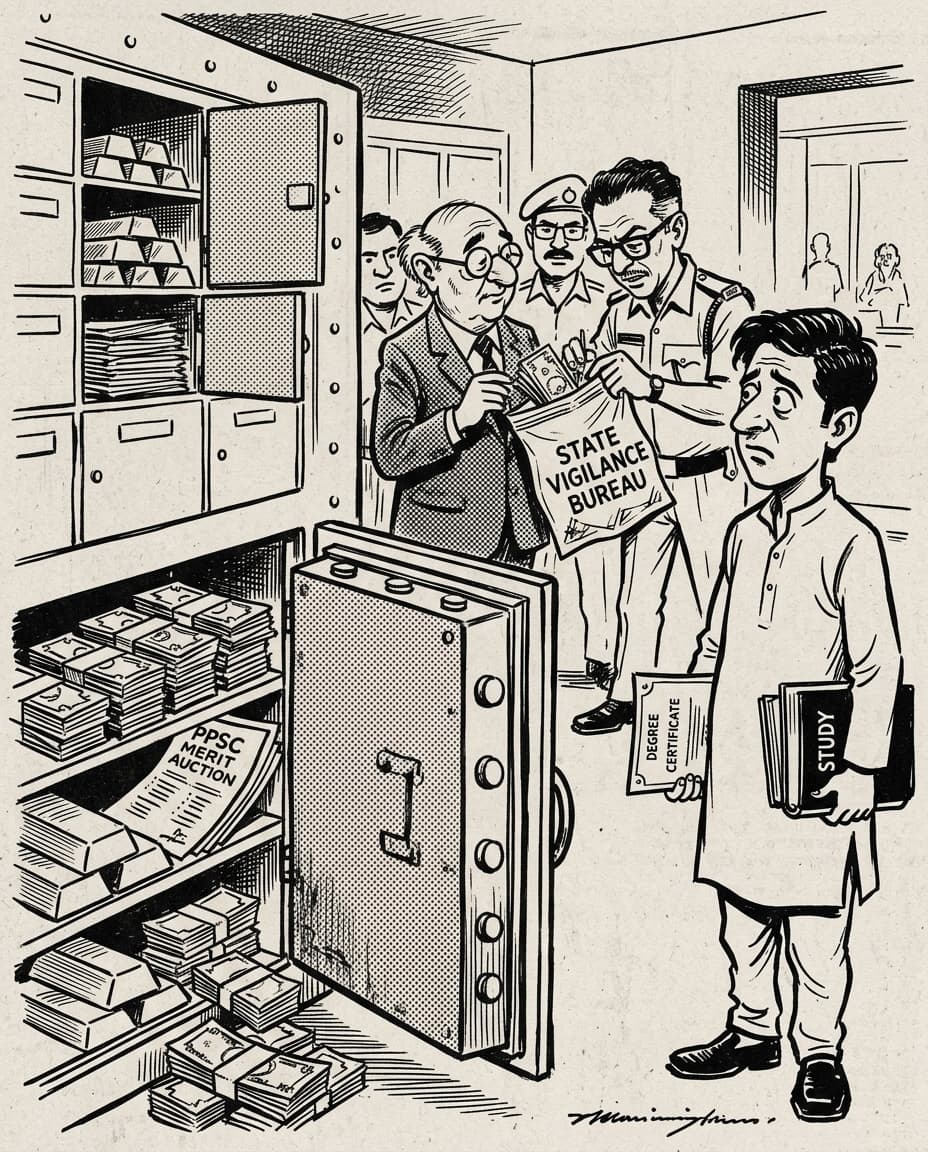
Editorial Illustration:Editorial illustration reflecting the events and context of The Lockers of Baradari Gardens: Inside the PPSC Cash-for-Jobs Scandal, the Trap of Ravinderpal Sidhu, and the Dismantling of a Rigged Civil Service.
VINTAGE INK ARCHIVE
I. The Aristocratic Journalist: The Rise of R.P.S. Sidhu
To comprehend how Ravinderpal Singh Sidhu executed the most audacious public service commission heist in modern Indian history, one must examine his background.
Sidhu was not a weathered, back-room party hack. Born into a prominent Punjabi family, he was educated at elite institutions and built a distinguished career as a special correspondent for The Hindu and The Indian Express throughout the tumultuous 1980s and 1990s. In the corridors of the Punjab Civil Secretariat, Sidhu was known as a sharp, investigative reporter with intimate knowledge of political rivalries and administrative machinery.
In 1996, at the relatively young age of 42, Sidhu was appointed Chairman of the Punjab Public Service Commission. The appointment was hailed by many in the Chandigarh media and intelligentsia as an enlightened choice: a crusading journalist placed at the helm of a critical institution to clean up recruitment.
Once ensconced in the Chairman’s grand office at Baradari Gardens, however, Sidhu realized the near-total immunity granted to him by the Constitution. Under Article 317(1), a Chairman of a Public Service Commission cannot be suspended, transferred, or summarily dismissed by a Chief Minister, a Governor, or even the state legislature. He can only be removed by the President of India on the grounds of "misbehavior" after the Supreme Court of India conducts a formal inquiry following a Presidential reference.
Insulated by this constitutional fortress, Sidhu set about building a shadow enterprise.
II. The Cash-and-Carry Tariff: Selling the Sub-Divisional Throne
In Punjab, where landed families, affluent farmers, and business dynasties possessed immense wealth but limited bureaucratic leverage, a post in the Punjab Civil Services (Executive Branch) or Punjab Police Service (DSP) represented the apex of prestige. A PCS officer wields magisterial powers, oversees land acquisition, controls municipal contracts, and regularly ascends to the Indian Administrative Service (IAS). A Civil Judge commands judicial authority over property disputes worth hundreds of crores.
Sidhu established a structured, mafia-style rate card. Working through an insulated inner circle of touts—most notably Pritpal Singh, Paramjit Singh (alias Pammi), and his close confidant Jagman Singh—the Chairman let it be known that merit was merely an optional ornament; the only currency that guaranteed selection was hard cash.
The tariffs were ruthlessly indexed to the power of the post: - Punjab Civil Services (Executive / SDM): ₹60 lakh to ₹75 lakh. - Punjab Police Service (DSP): ₹40 lakh to ₹50 lakh. - Punjab Civil Services (Judicial / Civil Judge): ₹35 lakh to ₹50 lakh. - Excise & Taxation Inspector: ₹25 lakh to ₹30 lakh. - Food & Civil Supplies Inspector / Block Development Officer: ₹15 lakh to ₹20 lakh.
In the late 1990s and early 2000s, these were staggering sums. Affluent families mortgaged ancestral lands, sold commercial plots in Ludhiana and Jalandhar, and liquidized generational gold to buy a seat at the table of state power for their sons and daughters.
Over a six-year period, Sidhu conducted multiple examination cycles, including the 1998, 1999, 2000, and 2001 batches of the PCS (Executive) and PCS (Judicial).
Behind the facade of solemn invigilation, the examination process was an elaborate sham.
III. Modus Operandi: The Midnight Substitution and the Interview Trap
How did the syndicate guarantee the selection of candidates who were often academically mediocre, while preventing brilliant, honest aspirants from overtaking them on marks?
The Punjab Vigilance Bureau and subsequent judicial findings detailed an insidious, two-tiered operational methodology:
1. The Strongroom Answer Sheet Substitution For the written Mains examinations—where candidates were required to write essay-style analytical papers on law, history, political science, and economics—paying candidates were instructed to fill their initial answer sheets in the examination hall with ordinary, sparse text, or leave specific subtle identification marks (such as a unique sequence of question numbering or a distinctive pencil stroke on page 1).
Following the conclusion of the examination, the sealed trunks containing the answer booklets were deposited inside the confidential strongroom at the PPSC headquarters in Baradari Gardens.
Here, Sidhu exercised unilateral authority. Using his executive override, the Chairman had the confidential trunks unsealed at night. The answer booklets of the paying candidates were extracted from the packets and delivered to private safehouses in Patiala and Chandigarh.
There, panels of hired college professors and subject specialists sat with textbooks, drafting flawless, high-scoring answers into fresh, identical blank answer booklets that had been illicitly procured from government printing presses. The candidates' roll numbers were forged on the covers, and the fake booklets were stamped with counterfeit invigilator signatures.
The doctored, top-scoring answer sheets were then slipped back into the bundles, while the original, mediocre sheets were burned in Sidhu’s fireplace. When the bundles were dispatched to outside university examiners for grading, the substituted sheets predictably received the highest marks in the state.
2. The Interview Board Execution For candidates who could not be accommodated via answer sheet substitution, or where genuine candidates had scored exceptionally high marks in the written exam, Sidhu utilized the **viva voce (interview) stage** as an administrative execution chamber.
In the PCS examination structure, the interview carried substantial weight—often enough to swing a candidate from rank 1 to rank 200.
Sidhu personally presided over the interview boards. Paying candidates who had barely scraped through the written test were awarded astronomical interview scores—often 85 to 95 percent of the total viva marks.
Conversely, genuine, brilliant candidates who had topped the written test but refused to pay bribes were subjected to deliberate humiliation and awarded arbitrary, failing marks—frequently between 10 and 15 percent. This mathematical distortion dragged their cumulative totals below the cut-off line, pushing them out of the selection zone and replacing them with paying clients.
IV. March 2002: The Whistleblower and the Trap
The unraveling of the syndicate began with an act of desperate rebellion from an insider.
In early 2002, Bhupinder Singh, an Excise and Taxation Inspector who had appeared for the PCS (Executive) examination, was approached by Sidhu's touts. Bhupinder had performed well in the written exam, but touts informed him that unless he paid a bribe of ₹35 lakh, his name would be struck off the final selection list and his career finished.
Bhupinder had already paid an initial installment of ₹5 lakh, but as the extortion demands escalated, he realized he was being bled dry. In mid-March 2002, following a change in state government that saw Captain Amarinder Singh assume office as Chief Minister with a mandate to eradicate corruption, Bhupinder walked into the headquarters of the Punjab Vigilance Bureau.
He met with Additional Director General of Police (ADGP) A.P. Pandey and Deputy Inspector General (DIG) Sumedh Singh Saini.
Recognizing that catching a sitting constitutional Chairman required absolute, ironclad evidentiary proof, the Vigilance Bureau orchestrated a meticulously planned trap.
Bhupinder agreed to wear a covert audio recording device and act as bait. On the morning of Monday, March 25, 2002, Bhupinder arranged to deliver a fresh installment of ₹5 lakh in cash to Sidhu’s private residence in Sector 39, Chandigarh.
The Vigilance Bureau treated the banknotes with phenolphthalein powder—a chemical that turns brilliant pink when exposed to sodium carbonate.
At approximately 11:30 AM, Bhupinder entered Sidhu’s residence. Inside the drawing room, Sidhu sat comfortably, discussed the remaining balance, and personally accepted the packet of currency, placing it on the table.
As Bhupinder stepped out and gave the pre-arranged signal, a tactical raid team led by DIG Sumedh Saini converged on the house.
Rushing into the room, vigilance sleuths caught the Chairman of the Punjab Public Service Commission sitting beside the pile of cash. When investigators washed Sidhu’s hands in a sodium carbonate solution, his fingers immediately flushed deep magenta, confirming direct contact with the treated currency.
Sidhu was placed under immediate arrest. In the rigid history of Indian constitutional governance, an unthinkable threshold had been crossed: the Chairman of a Public Service Commission was in handcuffs.
V. The Fifty Lockers of Chandigarh: Spilling the Booty
If the initial trap yielded ₹5 lakh, what investigators discovered inside the house over the next twelve hours stunned seasoned financial detectives.
A search of the residence uncovered: - ₹1.36 crore in liquid Indian currency bundled in suitcases and hidden inside cupboards. - Thousands of US dollars, British pounds, and Canadian currency. - Keys and passbooks to more than 50 safe-deposit lockers in commercial banks across Chandigarh, Patiala, and Delhi—registered under the names of Sidhu’s mother Pritpal Kaur, his brother Reetinder Singh, sister-in-law, and fictitious aliases.
Over the following week, accompanied by bank managers, executive magistrates, and television camera crews, the Vigilance Bureau systematically broke open the lockers across branches of Bank of India, IndusInd Bank, Standard Chartered, and Central Bank of India.
What poured out was an almost mythical hoard of ill-gotten wealth: - Locker after locker was packed floor-to-ceiling with tight brick-packs of ₹500 and ₹1,000 currency notes. - In total, the cash seized from the lockers exceeded ₹16.5 crore. - Over 10 kilograms of pure gold bullion, luxury Swiss watches, and property title deeds for prime commercial real estate in Chandigarh, Gurgaon, and agricultural farms spanning hundreds of acres across Punjab. - Ledger books containing handwritten lists of roll numbers, parent names, and the exact amounts paid for PCS (Executive), PCS (Judicial), and DSP selections.
The visual images of currency counting machines smoking from overuse as police officers sat surrounded by pyramids of money dominated national news headlines for weeks. The venerable PPSC had been unmasked as a criminal mint.
VI. The Presidential Reference and Mass Purge
With Sidhu jailed in Patiala Central Jail, the state government faced a formidable constitutional obstacle. Sidhu brazenly refused to resign as Chairman, believing his constitutional shield under Article 316 would allow him to draw his salary and retain his title indefinitely.
Chief Minister Captain Amarinder Singh petitioned the Central Government. In May 2002, the President of India invoked Article 317(1) of the Constitution, making a formal reference (Special Reference No. 1 of 2002) to the Supreme Court of India to investigate the misbehavior of Ravinderpal Singh Sidhu and recommend his dismissal. Faced with overwhelming prima facie evidence, the Supreme Court initiated the inquiry, stripping Sidhu of all administrative and financial powers.
Simultaneously, the Punjab Government took the radical decision to cleanse the state administration.
In May and June 2002, the state government issued executive orders terminating the services of over 100 serving officers recruited through Sidhu’s compromised examinations between 1998 and 2001.
Dozens of Sub-Divisional Magistrates, DSPs, and Civil Judges who had been presiding over courtrooms and commanding police divisions were stripped of their badges, evicted from their official bungalows, and named as co-accused or beneficiaries in supplementary vigilance chargesheets.
The dismissals triggered a titanic constitutional battle that raged through the courts for nearly a decade.
In its landmark 2006 judgment, Inderpreet Singh Kahlon & Ors vs State of Punjab (2006 11 SCC 356), the Supreme Court of India laid down the definitive jurisprudence on mass recruitment fraud. While the apex court held that candidates against whom definitive proof of bribery or sheet-substitution existed must be ruthlessly weeded out and prosecuted, it also ruled that the state must make every effort to segregate "tainted" candidates from "untainted" candidates who had cleared the exam on genuine merit, rather than cancelling an entire recruitment en masse if segregation was technically feasible.
Following detailed forensic audits, the tainted beneficiaries were permanently purged from public service.
VII. The Thirteen-Year Trial: Conviction and Judgment
The legal battle against Ravinderpal Singh Sidhu was long, grueling, and fought with ferocious resistance. Utilizing top defense counsels, Sidhu filed dozens of interlocutory appeals, challenged the constitutional validity of his arrest, disputed the chemical phenolphthalein evidence, and attempted to delay the framing of charges.
The Punjab Vigilance Bureau, however, built an airtight case anchored in forensic handwriting comparisons, bank transaction paper trails, locker ownership registries, and the direct eyewitness testimony of whistleblower Bhupinder Singh.
On May 27, 2015—thirteen years after his sensational arrest—the Court of Special Judge (Vigilance) Jaswinder Singh in Patiala delivered the historic final judgment.
The Court found Ravinderpal Singh Sidhu guilty under Sections 7 and 13(1)(d) read with Section 13(2) of the Prevention of Corruption Act, and Section 120-B of the Indian Penal Code.
Special Judge Jaswinder Singh sentenced Sidhu to 7 years of rigorous imprisonment and imposed a massive fine of ₹1 crore. Three of his key touts and conduits—Paramjit Singh, Prof. Jaspal Singh, and Shamsher Singh—were also convicted and sentenced.
In his blistering 120-page judgment, the Special Judge captured the existential gravity of Sidhu’s crime:
"The accused was holding a constitutional post of highest dignity and trust. Instead of upholding merit, he turned the sacred institution of the Public Service Commission into a commercial shop, auctioning seats of magistrates and police officers to the highest bidders. When the judiciary and the executive are populated by people who purchase their offices with black money, the common citizen loses all faith in the rule of law. Such institutional betrayal deserves no leniency."
Sidhu’s appeals to the Punjab & Haryana High Court were subsequently rejected, confirming his prison sentence and ensuring that the ill-gotten crores remained forfeited to the state treasury.
VIII. Institutional Legacy: The Barcode and Blind Evaluation
The 2002 PPSC scandal remains the defining turning point in the history of Indian public service commission governance. It shattered the naive assumption that constitutional tenure automatically guarantees moral rectitude, proving that without external transparency, constitutional bodies can mutate into autocracies of corruption.
In the aftermath of the Sidhu scandal, the Punjab Public Service Commission implemented radical structural reforms that became a model for other state commissions: 1. The Fictitious Roll Number / Barcode Protocol: The physical names and roll numbers of candidates were permanently detached from answer sheets at the moment of collection. Automated high-speed machines applied encrypted barcodes, ensuring that examiners and evaluation staff had zero knowledge of whose paper they were grading. 2. CCTV-Monitored Strongrooms: Access to answer sheet vaults was placed under three-tier biometric control, requiring simultaneous authentication by the Commission Secretary, Controller of Examinations, and an independent police vigilance observer, under continuous 24/7 video recording. 3. Structured Viva-Voce Limits: In accordance with subsequent Supreme Court directives, the percentage of marks allocated to interviews across state civil services was drastically curtailed (typically to less than 12.2% of total marks), preventing interview panels from mathematically overriding written merit. 4. Digitized OMR Prelims & Carbon Duplicates: Preliminary screening was completely automated with carbonized candidate copies, preventing any manual alteration of qualifying lists.
For the people of Punjab, the name Ravinderpal Singh Sidhu remains synonymous with the dark era of the "cash-and-carry commission." But the legacy of his downfall serves as an enduring warning across India’s administrative landscape: that no matter how high a constitutional officer sits, the law’s long arm can penetrate even the grandest offices of Baradari Gardens to reclaim the stolen dignity of merit.
Chronological Case Timeline
| Exact Date / Period | Authority / Entities Involved | What Happened & What Changed | Verified Source / Reference |
|---|---|---|---|
| 1996 – 2001 | Ravinderpal Singh Sidhu, PPSC Patiala | R.P.S. Sidhu appointed Chairman of PPSC; operates institutional cash-for-jobs racket auctioning PCS Executive, Judicial, and DSP posts for ₹40–75 lakh each. | Punjab Vigilance Bureau FIR No. 15/2002 |
| Early March 2002 | Whistleblower Bhupinder Singh, Punjab Vigilance Bureau | Excise Inspector Bhupinder Singh approaches Vigilance Bureau alleging Sidhu demanded ₹35 lakh; ADGP A.P. Pandey and DIG Sumedh Saini lay a covert sting. | The Tribune, March 26, 2002: "PPSC Chief Sidhu Held in ₹1.36 Cr Cash-for-Jobs Sting" |
| March 25, 2002 | Punjab Vigilance Bureau | Vigilance sleuths trap Sidhu red-handed accepting ₹5 lakh marked currency in Chandigarh residence; seize ₹1.36 crore in cash and keys to dozens of fictitious bank lockers. | The Indian Express, March 26, 2002: "Vigilance Traps PPSC Chairman with Booty of Crores" |
| April 2002 | Punjab Vigilance Bureau, Commercial Banks | Vigilance opens over 50 safe-deposit lockers across Chandigarh and Delhi, uncovering an unprecedented ₹16+ crore in cash, gold bullion, and foreign exchange. | Frontline, Vol. 19, Issue 08, April 2002: "The Cash-and-Carry Commission" |
| May 2002 | President of India, Supreme Court of India | President refers Sidhu's removal to the Supreme Court of India under Article 317(1) of the Constitution for misbehavior and constitutional misconduct. | Supreme Court of India Presidential Reference No. 1 of 2002 |
| May – June 2002 | Government of Punjab (Capt. Amarinder Singh) | Punjab Government terminates the services of over 100 serving PCS (Executive), PCS (Judicial), and DSP officers recruited between 1998 and 2001 through fraudulent selections. | Punjab Government Gazette Extraordinary Notification, May 2002 |
| May 3, 2006 | Supreme Court of India | Landmark judgment in Inderpreet Singh Kahlon vs State of Punjab (2006 11 SCC 356) directing segregation of tainted from untainted candidates in the 1998 batch. | Supreme Court of India, Inderpreet Singh Kahlon vs State of Punjab |
| May 27, 2015 | Special Vigilance Court, Patiala | Special Judge Jaswinder Singh convicts Ravinderpal Singh Sidhu to 7 years rigorous imprisonment and imposes ₹1 crore fine under PC Act and IPC. | Special Court Patiala Judgment in State vs Ravinderpal Singh Sidhu (FIR 15/2002) |
| 2017 – 2018 | Punjab & Haryana High Court | High Court upholds Sidhu's conviction and prison sentence, affirming that public service commission positions were brazenly auctioned to the highest bidders. | Punjab & Haryana High Court Criminal Appeal No. CRA-S-2436-SB-2015 |
Sources & Further Reading
- Special Judge (Vigilance), Patiala — Judgment and Order on Sentence in Case FIR No. 15/2002, Police Station Vigilance Bureau Flying Squad-I, SAS Nagar (State of Punjab vs Ravinderpal Singh Sidhu & Ors), convicting R.P.S. Sidhu under Sections 7, 13(1)(d) read with 13(2) Prevention of Corruption Act and Section 120-B IPC, May 27, 2015.
- Supreme Court of India — Special Reference No. 1 of 2002 (Under Article 317(1) of the Constitution of India in re: Dr. Ravinderpal Singh Sidhu, Chairman, Punjab Public Service Commission), 2002. https://main.sci.gov.in
- Supreme Court of India — Inderpreet Singh Kahlon & Ors vs State of Punjab & Ors (2006) 11 SCC 356, Constitutional Bench judgment on mass dismissal of tainted vs untainted PCS officers, May 3, 2006. https://indiankanoon.org/doc/170966/
- Punjab & Haryana High Court — Judgment in Criminal Appeal CRA-S-2436-SB-2015 (Ravinderpal Singh Sidhu vs State of Punjab), upholding conviction and 7-year imprisonment, 2018. https://phhc.gov.in
- The Tribune (Chandigarh) — PPSC Chief Sidhu Held in ₹1.36 Cr Cash-for-Jobs Sting: Vigilance Bureau Recovers Mountains of Cash, Prabhjot Singh, March 26, 2002. https://www.tribuneindia.com/2002/20020326/main1.htm
- The Indian Express — Vigilance Traps PPSC Chairman with Booty of Crores: Lockers Yield Mountain of Ill-Gotten Wealth, Vipin Pubby, March 26, 2002. https://indianexpress.com/archive/2002/03/26/ppsc-chairman-arrested/
- Frontline Magazine (The Hindu Group) — The Cash-and-Carry Commission: The Astounding Dimensions of the PPSC Recruitment Racket, Praveen Swami, Vol. 19, Issue 08, April 13–26, 2002. https://frontline.thehindu.com/the-nation/article30245037.ece
- India Today — Mr Clean's Muddy Past: How Journalist-Turned-PPSC Chairman Ravinderpal Singh Sidhu Auctioned Constitutional Posts, Ramesh Vinayak, April 8, 2002. https://www.indiatoday.in/magazine/states/story/20020408-ppsc-chairman-ravinderpal-singh-sidhu-held-in-cash-for-jobs-scam-795768-2002-04-08
Comments
0Want to participate in the discussion?
No comments yet. Start the discussion above.