The Mid-Exam Interruption: Inside the UPTET WhatsApp Breach and the Twenty-Lakh Bus Ride
•INVESTIGATIVE DISPATCH•BY ADITYA
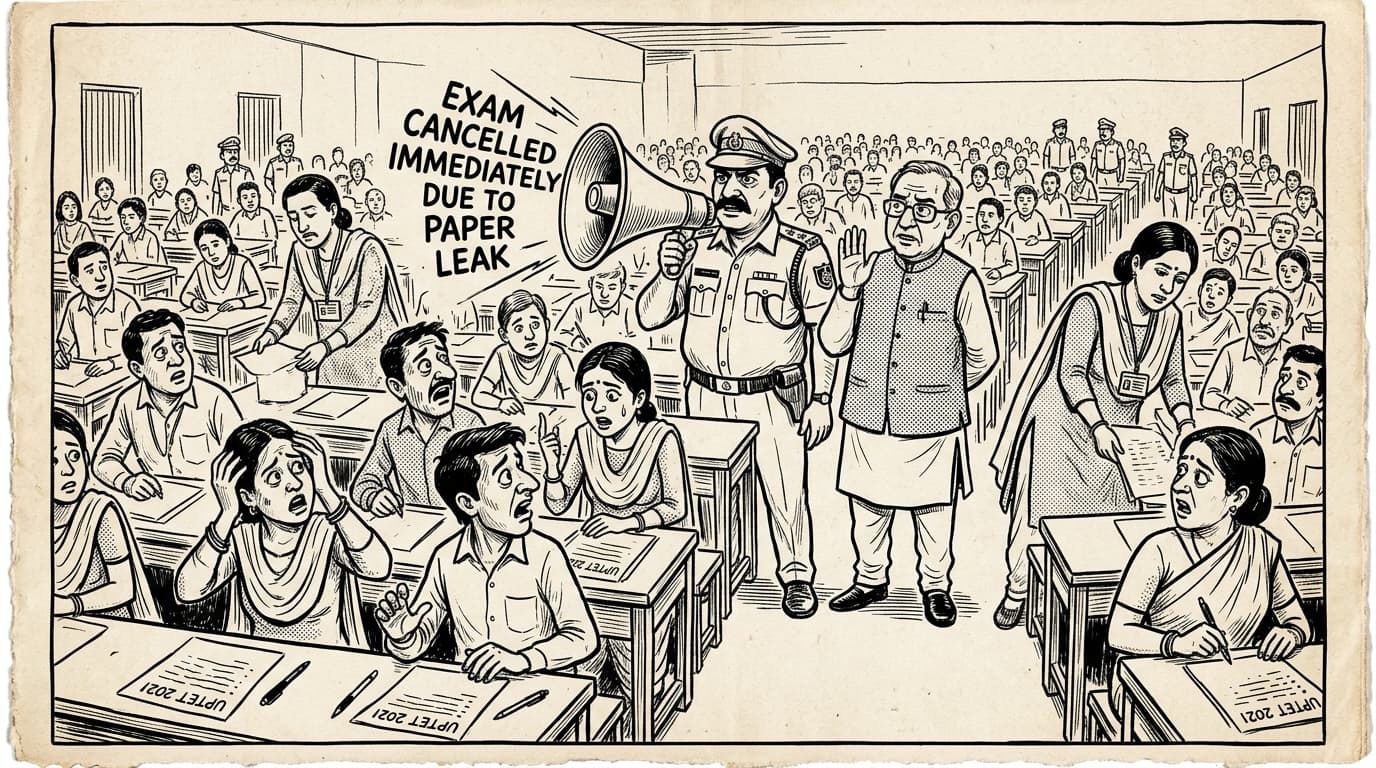
Editorial Illustration:Editorial illustration reflecting the events and context of The Mid-Exam Interruption: Inside the UPTET WhatsApp Breach and the Twenty-Lakh Bus Ride.
VINTAGE INK ARCHIVE
### By Newsroom Editorial Desk
*Published January 25, 2022 (Archived in the National Examination Integrity Repository)* | Archival Incident INC-2021-UP-LUCKNOW-012
At 10:38 on the morning of Sunday, November 28, 2021, a sudden, surreal silence fell over Examination Hall Number 4 at an intermediate college in Gorakhpur, eastern Uttar Pradesh.
Around seventy candidates—mostly young women and men from agricultural hamlets across Purvanchal—were hunched over their desks, filling in optical mark recognition (OMR) bubbles with black ballpoint pens. They were thirty-eight minutes into the Uttar Pradesh Teacher Eligibility Test (UPTET 2021). The questions on child pedagogy, Hindi grammar, environmental science, and basic arithmetic were familiar; for many, this test was the culmination of three years of private B.Ed coaching, countless night shifts under solar lanterns, and family debts incurred to pay tuition fees. Qualifying this exam was their only pathway to a permanent primary school teaching post with a government salary of ₹42,000 a month.
Without warning, the classroom door swung open. The centre superintendent walked in, accompanied by two armed constables and three visibly shaken invigilators.
"Stop writing," the superintendent announced, his voice crackling with nervous tension. "Do not darken any more circles. Hand over your question booklets and OMR sheets immediately."
A young woman in the front row looked up, her pen hovering in mid-air. "Sir, there are still ninety minutes left," she protested.
"The exam has been cancelled by the state government," the superintendent said flatly. "The paper was leaked. Everyone must vacate the premises immediately."
Within five minutes, the scene was replicated across 2,736 examination centres in all 75 districts of Uttar Pradesh. In Varanasi, Prayagraj, Meerut, Agra, Lucknow, and Jhansi, invigilators walked up and down aisles, literally snatching question booklets from the hands of crying, pleading candidates.
It was the largest mid-examination cancellation in the history of Indian public education: a simultaneous, statewide termination affecting 20,67,249 registered candidates.
1. The ₹20,000 WhatsApp PDF
The disaster had not begun in the morning; it had unfolded in plain sight during the quiet hours of Saturday night.
Around 11:00 PM on November 27, PDF files containing images of freshly printed test booklets for both Shift-1 (Primary) and Shift-2 (Upper Primary) began circulating in closed WhatsApp and Telegram groups. The files were not blurry photographs of hand-scrawled notes. They were sharp, full-page scans of the official UPTET question papers, complete with official serial fonts, watermark seals, and margin registration marks.
In coaching hostels across Prayagraj’s Katra and Salori neighborhoods, and in private residences in Mathura and Bulandshahr, touts were offering the solved PDF for prices ranging from ₹20,000 to ₹50,000. By 3:00 AM, the PDFs had slipped out of paid syndicate channels into wider student networks. By 6:00 AM, hundreds of aspirants waiting outside bus stops and railway stations were reading questions off their smartphone screens, assuming they were standard mock test forwards—until they realized that everyone around them was reading the exact same questions.
At 7:00 AM, the Uttar Pradesh Special Task Force (STF) intercepted several touts exchanging cash and phone screens near a highway dhaba in Mathura. The STF immediately transmitted copies of the intercepted PDF to senior home department officials and the Basic Education Directorate in Lucknow.
By 8:30 AM, officials compared the WhatsApp text with the confidential master booklet stored in the examination vault. Every single question—from environmental pedagogy to mathematical problem sets—matched verbatim.
Inside the state secretariat, an emergency consultation was held. Over two million candidates were already entering test centres; gates were closing, and the logistics of halting an exam across 75 districts before 10:00 AM was an administrative nightmare. The government allowed the test to begin at 10:00 AM, hoping to confirm the exact scope of the leak. But as reports flooded in from district magistrates that the WhatsApp files had been downloaded in virtually every district, Chief Minister Yogi Adityanath pulled the plug. At 10:35 AM, the order for statewide termination was issued.
2. The Exodus on Free Buses
What followed the morning cancellation was a logistical crisis of staggering proportions.
Over two million candidates—many of whom had traveled all night by unreserved passenger trains, sleeper buses, and shared auto-rickshaws to reach assigned district headquarters far from their villages—were suddenly dumped onto the streets at 11:00 AM. In cities like Prayagraj, Kanpur, and Lucknow, thousands of furious, weeping candidates gathered at major intersections and railway stations. Slogans were shouted, tears were shed, and an explosive public protest seemed imminent.
Recognizing the immense political and law-and-order peril, Chief Minister Yogi Adityanath appeared on state television and radio with an unprecedented emergency decree:
- Free Transport on State Buses: Every one of the twenty lakh candidates was granted immediate, free travel across Uttar Pradesh on Uttar Pradesh State Road Transport Corporation (UPSRTC) buses. All a student needed to do was show their UPTET admit card to the bus conductor to travel back to their home district without paying a single rupee.
- Zero Retest Fees: The examination would be reconducted within one month under fortified security, with no additional application fee.
- The Iron Fist: The Chief Minister promised that the perpetrators would face the National Security Act (NSA) and the UP Gangsters Act, and that the state would demolish their illegally acquired properties with bulldozers.
Within hours, bus depots across Uttar Pradesh were overwhelmed. Fleets of red UPSRTC buses were mobilized to ferry tens of thousands of stranded students from district centres back to rural towns and villages. The roads of Uttar Pradesh witnessed the poignant spectacle of a two-million-strong student army traveling home on free state buses—exhausted, disillusioned, and clutching admit cards that had turned into bus tickets.
3. The Unvetted Press: The Story of RSM Finserv
While candidates traveled home, the UP STF launched an aggressive forensic hunt to identify how twenty lakh question papers had leaked before the ink was barely dry.
The investigation led directly to the office of the highest examination authority in the state: Sanjay Kumar Upadhyay, the Secretary of the Examination Regulatory Authority (ERA) based in Prayagraj.
In the institutional hierarchy of Uttar Pradesh education, the Secretary of the ERA is the absolute custodian of examination integrity. Upadhyay was responsible for drafting the papers, selecting the printing press, overseeing transportation to district treasuries, and ensuring confidential protocols.
When STF sleuths interrogated Upadhyay and audited the procurement files, they uncovered an act of astonishing institutional negligence and corruption.
Under official state guidelines for high-stakes examinations involving over a million candidates, printing contracts may only be awarded to certified, high-security currency or security printing presses equipped with round-the-clock biometric access, CCTV surveillance, signal jammers, and non-disclosure vetting.
Instead, Upadhyay had awarded the lucrative multi-crore contract to print 21 lakh question papers to RSM Finserv Ltd., a private commercial company registered in Okhla, New Delhi, owned by a businessman named Rai Anoop Prasad.
The investigation revealed:
- Zero Security Credentials: RSM Finserv was essentially a financial consultancy and commercial trading firm. It did not possess a secure printing facility, had never printed a national competitive exam, and lacked basic security press accreditations.
- The Secret Noida Meeting: STF investigators recovered hotel security footage and CDR (Call Detail Record) logs proving that Sanjay Kumar Upadhyay and Rai Anoop Prasad had held a covert, private meeting at a luxury hotel in Gautam Buddh Nagar in late October 2021, just days before the tender was formally granted. Upadhyay awarded the tender without floating an open, transparent global bid or verifying the company’s factory premises.
- The Chain of Outsourcing: Lacking the industrial machinery to print 21 lakh multi-page test booklets within weeks, RSM Finserv secretly sub-contracted the printing to four third-party commercial printing presses across Delhi and western Uttar Pradesh.
The moment the confidential manuscripts were handed over to commercial presses with low-wage pressmen and zero security audits, secrecy evaporated. Press workers and supervisors photographed the pages, generated digital PDFs, and sold them to broker networks in western UP for a few lakh rupees.
4. The Custodial Fall: The Secretary in Handcuffs
The retribution was swift.
On November 30, 2021, an STF team raided the corporate offices of RSM Finserv in New Delhi, arresting director Rai Anoop Prasad. Prasad admitted during custodial interrogation that his firm possessed neither the machinery nor the security clearances to handle an examination of such scale, and that the contract had been procured through corrupt collusion.
On December 1, 2021, the Uttar Pradesh government officially placed ERA Secretary Sanjay Kumar Upadhyay under suspension. Within hours, STF officers arrived at his official residence in Prayagraj, took him into custody, and formally arrested him under Sections 420 (Cheating), 467, 468, 471 (Forgery), and 120B (Criminal Conspiracy) of the Indian Penal Code, alongside the Prevention of Corruption Act, 1988 and the UP Public Examinations Act.
Over the next two weeks, the STF conducted a statewide sweep, arresting more than 38 individuals across Mathura, Prayagraj, Aligarh, and Lucknow. The arrested included solver gang kingpins, coaching institute owners, and complicit press workers. The state government invoked the stringent UP Gangsters and Anti-Social Activities (Prevention) Act, initiating formal proceedings to attach and seize the private properties and bank accounts of the syndicate operators.
In judicial proceedings before the High Court of Judicature at Allahabad, judges repeatedly rejected the bail petitions of Sanjay Kumar Upadhyay and Rai Anoop Prasad. The court noted with grave indignation that when the highest administrative custodian of an examination sells out his institutional trust, he does not merely commit a financial fraud; he poisons the well of public education, demoralizes an entire generation of honest youths, and severely imperils the future of millions of school children.
5. The January 23 Retest: The Overhaul
Faced with massive public skepticism and looming state assembly elections, the Uttar Pradesh government worked around the clock to restore credibility.
A new ERA administration was appointed. The basic education department bypassed private commercial printers entirely, contracting government security printing facilities and certified RBI-grade security presses to produce fresh sets of question papers. The logistics were overhauled from scratch:
- Tamper-Evident Envelopes: Question booklets were sealed in specialized, three-layered tamper-evident waterproof packaging that could only be unsealed inside the exam hall in the presence of two candidate witnesses.
- Armed Strongroom Escorts: Papers were transported directly from treasuries to examination centres under armed police escorts, with GPS tracking enabled on all transit vehicles.
- Live Command Feeds: All 2,736 centres were mandated to connect their CCTV cameras to a centralized digital command room at the Basic Education Directorate in Lucknow.
On Sunday, January 23, 2022, the UPTET re-examination was conducted across all 75 districts.
Despite severe winter chill and lingering COVID-19 precautions, 18,22,112 candidates turned out to write the examination—an extraordinary turnout rate exceeding 88%. The test concluded peacefully without a single report of paper compromise, proving that administrative integrity is not a matter of technical impossibility, but of political and bureaucratic will.
When results were declared on April 8, 2022, a total of 5.1 lakh candidates qualified (2.94 lakh for Primary and 2.16 lakh for Upper Primary), finally earning their hard-won eligibility certificates.
6. The Lingering Scars of November 28
The UPTET 2021 scandal stands as an enduring case study of the vulnerabilities that plague state-level public recruitment in India.
It laid bare the lethal cocktail of bureaucratic hubris and private greed: how an unvetted commercial printer in an industrial suburb of Delhi could be handed the destiny of two million citizens through a clandestine hotel meeting, and how a ₹20,000 WhatsApp forward could bring the administrative apparatus of India’s most populous state to a grinding halt.
The image of that Sunday morning—the twenty-year-old student sitting in Gorakhpur having her test paper snatched away while the clock still ticked, and the two million aspirants riding home in silence on state buses—remains etched in the collective memory of Uttar Pradesh. It was the day the examination system broke in broad daylight, and the day an entire generation learned how fragile their aspirations truly were.
7. Chronological Case Timeline
| Date & Time | Authority / Entities Involved | What Happened & Case Developments | Verified Source Link |
|---|---|---|---|
| 2021-10-25 | Examination Regulatory Authority (ERA) | ERA Secretary Sanjay Kumar Upadhyay bypasses government procurement guidelines to award the confidential contract for printing UPTET question papers to RSM Finserv Ltd., owned by Rai Anoop Prasad, following an unrecorded hotel meeting in Gautam Buddh Nagar. | Hindustan Times Investigation |
| 2021-11-20 | RSM Finserv Ltd. | Lacking industrial security press infrastructure, RSM Finserv clandestinely subcontracts the printing of over 21 lakh examination papers to four third-party commercial printing presses in Delhi and western UP, destroying chain-of-custody secrecy. | India Today Crime Bureau |
| 2021-11-27 (23:00 IST) | WhatsApp Solver Networks | Solved question paper sets for both UPTET Primary and Upper Primary shifts are leaked via WhatsApp and Telegram groups originating from Mathura, Prayagraj, and Bulandshahr, sold to coaching candidates for ₹20,000–₹50,000. | The Times of India Ground Report |
| 2021-11-28 (07:00 IST) | Uttar Pradesh Special Task Force (STF) | UP STF intercepts the leaked papers during pre-dawn tracking, arresting 29 suspects across Mathura, Prayagraj, and Lucknow; STF verifies text against master question papers and alerts Chief Minister Yogi Adityanath. | The Indian Express Front Page |
| 2021-11-28 (10:00 IST) | Candidates & Examination Centres | Shift 1 of UPTET commences across 2,736 examination centres in all 75 districts of Uttar Pradesh, with over 12.9 lakh candidates actively writing the test. | Economic Times Coverage |
| 2021-11-28 (10:35 IST) | Chief Minister Yogi Adityanath | CM Yogi Adityanath orders immediate statewide cancellation of UPTET 2021; invigilators enter classrooms forty minutes into the exam and confiscate question booklets and OMR sheets directly from students' desks. | The Hindu Live Coverage |
| 2021-11-28 (11:00 IST) | Government of Uttar Pradesh | UP government announces free emergency travel for all 20 lakh candidates on UPSRTC state buses upon presenting admit cards; promises a transparent re-examination within one month without any additional application fee. | Hindustan Times Transit Report |
| 2021-11-30 | UP STF & Delhi Police | UP STF raids RSM Finserv Ltd. in Okhla, New Delhi, arresting director Rai Anoop Prasad for gross negligence and criminal breach of confidentiality covenants. | India Today Crime Bureau |
| 2021-12-01 | UP Basic Education Department & STF | State government suspends Examination Regulatory Authority Secretary Sanjay Kumar Upadhyay; UP STF arrests Upadhyay in Lucknow under the Prevention of Corruption Act, IPC 420/120B, and UP Public Examinations Act. | The Indian Express Lucknow |
| 2021-12-05 | UP Police Headquarters | UP Police invokes the UP Gangsters and Anti-Social Activities (Prevention) Act and initiates attachment of properties of syndicate leaders; arrests surpass 38 individuals. | Times of India Crime Desk |
| 2021-12-22 | Basic Education Department, UP | Government officially issues revised schedule for UPTET 2021 re-examination, set for January 23, 2022, under freshly contracted government security printing facilities. | Livemint Official Notice |
| 2022-01-23 | Basic Education Department & UP Police | UPTET 2021 re-examination is successfully conducted across 75 districts for 18,22,112 candidates under armed police deployment and live CCTV feed monitoring at state control rooms. | Hindustan Times Education |
| 2022-04-08 | Examination Regulatory Authority | ERA declares final UPTET 2021 results; 2.94 lakh candidates qualify for Primary Level and 2.16 lakh qualify for Upper Primary Level. | NDTV Results Bureau |
| 2022–2024 | Allahabad High Court | High Court of Judicature at Allahabad repeatedly rejects bail petitions of Sanjay Kumar Upadhyay and Rai Anoop Prasad, observing that corrupting the selection of elementary teachers inflicts irreparable damage on future generations. | Allahabad High Court Orders via Indian Kanoon |
8. Sources & Further Reading
- UPTET 2021 exam cancelled after paper leak, STF arrests 29 people
Publication: The Economic Times
Date: November 28, 2021
- UPTET cancelled due to paper leak; Yogi says culprits to be booked under NSA, Gangsters Act
Publication: The Hindu
Date: November 28, 2021
- UPTET paper leak: Suspended ERA Secretary arrested
Publication: The Indian Express
Date: December 2, 2021
Direct URL: https://indianexpress.com/article/cities/lucknow/uptet-paper-leak-suspended-era-secretary-arrested-7650893/
- UPTET paper leak: ERA secretary awarded tender to firm without checking credentials
Publication: Hindustan Times
Date: December 3, 2021
- UPTET candidates to get free travel in UPSRTC buses
Publication: Hindustan Times
Date: November 28, 2021
- UPTET 2021 re-exam concludes peacefully; over 80 per cent turnout recorded
Publication: Hindustan Times
Date: January 23, 2022
- Government of Uttar Pradesh Official Gazette & Basic Education Directorate
Document: Executive Order No. 1827/2021 on Statewide Examination Annulment
Direct URL: https://basiceducation.up.gov.in
- High Court of Judicature at Allahabad Case Record
Forum: Allahabad High Court Bail Application Bench
Direct URL: https://allahabadhighcourt.in
Comments
0Want to participate in the discussion?
No comments yet. Start the discussion above.