The Midnight Convoy to Hazaribagh: Inside the BPSC TRE 3.0 Paper Leak
•INVESTIGATIVE DISPATCH•BY ADITYA
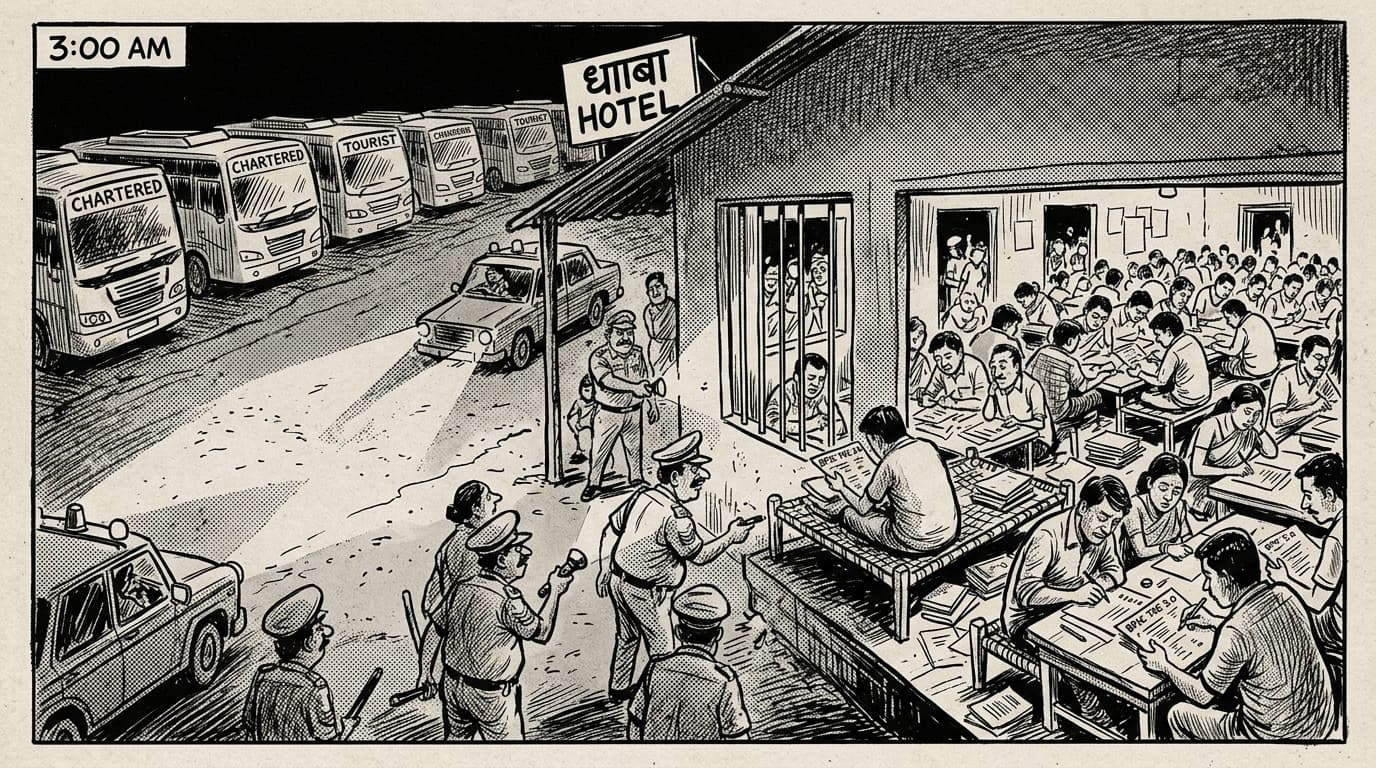
Editorial Illustration:Editorial illustration reflecting the events and context of The Midnight Convoy to Hazaribagh: Inside the BPSC TRE 3.0 Paper Leak.
VINTAGE INK ARCHIVE
### By Newsroom Editorial Desk
*Published March 22, 2024 (Archived in the National Examination Integrity Repository)* | Archival Incident INC-2024-BR-PATNA-021
On the night of Thursday, March 14, 2024, half a dozen chartered tourist buses with blackened windows slipped quietly out of private parking lots on the southern outskirts of Patna, Gaya, and Nawada.
Aboard the buses were more than three hundred young men and women. They carried no luggage except small plastic folders containing their most valuable possessions on earth: their original matriculation certificates, intermediate marksheets, B.Ed and D.El.Ed diplomas, and signed blank bank cheques.
The passengers were candidates for the third phase of the Bihar School Teacher Recruitment Examination (BPSC TRE 3.0), scheduled to be conducted the following morning by the Bihar Public Service Commission. With 87,774 permanent teacher posts on offer, the examination had drawn nearly four lakh applicants across the state. In Bihar’s agrarian districts, where secure formal employment is nearly nonexistent, qualifying for a permanent teacher post offers more than a livelihood: it offers an escape from generational poverty, social prestige, and a guaranteed pension.
Yet, the buses were not heading toward designated examination centres in Bihar.
They were speeding south down National Highway 22, crossing the forested state border into Jharkhand. Their destination was Hazaribagh, a quiet plateau town eighty kilometers inside Jharkhand territory. There, behind the locked gates of Kohinoor Hotel and several private marriage banquet halls, an industrial-scale solver camp had been constructed to execute the ultimate academic heist.
1. The ₹10-Lakh Banquet Hall in Hazaribagh
The business model was executed with military precision.
For weeks prior to March 15, broker networks operating across central Bihar had solicited candidates through trusted village intermediaries and coaching centers. The guarantee was total: 100% selection in the primary or middle-school teaching cadre. The price: ₹10 lakh per candidate.
To ensure compliance, the syndicate enforced a ruthless collateral mechanism. Before boarding the buses, candidates surrendered their original academic diplomas and signed undated cheques for the full amount. If a candidate failed to pay after the merit list was released, their certificates would be withheld, destroying their ability to apply for any future government job.
Upon arriving in Hazaribagh between 1:00 AM and 3:00 AM on Friday, March 15, the candidates were ushered into locked banquet halls and private guest rooms. Handlers confiscated all mobile phones and wristwatches.
Inside the rooms, high-speed laser printers and industrial photocopiers were humming in overdrive. Syndicate technicians had inserted encrypted USB pen drives into laptops, downloading complete, multi-page test booklets for both Shift-1 (Classes 1–5 Primary) and Shift-2 (Classes 6–8 Middle School).
The printouts were distributed in batches. Stationed around the banquet tables were expert "solvers"—coaching teachers recruited from Patna and Nalanda—who guided the candidates through each question, reading out correct answers and forcing students to memorize the serial options: Question 24, Option C; Question 25, Option A.
The plan was simple: the candidates would memorize the solutions until 6:00 AM, eat a quick breakfast, and board waiting passenger vans that would rush them across the border to their assigned exam centres in Gaya, Nawada, and Aurangabad just in time for the 9:30 AM bell.
They never left the banquet hall.
2. The 5:00 AM Raid: EOU Strikes
At 5:00 AM, as dawn broke over the Hazaribagh hills, a joint strike force of the Bihar Police Economic Offences Unit (EOU) and Jharkhand District Police breached the hotel perimeter.
Acting on real-time cyber intelligence and covert surveillance of the bus charter operators, EOU detectives stormed Kohinoor Hotel and the adjacent marriage grounds.
The scene inside was pandemonium. Syndicate handlers attempted to smash laptops and fling pen drives out of windows; candidates huddled in terror under banquet tables; reams of freshly printed question papers fluttered across the floor.
The police operation resulted in one of the largest single-day mass detentions in Indian testing history:
- Over 270 individuals detained, including 266 candidates and key middleman handlers;
- Multiple encrypted USB pen drives containing unreleased BPSC question paper PDF files;
- High-speed laser printers, photocopiers, and laptops used to produce paper copies on site;
- Suitcases filled with original candidate diplomas, Class 10/12 marksheets, and signed blank bank cheques; and
- Fleets of chartered buses and transport vans idling outside.
The detainees were rounded up, placed under armed guard, and loaded onto state police buses to be transported back across the border to the EOU headquarters in Patna for custodial interrogation.
Yet, even as the Hazaribagh raid concluded, the bureaucratic machinery in Patna refused to halt.
3. The Institutional Standoff: BPSC vs. EOU
At 9:30 AM on Friday, March 15, while hundreds of detained candidates were being driven in police convoys toward Patna, the BPSC TRE 3.0 examination commenced across 415 examination centres in 26 districts of Bihar. Over 3,75,000 candidates sat for Paper-1, followed by Paper-2 in the afternoon.
The EOU had notified BPSC officials early Friday morning about the Hazaribagh raid. However, the commission initially resisted calls for an immediate cancellation.
In an official statement issued on March 16, the BPSC stated that while it had taken note of the EOU's communication, it required "concrete, undeniable physical proof" that the question paper had leaked prior to the exam, demanding to know the exact timeline and source before cancelling a test involving nearly four lakh citizens.
The EOU responded with overwhelming forensic force.
Forensic cyber specialists at the EOU extracted the metadata from the seized pen drives recovered from Kohinoor Hotel at 5:00 AM. The digital timestamps confirmed that the PDF files had been created and stored on the flash drives hours before the examination began.
When the EOU compared the questions printed in Hazaribagh against the official master booklets distributed in examination halls, the match was devastating:
- 100% Verbatim Duplication: Every question across General Studies, Language, and Technical Pedagogy was identical in exact numerical sequence, down to grammatical errors and punctuation marks.
- The Master Manuscript Proof: The soft copies on the pen drives did not originate from a photograph of a printed booklet taken inside an exam hall. They were high-resolution pre-press digital proofs—the exact digital files sent to the printing facility.
On March 18 and 19, the EOU submitted an exhaustive 100-page forensic report to the BPSC Chairman and the Education Department.
Faced with irrefutable legal proof that could not survive judicial review, the BPSC surrendered. On Wednesday, March 20, 2024, the commission issued an official notification declaring the complete, statewide cancellation of both shifts of the TRE 3.0 examination.
4. The Shadow of Nalanda: The Sanjeev Mukhiya Nexus
The Hazaribagh bust was not an isolated venture by small-time local brokers. It led investigators directly into the beating heart of India's most entrenched academic mafia: the Sanjeev Mukhiya syndicate.
Hailing from Nalanda district, Bihar—the historic home turf of Ranjit Don two decades earlier—Sanjeev Kumar Singh alias Sanjeev Mukhiya was the supreme kingpin of paper-leak cartels across eastern India. Mukhiya, a former village head with deep political connections, had built an underground empire specializing in procurement from private printing presses. His son, Dr. Shiv Kumar (an MBBS graduate), acted as the operational coordinator, organizing solver networks and hotel camps.
The EOU investigation revealed that the syndicate had bypassed state borders entirely. Mukhiya’s operatives had compromised an employee at an outsourced private security printing press in Kolkata, West Bengal, where the BPSC manuscripts had been sent for mass printing. The digital files had been smuggled out on an encrypted flash drive days before the examination and ferried to Hazaribagh.
The Mukhiya network was an interstate cartel with near-monopolistic reach:
- Weeks earlier, elements of the same syndicate had been linked to the UP Police Constable and RO/ARO leaks;
- Weeks later, in May 2024, the exact same Sanjeev Mukhiya gang would execute the infamous NEET-UG 2024 paper breach at Learn Play School in Patna, plunging the entire Indian medical education system into a constitutional crisis.
Over the spring and summer of 2024, the EOU arrested over 296 individuals in connection with the TRE 3.0 case, including government clerks, coaching proprietors, transport operators, and candidate brokers.
5. The July Retest: Reclaiming the Classroom
Faced with furious public demonstrations by job-seekers across Bihar, the state government and BPSC undertook a complete administrative and security overhaul.
The commission scrapped its contracts with the compromised Kolkata printing facility, transitioning to certified government security presses equipped with round-the-clock paramilitary surveillance.
Between July 19 and July 22, 2024, the BPSC re-conducted the TRE 3.0 examination across Bihar under unprecedented security measures:
- AI Facial Recognition & Biometrics: Every candidate’s identity was verified through dual-biometric facial and fingerprint scans at centre entry points, cross-referenced with their initial application photographs to prevent impersonators.
- Live Video Webcasting: CCTV cameras inside every single examination classroom were linked directly to a centralized digital command room at BPSC headquarters in Patna.
- Three-Tier Tamper Seals: Question paper trunks were fitted with digital GPS locks that could only be unsealed via one-time passwords (OTP) transmitted simultaneously to the static magistrate and central observers minutes before the bell.
The re-examination concluded peacefully without a single breach, restoring a measure of dignity to a recruitment process that had been pushed to the edge of collapse.
In successive hearings before the High Court of Judicature at Patna, judges repeatedly dismissed bail petitions filed by the arrested syndicate handlers, affirming that those who orchestrate interstate solver camps and traffic in examination papers commit an unforgivable crime against the youth of Bihar.
6. The Enduring Lesson of Hazaribagh
The BPSC TRE 3.0 scandal of March 2024 revealed the sheer scale and commercial sophistication of India’s modern examination mafias.
It demonstrated that the solver racket had evolved far beyond the clandestine classroom whisper or the smuggled micro-Bluetooth earpiece. It had become a full-scale corporate logistics enterprise: chartering interstate bus fleets, booking entire hotels in neighboring states, deploying industrial laser printers, and moving hundreds of candidates across state lines under the cover of darkness.
Yet, Hazaribagh also demonstrated the power of decisive police intelligence.
The pre-dawn raid by the Bihar EOU intercepted the paper while it was still being memorized in the banquet hall, creating the digital forensic paper trail that made denial impossible. For the 3.75 lakh honest candidates who returned to the examination halls in July, the fall of the Hazaribagh camp was proof that while the syndicates may cross borders, the law can still catch them in the dawn.
7. Chronological Case Timeline
| Date & Time | Authority / Entities Involved | What Happened & Case Developments | Verified Source Link |
|---|---|---|---|
| 2024-03-10 | Kolkata Printing Press & Syndicate | Operatives affiliated with the Sanjeev Mukhiya solver network procure unencrypted digital copies of the BPSC TRE 3.0 question papers directly from an outsourced printing press in Kolkata prior to bulk distribution. | The Indian Express Crime Bureau |
| 2024-03-14 (Night) | Solver Gang & Candidates | Over 300 candidates from various districts of Bihar are boarded onto chartered tourist buses and driven across the Jharkhand border to hotels and marriage halls in Hazaribagh, surrendering original certificates for ₹10-lakh solver access. | NDTV News Bulletin |
| 2024-03-15 (05:00 IST) | Bihar Police Economic Offences Unit (EOU) | In a synchronized dawn raid, Bihar EOU sleuths and Jharkhand Police storm Kohinoor Hotel and nearby marriage halls in Hazaribagh; detain 270+ people including 266 candidates and handlers, seizing pen drives with live question sets, laptops, and high-speed printers. | The Times of India Patna |
| 2024-03-15 (09:30–17:00 IST) | BPSC & Candidates | Both shifts of TRE 3.0 proceed across 415 examination centres in Bihar for 3.75 lakh candidates, while EOU forensics extracts matching PDF documents from the seized Hazaribagh flash drives. | Hindustan Times Education |
| 2024-03-16 | Economic Offences Unit (EOU) | EOU formally registers FIR No. 06/2024 in Patna under IPC Sections 420, 467, 468, 471, 120B and the Bihar Conduct of Examinations Act against Sanjeev Mukhiya syndicate handlers and detained candidates. | Bihar EOU Official Press Release |
| 2024-03-18 | Bihar EOU & BPSC | EOU submits an exhaustive forensic dossier to BPSC Chairman, proving that question paper files recovered from pen drives in Hazaribagh at 5:00 AM were a 100% verbatim duplicate of the live BPSC master papers. | India Today Education Bureau |
| 2024-03-20 | Bihar Public Service Commission (BPSC) | BPSC issues an official notification cancelling the TRE 3.0 examination for both shifts held on March 15, 2024, citing the conclusive evidence provided by the EOU. | BPSC Official Cancellation Notice |
| 2024-04-12 | Bihar Police EOU | EOU unmasks the kingpin of the operation as Sanjeev Kumar Singh alias Sanjeev Mukhiya and his son Dr. Shiv Kumar, issuing non-bailable arrest warrants across multiple states. | The Indian Express Patna |
| 2024-05-10 | Patna High Court | Patna High Court rejects bail petitions of detained solver ring managers and candidate intermediaries, observing that the interstate coaching camps represent a grave threat to educational governance. | Patna High Court Orders via Indian Kanoon |
| 2024-07-19 to 2024-07-22 | BPSC & District Administrations | BPSC successfully re-conducts the TRE 3.0 examination across Bihar under fortified security protocols: live webcasting, AI facial recognition, and strict question paper custody. | The Hindu National Coverage |
| 2024–2026 | Bihar Police EOU | Total arrests in the BPSC TRE 3.0 paper leak case reach 296, as EOU files multiple supplementary chargesheets before the Special Vigilance Court in Patna. | Bihar EOU Special Dossier |
8. Sources & Further Reading
- BPSC TRE 3.0 exam cancelled over paper leak; EOU arrests over 250 people
Publication: NDTV
Date: March 20, 2024
- BPSC paper leak: 270 detained in Hazaribagh
Publication: The Times of India
Date: March 16, 2024
- BPSC teacher recruitment exam cancelled after paper leak
Publication: The Indian Express
Date: March 20, 2024
Direct URL: https://indianexpress.com/article/cities/patna/bpsc-teacher-recruitment-exam-cancelled-paper-leak-9225134/
- BPSC TRE 3.0 re-exam held peacefully across Bihar
Publication: The Hindu
Date: July 22, 2024
- Bihar Police Economic Offences Unit Official Case Dossier
Document: EOU PS Case No. 06/2024 & Press Releases
Direct URL: https://state.bihar.gov.in/eou
- Bihar Public Service Commission Official Announcement
Document: Notice on Cancellation of TRE 3.0 Examination
Direct URL: https://bpsc.bih.nic.in
- High Court of Judicature at Patna Case Record
Forum: Patna High Court Criminal Misc. Bench
Direct URL: https://patnahighcourt.gov.in
Comments
0Want to participate in the discussion?
No comments yet. Start the discussion above.