The Midnight Pause: Inside the Eleven-Hour Panic that Halted NEET-PG 2024 and Stranded Two Lakh Doctors
•INVESTIGATIVE DISPATCH•BY ADITYA
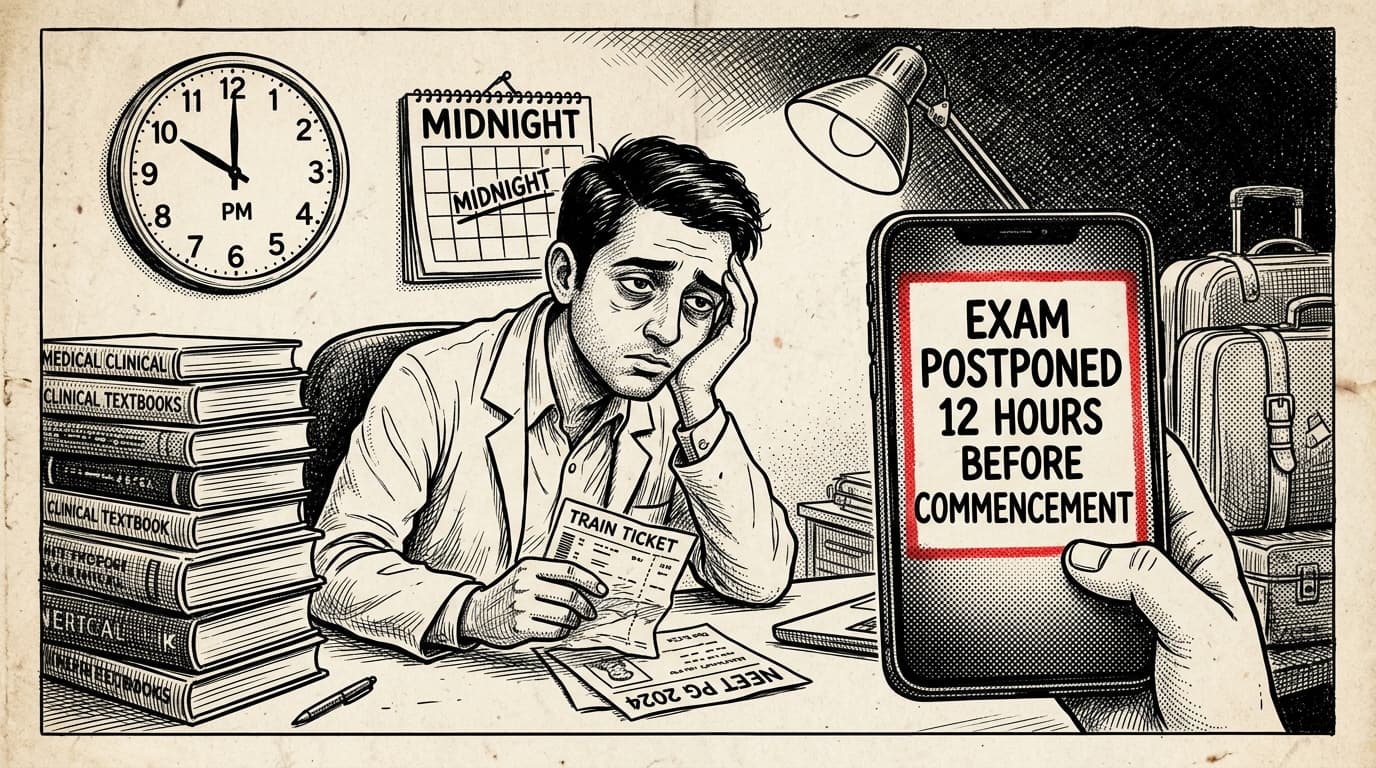
Editorial Illustration:Editorial illustration reflecting the events and context of The Midnight Pause: Inside the Eleven-Hour Panic that Halted NEET-PG 2024 and Stranded Two Lakh Doctors.
VINTAGE INK ARCHIVE
By Newsroom Editorial Desk
Published June 25, 2024 (Archived in the National Examination Integrity Repository) | Archival Incident INC-2024-NAT-NEETPG-024
On the night of Saturday, June 22, 2024, Dr. Ananya Sen, a twenty-six-year-old medical officer who had just completed a grueling twelve-hour casualty shift at a state medical college in Siliguri, was sitting on an unreserved bench in the crowded waiting room of New Jalpaiguri railway station. Her train had been delayed by four hours. She was traveling over four hundred kilometers to an allocated computer-based examination centre on the outskirts of Kolkata. Her admit card, printed on crisp A4 paper, instructed her to report to the venue at 7:00 AM the following morning for the National Eligibility cum Entrance Test (Postgraduate)—NEET-PG 2024.
Across the country, two lakh twenty-eight thousand junior doctors, medical residents, and interns were living variations of the same high-stakes pilgrimage. In Srinagar, candidates were negotiating pre-dawn taxis across mountain roads; in Bengaluru, young doctors were sleeping on cheap mattresses in budget lodges adjacent to industrial tech parks; in Delhi, hundreds were checking into dormitories after taking months of unpaid leave from hospital ICUs.
At precisely 10:00 PM Indian Standard Time—ten hours before the biometric scanners at more than a thousand testing centres were scheduled to open—an official notification flashed across the website of the Press Information Bureau. Issued by the Union Ministry of Health and Family Welfare, the headline was as blunt as it was devastating:
"Taking into consideration the recent incidents of allegations regarding the integrity of certain competitive examinations, the Ministry of Health has decided to undertake a thorough assessment of the robustness of processes of NEET-PG Entrance Examination... It has accordingly been decided, as a precautionary measure, to postpone the NEET-PG Entrance Examination scheduled to be held on 23rd June, 2024."
In the history of Indian competitive entrance tests, examinations had been postponed due to floods, violent political unrest, paper leaks discovered in transit, or pandemic lockdowns. But never before had a premier national postgraduate examination—one that determines the specialists, surgeons, and pediatricians of an entire subcontinent—been abruptly halted in the middle of the night solely as a "precautionary measure" against an intangible specter of panic.
The midnight pause of NEET-PG 2024 was not merely an administrative inconvenience. It was the definitive proof that India’s centralized examination ecosystem had reached a point of catastrophic psychological and systemic exhaustion.
1. The Crucible of June: A State Apparatus Under Siege
To understand why the Union Health Ministry pulled the emergency brake on June 22, one must reconstruct the twenty days of relentless institutional erosion that preceded that Saturday evening.
The crisis began on June 4, when the National Testing Agency (NTA) announced the results of NEET-UG 2024 on the same afternoon the nation watched the Lok Sabha general election vote counts. What was intended to be routine statistical processing immediately disintegrated into national fury. Sixty-seven candidates had achieved an impossible, unprecedented perfect score of 720 out of 720; thousands had received arbitrary "grace marks" for lost time under an undisclosed formula; and in Patna, the Economic Offences Unit (EOU) of the Bihar Police had already arrested thirteen members of an interstate solver cartel after seizing partially burnt question papers from a solver den in Ramkrishna Nagar.
Public trust evaporated overnight. But the real institutional domino fell two weeks later.
On Tuesday, June 18, the NTA conducted the UGC-NET across hundreds of cities for nine lakh aspiring university lecturers and doctoral researchers. Less than twenty-four hours later, on the evening of June 19, the Union Ministry of Education took the unprecedented step of outright cancelling the entire examination. The reason was chilling: the Indian Cyber Crime Coordination Centre (I4C) under the Ministry of Home Affairs had flagged that the question paper had been leaked and traded on encrypted darknet forums and Telegram channels a day before the test was administered.
Forty-eight hours after the UGC-NET cancellation, on Friday, June 21, the government announced the indefinite postponement of the Joint CSIR-UGC-NET, citing "logistical issues" and "unavoidable circumstances."
By Saturday morning, June 22, the central government was in a state of full administrative mobilization:
- The Director General of the NTA, Subodh Kumar Singh, was summarily removed from his post and placed on compulsory wait.
- A seven-member high-level expert committee, headed by former ISRO Chairman Dr. K. Radhakrishnan, was formed to recommend structural reforms in exam security and data protocols.
- The Union Home Ministry and cyber intelligence wings were placed on maximum alert.
Inside the Ministry of Health and Family Welfare at Nirman Bhawan in New Delhi, senior bureaucrats and officials of the National Board of Examinations in Medical Sciences (NBEMS) were watching the escalating crisis with acute dread. NEET-PG was not conducted by the NTA; it was managed by the NBEMS in technical partnership with Tata Consultancy Services (TCS). But to the public, the courts, and opposition politicians, technical distinctions between agencies had ceased to exist.
If NEET-PG were held on Sunday morning and even a single compromised question paper surfaced on social media, the credibility of the entire public healthcare recruitment apparatus would be shattered beyond repair.
2. The Ghost Papers of Telegram: Anatomy of a Digital Swarm
In the forty-eight hours leading up to June 22, the digital corridors inhabited by medical aspirants had become infested with predatory cyber rackets.
Dozens of newly minted Telegram channels—bearing names like "NEET-PG 2024 Paper Leak Real", "Original Leaked Paper NBEMS", and "Dr. Solver Medical Hub"—began flooding student discussion boards with screenshots of purported question sets. The operators claimed they possessed "master question banks" exfiltrated directly from confidential servers. The price for access was advertised between ₹50,000 and ₹2 lakh, payable via cryptocurrency wallets or anonymous UPI handles.
Earlier on Saturday, June 22, NBEMS had felt compelled to issue an urgent public caution notice. In a sharply worded document signed by its Cyber Security division, the Board assured candidates that the examination was physically and digitally impregnable:
"It has come to the notice that certain unscrupulous elements are circulating fraudulent messages on Telegram and social media platforms claiming to possess questions of NEET-PG 2024... NBEMS has lodged complaints with cyber crime authorities... The question papers for computer-based tests are generated through proprietary cryptographic algorithms and delivered to exam centres moments before the commencement of the exam via highly secure digital tunnels. No individual possesses access to the complete test paper."
Technically, the Board’s defense was entirely accurate. Unlike NEET-UG or UP Constable recruitment, which relied on physical paper printed at commercial presses and transported via private logistics vans to district bank vaults, NEET-PG had transitioned to a secure Computer-Based Test (CBT) model over a decade earlier. At TCS iON centres, question banks are encrypted with multiple key layers; the test decrypts only when candidate biometric logins synchronize with centralized server authorization keys on the morning of the exam.
Yet, in the hyper-suspicious climate of June 2024, cryptographic reality was irrelevant compared to political and psychological risk.
Intelligence agencies monitoring social media reported that the proliferation of scam channels was creating a mass perception of compromise. If thousands of desperate candidates believed a leak was possible, fraudulent claims would be treated as verified scandals the moment the test concluded. Furthermore, reports surfaced that cyber wings could not rule out sophisticated remote desktop access Trojans or impersonation rackets similar to the Russian hacker network uncovered during JEE Main 2021.
By 8:30 PM on Saturday, top-level meetings between the Health Ministry, the Prime Minister’s Office, and NBEMS leadership concluded that the system could not withstand another day of nationwide protests. The decision was taken: pull the plug immediately.
3. The 10:00 PM Shockwave: Humanity on the Roadside
The bureaucratic press release landed with catastrophic human consequences.
For India's junior doctors, NEET-PG is not an academic examination one casually strolls into. It is a grueling, life-altering ordeal. Medical graduates work eighty- to one-hundred-hour weeks in government hospitals, managing overloaded emergency rooms and performing emergency surgeries while carving out sleep-deprived hours to master nineteen distinct clinical subjects spanning Pathology, Pharmacology, Surgery, and Obstetrics.
To prepare for the June 23 date—which the NBEMS had already advanced from July 7 earlier in the year—thousands of candidates had taken extreme measures:
- Junior residents had resigned from non-academic posts, forfeiting their monthly stipends.
- Women doctors with nursing infants had traveled across multiple state lines accompanied by family members, booking hotel rooms near remote testing industrial zones.
- Candidates had expended significant portions of their modest savings on non-refundable last-minute flights, Tatkal train tickets, and overpriced accommodations.
[MOHFW PRESS RELEASE - 10:00 PM, JUNE 22]
                       │
         ┌─────────────┴─────────────┐
         ▼                           ▼
[2.28 Lakh Medical Doctors]  [Government Hospitals & ICUs]
- Stranded in transit hubs   - Emergency rosters gutted
- Unrecoverable travel funds  - Senior residents double-shifted
- Acute psychological trauma  - Complete crisis of faith
When news of the postponement broke at 10:00 PM, the scenes across the country were agonizing. At railway stations and airport lounges, doctors gathered around smartphone screens in disbelief. Outside TCS iON centres in Noida, Chennai, and Hyderabad, candidates who had arrived early to verify their reporting gates stood in stunned silence as security guards informed them that the test had been called off.
The Resident Doctors’ Associations—including the Federation of Resident Doctors’ Association (FORDA) and the Federation of All India Medical Association (FAIMA)—issued scathing midnight statements. They pointed out that while the government claimed to act in the interest of "sanctity," the timing of the decision demonstrated callous indifference toward the very frontline doctors whom the nation had celebrated as healthcare warriors during the COVID-19 pandemic.
Furthermore, the postponement had an immediate domino effect on India’s hospital infrastructure. Across major teaching hospitals, junior residents had swapped duties or taken emergency leaves to appear for the exam. With the test abruptly delayed to an unknown future date, department heads were left scrambling to reorganize emergency rosters, creating acute operational shortages in trauma and pediatric wards.
4. Chronological Case Timeline: The Road to the August Retest
The following verified chronological timeline details the sequence of administrative shifts, security scares, judicial interventions, and the final resolution of the NEET-PG 2024 crisis:
| Exact Date / Timestamp | Authority / Entities Involved | What Happened & What Changed | Verified Direct Link / Official Order |
|---|---|---|---|
| March 20, 2024 | National Board of Examinations in Medical Sciences (NBEMS) | NBEMS advances the examination date of NEET-PG 2024 from July 7 to June 23, 2024, aiming to expedite post-graduate counseling and college session starts. | NBEMS Date Advancement Notice |
| April 16, 2024 | NBEMS | Official Information Bulletin released; computer-based test scheduled across 1,000+ venues on Sunday, June 23, 2024 (9:00 AM to 12:30 PM). | NEET-PG 2024 Information Bulletin |
| June 4, 2024 | National Testing Agency (NTA) | NEET-UG 2024 results declared with 67 Rank-1 toppers and arbitrary grace marks, sparking national outrage and legal challenges over exam integrity. | NTA Official Release on NEET-UG |
| June 18, 2024 | NBEMS | Admit cards issued to 2,28,540 candidates, assigning examination centres across nearly 300 cities nationwide. | NBEMS Admit Card Notification |
| June 19, 2024 | Ministry of Education & I4C | Union Ministry cancels UGC-NET June 2024 within 24 hours of its conduct after darknet leaks are confirmed by the Ministry of Home Affairs. | MoE UGC-NET Cancellation Order |
| June 21, 2024 | NTA & CSIR | Joint CSIR-UGC-NET examination postponed indefinitely due to logistical disruptions and systemic security reviews. | NTA Public Notice on CSIR-NET |
| June 22, 2024 (11:00 AM) | NBEMS Cyber Security Section | NBEMS releases urgent advisory warning candidates against fraudulent Telegram groups selling fake question papers; lodges cyber FIRs. | NBEMS Cyber Caution Notice |
| June 22, 2024 (6:00 PM) | Ministry of Education / DoPT | Government removes NTA Chief Subodh Kumar Singh and constitutes high-level 7-member reform panel under Dr. K. Radhakrishnan. | DoPT PIB Notification PRID 2027906 |
| June 22, 2024 (10:00 PM) | Ministry of Health and Family Welfare (MoHFW) | MoHFW abruptly announces the postponement of NEET-PG 2024 just 10 hours before the exam as a "precautionary measure" to review security protocols. | MoHFW Press Release PRID 2027954 |
| June 23, 2024 | Medical Associations (FORDA, FAIMA) | National outcry from over 2.28 lakh stranded doctors; protests break out over wasted expenditures, mental trauma, and administrative failure. | FAIMA National Statement |
| July 2, 2024 | NBEMS | NBEMS announces revised exam date: August 11, 2024. The board announces the test will be conducted in two separate shifts with percentile normalization. | NBEMS Reschedule Notification |
| August 8, 2024 | NBEMS | NBEMS publishes its normalization formula, modeled on the AIIMS procedure, to combine scores across morning and afternoon shifts. | NBEMS Normalization Protocol Notice |
| August 9, 2024 | Supreme Court of India | A bench led by CJI D.Y. Chandrachud dismisses petitions seeking postponement and reallocation of test centres, refusing to jeopardize 2 lakh careers. | Supreme Court Order in Vishal Soren v. UOI |
| August 11, 2024 | NBEMS & TCS | NEET-PG 2024 reconducted successfully across 170 cities in two shifts without any leakage or security breach; attendance tops 95%. | NBEMS Successful Retest Notice |
| August 23, 2024 | NBEMS | Official results declared based on normalized percentile scores, ending two months of intense uncertainty for postgraduate medical aspirants. | NBEMS Result Declaration Notification |
5. The Normalization Battle: The August 11 Retest
When NBEMS finally announced the rescheduled examination for Sunday, August 11, 2024, it solved one logistical challenge only to create another bitter controversy.
Because of enhanced surveillance protocols, increased spacing between terminals, and the elimination of private unvetted examination centres, the testing partner TCS could not accommodate all 2.28 lakh candidates in a single morning session. For the first time in NEET-PG’s history, NBEMS announced that the examination would be divided into two separate shifts:
- Shift 1: 9:00 AM to 12:30 PM
- Shift 2: 3:30 PM to 7:00 PM
To reconcile the two distinct question papers, NBEMS announced that it would adopt the AIIMS normalization methodology, converting raw scores into percentiles.
The announcement sparked immediate panic among candidates. In medical entrance tests, where an error in two clinical diagnostic questions can drop a candidate’s rank by several thousand positions, normalization across two papers of varying difficulty was perceived as an arbitrary gamble. Furthermore, candidates were assigned test centres hundreds of miles from their home towns with less than a week’s notice, forcing thousands to scramble once again for emergency transport during the peak monsoon season.
A group of candidates, led by Dr. Vishal Soren, approached the Supreme Court of India under Article 32, seeking an urgent stay on the August 11 retest and demanding a single-shift examination with centres allocated within candidate home states.
On Friday, August 9—just forty-eight hours before the rescheduled test—a three-judge bench headed by Chief Justice of India Dr. D.Y. Chandrachud, along with Justices J.B. Pardiwala and Manoj Misra, took up the petition. The courtroom exchange captured the impossible tightrope between administrative perfection and public necessity:
Counsel for Petitioners: "My Lords, candidates have been assigned centres in cities five hundred kilometers away. The exam is being held in two shifts with different papers. Normalization without disclosing raw marks or answer keys destroys the sanctity of merit."
>
Chief Justice D.Y. Chandrachud: "How can we postpone an exam at the eleventh hour again? Two lakh candidates are appearing. The career of two lakh doctors is at stake. How can we jeopardize the future of all these doctors because a few people have approached this court? We cannot put the entire medical education system on hold."
The Supreme Court dismissed the petitions. On Sunday, August 11, 2024, the examination took place under unprecedented security: AI-driven CCTV surveillance, multi-factor biometric authentication, physical jammers, and direct monitoring by central cyber teams.
No question paper was leaked. No Telegram channel proved genuine. On August 23, 2024, results were declared, and the admissions cycle finally commenced—two months late, but intact.
6. The Lingering Malady: When Fear Becomes Policy
The midnight postponement of NEET-PG 2024 stands as a singular case study in modern institutional pathology.
Unlike Vyapam, AIPMT 2015, or the UP Police Constable scandal, where examinations were ruined by corrupt officials, compromised printing presses, and predatory commercial cartels, NEET-PG 2024 was brought down by the collapse of administrative self-confidence. The state had become so paralyzed by its own past failures—and so terrified of the political fallout of a potential paper leak—that it preemptively sacrificed the logistical well-being and psychological stability of over two lakh doctors to avoid the mere appearance of vulnerability.
It revealed an uncomfortable truth about India’s competitive testing architecture: the transition from paper to computer-based testing does not automatically confer resilience if the public trust surrounding the testing agency has decayed. When candidates believe the system is corrupt, fake Telegram scammers wield as much power to disrupt public administration as real organized syndicates.
Until examination authorities establish transparent, audited, and unassailable protocols—backed by institutional independence rather than panic-driven midnight diktats—the ghosts of Telegram will continue to haunt the corridors of Indian public recruitment.
Sources & Further Reading
1. Primary & Official Documents (Tier 1)
- Ministry of Health and Family Welfare (MoHFW): Press Release: Health Ministry Decides to Postpone NEET-PG 2024 Entrance Examination Scheduled for 23rd June 2024 as a Precautionary Measure (Published June 22, 2024, Press Information Bureau, New Delhi). PIB Release PRID 2027954.
- National Board of Examinations in Medical Sciences (NBEMS): Public Notice: Caution Advisory Against Fraudulent Social Media Messages Regarding NEET-PG 2024 (Dated June 22, 2024, NBEMS Cyber Security Section). NBEMS Cyber Advisory.
- Supreme Court of India: Order in Writ Petition (Civil) No. 493 of 2024 (Vishal Soren & Ors. v. Union of India & Anr.) (Coram: Hon'ble CJI Dr. D.Y. Chandrachud, Justice J.B. Pardiwala, Justice Manoj Misra; Decided August 9, 2024). Supreme Court Judgment Repository.
- NBEMS Public Notice: Conduct of NEET-PG 2024 in Two Shifts and Normalization Formula (Dated August 8, 2024). NBEMS Examination Protocol.
2. Investigative Journalism & Contemporary Reporting (Tier 2)
- The Indian Express: NEET-PG 2024 Postponed: 10 Hours Before Exam, Ministry Hits Pause Amid Paper Leak Concerns (June 23, 2024). Indian Express Investigation.
- The Hindu: Health Ministry Postpones NEET-PG Hours Before Exam; Resident Doctors Voice Outrage Over Eleventh-Hour Shock (June 23, 2024). The Hindu Report.
- NDTV: Inside the Midnight Exam Panic: Why Health Ministry Called Off NEET-PG At 10 PM (June 24, 2024). NDTV National Desk.
- LiveLaw: Supreme Court Refuses to Postpone NEET-PG 2024, Says Any Delay Will Jeopardize Careers of 2 Lakh Candidates (August 9, 2024). LiveLaw SC Coverage.
Comments
0Want to participate in the discussion?
No comments yet. Start the discussion above.