The Morphed Faces of Karkardooma: Inside the DSSSB Teacher Recruitment Solver Ring and the Supreme Court's Benchmark on Systemic Fraud
•INVESTIGATIVE DISPATCH•BY ADITYA
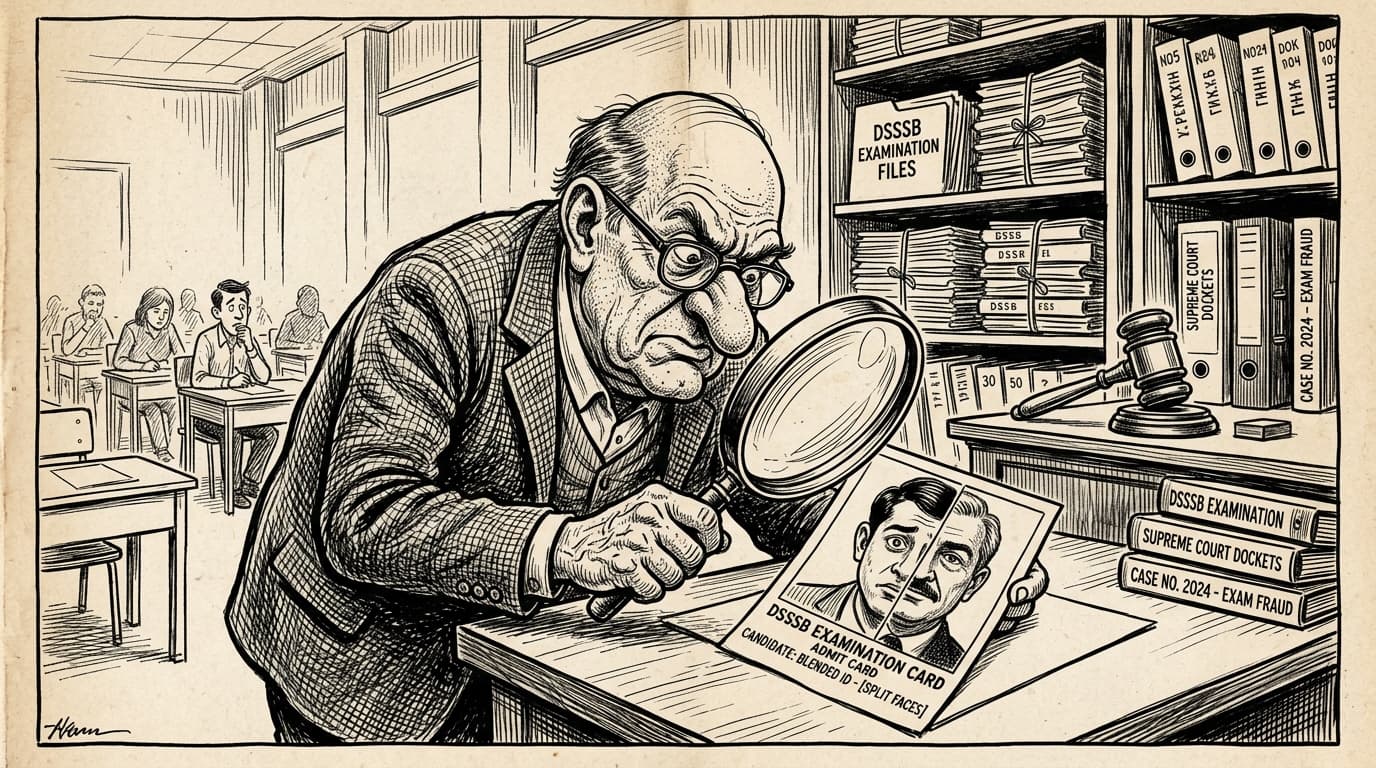
Editorial Illustration:Editorial illustration reflecting the events and context of The Morphed Faces of Karkardooma: Inside the DSSSB Teacher Recruitment Solver Ring and the Supreme Court.
VINTAGE INK ARCHIVE
I. The Classroom as the Auction Block
In the capital of the republic, a permanent teaching job in a government or municipal school is among the most coveted salaried positions. Beyond the stability of a central government pay scale and medical benefits, it offers social respect and a permanent sanctuary from the chaotic private school sector.
When the DSSSB issued advertisements across Post Codes 70/09, 1/13, 2/13, and 148/12 for over 4,300 teaching posts, it triggered an immense surge of applicants. The examination was designed as a single-tier, multiple-choice objective test evaluating general awareness, reasoning, numerical ability, Hindi, English, and specialized teaching methodologies.
However, the examination architecture of the DSSSB in 2014 was hobbled by an archaic reliance on physical paper workflows: - Admit cards were downloaded online, printed on ordinary desktop paper, and affixed with physical passport-sized photographs by candidates themselves. - Invigilation across hundreds of private school test centers was handled by contract teachers with minimal training in forensic identity verification. - OMR sheets were collected in paper bundles and transported to outsourced evaluation facilities without automated double-blind barcoding or tamper-evident digital tracking.
This administrative slack invited the attention of aggressive recruitment syndicates operating across the Delhi-NCR coaching belt of Mukherjee Nagar, Gandhi Nagar, and neighboring Haryana.
II. The Twin Modus Operandi: Morphed Faces and Blank Bubbles
The criminal syndicate, orchestrated by kingpin Sanjay Kumar and computer-savvy operators based in outer Delhi and Rohtak, offered candidates two distinct, expensive avenues to government appointments, charging between ₹8 lakh and ₹12 lakh per candidate.
1. The Photo-Morphing Impersonation Pipeline The first method was a technical refinement of the traditional "Munna Bhai" solver racket.
In ordinary impersonation scams, a proxy candidate enters the hall carrying a forged identity card bearing their own photo, risking immediate detection during subsequent document verification when the genuine candidate appears before the board.
To circumvent this, the syndicate utilized digital photo-morphing software: - Syndicate technicians blended the facial features of the genuine candidate with those of a high-scoring scholar solver (often a postgraduate from Rohtak, Kurukshetra, or Delhi University). - The resulting hybrid photograph—displaying an uncanny resemblance to both individuals—was uploaded during registration and printed on the official admit card. - In the examination hall, the scholar solver sat for the test. To the center invigilator, the morphed photo matched the face of the solver sitting at the desk. Months later, when the genuine candidate appeared for interview or document verification, the same morphed photograph bore enough resemblance to the candidate to pass superficial scrutiny.
2. The In-Vault Blank OMR Operation For candidates who preferred to sit in the examination hall themselves to avoid the risk of police arrest during impersonation, the syndicate offered the **Blank OMR strategy**.
Candidates were given a single, strict directive: Fill your roll number, booklet series, and signature. Do not touch a single question circle. Leave the entire sheet completely blank.
This strategy accomplished two objectives: - It completely eliminated the risk of negative marking. - It provided a pristine, unblemished sheet for post-exam intervention.
Following the conclusion of the test, corrupt insiders working inside the DSSSB confidential evaluation facility pulled the pre-identified roll numbers from the bundles. Armed with master answer keys, the conspirators manually shaded the correct bubbles using matching black pens before the sheets were fed into optical mark scanners.
The candidate, who had not solved a single equation in the exam hall, emerged on the computer scoring server with an elite score of 160 out of 200.
III. November 30, 2014: The Crime Branch Strikes
The scheme was derailed by the intervention of the Delhi Police Crime Branch (Inter-State Cell).
Acting on specific intelligence that professional proxy solvers had been positioned across test centers in East Delhi, Crime Branch tactical teams deployed outside suspect centers on Sunday, November 30, 2014.
During the examination, detectives entered designated examination rooms, cross-examining suspect candidates and demanding immediate proof of identity. Within minutes, multiple proxy solvers were caught red-handed carrying forged voter identity cards, fake driving licenses, and admit cards bearing digitally altered photographs.
The Crime Branch registered FIR No. 206/2014 at Police Station Crime Branch, initiating a massive inter-state investigation.
Over the subsequent months, detectives arrested more than 25 individuals across Delhi and Haryana: - Kingpin Sanjay Kumar and his technical lieutenants. - Half a dozen university scholar solvers who had accepted ₹50,000 each to write papers for clients. - Intermediaries running coaching centers in Mukherjee Nagar. - Corrupt data operators connected to the outsourced scanning operations.
During raids, police seized laptops containing morphing software, hundreds of scanned candidate photographs, forged identity documents, and registers containing the names of dozens of paying aspirants.
IV. The Directorate of Vigilance Report: Contamination Beyond Cure
Following the police crackdown, the Delhi government was confronted with an institutional crisis.
In December 2015, the DSSSB declared the provisional results of the written exam, but withheld final appointment recommendations.
A High-Level Committee was constituted by the Government of NCT of Delhi (GNCTD) under the Directorate of Vigilance to analyze the extent of the fraud. In coordination with the Crime Branch, the committee conducted a comprehensive forensic audit of the entire examination: 1. The Crime Branch confirmed that multiple FIRs had been registered across different police stations involving impersonation, leaked keys, and OMR tampering. 2. The forensic examination of physical OMR sheets revealed anomalous patterns: dozens of candidates who had scored extraordinary marks had identical sequence errors, and FSL reports confirmed ink discrepancies on answer sheets. 3. The committee observed that candidate seat allotments had been manipulated at specific centers in outer Delhi, where paying candidates had been grouped into adjacent clusters to facilitate collective cheating.
The committee’s conclusion was devastating: > "The taint is not confined to a few identified individuals who were arrested by the police. The rot has penetrated the examination system so deeply that it is impossible to segregate the genuine, honest candidates from the fraudulent beneficiaries with mathematical certainty."
Confronted with this finding, the Lieutenant Governor of Delhi, in consultation with the DSSSB, took the momentous decision in August 2017: the entire selection process for 4,366 teacher posts was cancelled and scrapped in its entirety.
V. The Legal Warfare: The Battle of the Tribunals
The cancellation order triggered an immediate, furious legal backlash from hundreds of honest, hard-working candidates who had spent years studying and had cleared the examination without resorting to unfair means.
Led by an aspirant named Sachin Kumar, a large coalition of candidates approached the Central Administrative Tribunal (CAT), Principal Bench, New Delhi.
The petitioners argued with powerful emotional and legal force: - Why should thousands of honest, innocent candidates be punished for the sins of a few dozen criminals? - The Supreme Court’s celebrated ruling in Inderpreet Singh Kahlon had established that the state must make an earnest effort to segregate "tainted" candidates from "untainted" candidates, rather than deploying the "nuclear option" of cancelling an entire examination. - Cancelling an exam three years after it was conducted, when many candidates were crossing the upper age limit for government recruitment, was arbitrary, disproportionate, and a violation of Article 14 of the Constitution.
In February 2018, the Central Administrative Tribunal ruled in favor of the candidates. The CAT quashed the Delhi Government’s cancellation order, holding that the administration had acted in an arbitrary, knee-jerk manner without making a serious effort to separate the tainted candidates from the untainted majority. The Tribunal ordered the DSSSB to proceed with appointments after excluding the candidates named in the police FIRs.
The DSSSB and the Delhi Government immediately appealed to the Delhi High Court.
In January 2020, a Division Bench of the Delhi High Court delivered a comprehensive reversal. Setting aside the CAT order, the High Court held that when an examination process is undermined by systemic fraud involving outsourced evaluation staff, morphed photographs, and OMR tampering, the sanctity of the selection is fatally compromised. The administration was entirely justified in scrapping the entire list.
Unwilling to accept defeat, Sachin Kumar and the candidate groups appealed to the apex court of the land: the Supreme Court of India.
VI. March 3, 2021: The Supreme Court Landmark Judgment
The appeal came before a Supreme Court bench comprising Dr. Justice D.Y. Chandrachud and Justice M.R. Shah.
The proceedings raised profound, enduring questions of constitutional jurisprudence: Where does the boundary lie between the rights of an innocent individual candidate and the collective interest of society in maintaining untainted public institutions? Does the government need to prove guilt against every single candidate before cancelling an examination?
On March 3, 2021, Justice D.Y. Chandrachud delivered the unanimous judgment in Sachin Kumar & Ors v. Delhi Subordinate Services Selection Board & Ors (Civil Appeal No. 840 of 2021).
In a masterclass of administrative jurisprudence, the Supreme Court unequivocally affirmed the Delhi High Court’s ruling and upheld the complete cancellation of the examination.
Justice Chandrachud drew a crucial constitutional distinction between two categories of recruitment cases: 1. Cases of Individual Malpractice: Where fraud is isolated, localized, and easily attributable to a handful of specific individuals, the state must segregate the guilty and preserve the selection of the honest majority. 2. Cases of Systemic, Pervasive Fraud: Where the institutional machinery itself has been breached—where question papers, seating arrangements, evaluation centers, and candidate identities have been corrupted on a widespread scale—the entire recruitment becomes contaminated.
In such cases of systemic rot, Justice Chandrachud held, it is legally and practically impossible to separate the wheat from the chaff:
"Recruitment to public services must be conducted with transparent integrity. If the recruitment process itself is contaminated by systemic fraud, the competent authority is fully entitled to take the decision to cancel the entire process. In such a situation, the authority is not required to hold an individual inquiry into the conduct of each candidate before cancelling the examination."
The Supreme Court emphasized that candidates appearing for a public examination possess a right to fair consideration, but do not possess an absolute, vested right to appointment if the examination itself has lost its public credibility.
Furthermore, Justice Chandrachud observed that the posts in question were for teachers of vulnerable and disabled children: > "The selection was for teachers in municipal and government schools, including special education teachers. The future of young students, and in particular children with special needs, rests upon the quality and integrity of teachers appointed to these schools. The state cannot be compelled to compromise the quality of education by accepting a selection process poisoned at its source."
To protect honest candidates who had aged out during the seven years of litigation, the Supreme Court directed the Delhi Government to grant a one-time age relaxation to all candidates who had appeared in the 2014 exam for subsequent recruitment drives.
VII. Institutional Legacy: The Transformation of DSSSB
The 2014 DSSSB scandal and the subsequent Supreme Court ruling in Sachin Kumar fundamentally revolutionized examination governance in the National Capital: 1. The Abolition of Paper-Based Testing: The DSSSB completely abandoned offline pen-and-paper examinations for all major recruitment drives. Today, all teacher and administrative recruitment tests conducted by the DSSSB are Computer-Based Tests (CBT) executed in secure, audited IT infrastructure. 2. Live Biometric & Iris Authentication: Candidates entering DSSSB test centers are subjected to live facial recognition and biometric iris scans that are cross-verified against their Aadhaar database records. The same biometric template is verified again at the time of document verification and final appointment, completely neutralizing the photo-morphing and proxy solver rackets. 3. Automated Algorithmic Jumbling: Questions and multiple-choice options are dynamically scrambled on individual computer terminals, ensuring that adjacent candidates receive completely different permutations of the test. 4. Legal Precedent for Anti-Corruption Actions: The Sachin Kumar judgment became the foundational legal shield for examination bodies across India. Whenever recruitment boards encounter widespread OMR manipulation or paper leaks (such as the 2024 UP Police Constable exam or the 2022 UKSSSC scam), governments cite Sachin Kumar v. DSSSB as the supreme legal authority empowering them to cancel compromised examinations cleanly and decisively without being paralyzed by endless tribunal litigation.
For the thousands of teachers who fought the seven-year battle, the outcome was painful and exhausting. But the legacy of Karkardooma and the Supreme Court’s verdict remains an enduring pillar of Indian administrative law: establishing that when corruption poisons the well of public recruitment, the only constitutional remedy is to pour the water out and begin anew.
Chronological Case Timeline
| Exact Date / Period | Authority / Entities Involved | What Happened & What Changed | Verified Source / Reference |
|---|---|---|---|
| November 30, 2014 | DSSSB, Delhi Police Crime Branch | DSSSB conducts written exam for 4,366 Teacher posts; Crime Branch intercepts proxy solvers in East Delhi and registers FIR No. 206/2014. | Delhi Police Crime Branch FIR No. 206/2014 |
| December 2014 – 2015 | Delhi Police Crime Branch (Inter-State Cell) | Crime Branch arrests over 25 individuals; exposes morphed-photo admit cards, professional scholar impersonators, and post-exam blank OMR doctoring. | The Hindu, December 2, 2014: "Solver Racket Busted in DSSSB Teacher Recruitment Exam" |
| December 18, 2015 | DSSSB, Directorate of Education | DSSSB declares provisional results but withholds final recommendations following alerts from Delhi Police regarding systemic contamination. | DSSSB Result Notice No. 347/2015 |
| August 2017 | Lt. Governor of Delhi, GNCTD, DSSSB | Based on Crime Branch report and High-Level Committee findings of pervasive fraud, Lt. Governor scraps the entire recruitment process for 4,366 vacancies. | GNCTD Directorate of Vigilance Order, August 2017 |
| February 2018 | Central Administrative Tribunal (CAT), Principal Bench | CAT quashes the GNCTD cancellation order upon petition by candidates, directing DSSSB to segregate tainted candidates from untainted candidates. | CAT Principal Bench Order in OA No. 324/2018, Feb 2018 |
| January 13, 2020 | Delhi High Court (Division Bench) | High Court sets aside CAT order, upholding DSSSB's decision to scrap the entire exam; holds that systemic contamination makes individual segregation impossible. | Delhi High Court Judgment in WP(C) No. 412/2016, Jan 2020 |
| March 3, 2021 | Supreme Court of India (Bench: Dr. D.Y. Chandrachud & M.R. Shah, JJ.) | Supreme Court delivers landmark verdict in Sachin Kumar & Ors v. DSSSB & Ors ((2021) 4 SCC 631); upholds full cancellation, establishing that systemic recruitment fraud justifies mass annulment without individual hearings. | Supreme Court of India Judgment in Civil Appeal No. 840 of 2021 |
| 2021 – 2022 | DSSSB, Government of NCT of Delhi | DSSSB abolishes offline pen-and-paper examinations for major cadres; transitions all teacher examinations to biometric-authenticated online Computer Based Tests (CBT). | DSSSB Modernization & CBT Transition Policy 2022 |
Sources & Further Reading
- Supreme Court of India — Sachin Kumar & Ors vs Delhi Subordinate Services Selection Board (DSSSB) & Ors (2021) 4 SCC 631, Civil Appeal No. 840 of 2021, Landmark judgment authored by Dr. Justice D.Y. Chandrachud on systemic recruitment fraud and administrative annulment powers, March 3, 2021. https://main.sci.gov.in/supremecourt/2018/14820/14820_2018_31_1501_26895_Judgement_03-Mar-2021.pdf
- Delhi High Court — Delhi Subordinate Services Selection Board & Anr vs Sachin Kumar & Ors, WP(C) No. 412/2016 and connected petitions, Division Bench judgment reversing CAT and upholding mass cancellation, January 13, 2020. https://delhihighcourt.nic.in
- Delhi Police Crime Branch — FIR No. 206/2014, Police Station Crime Branch, Delhi, Chargesheet records on solver gangs, morphed admit cards, and in-vault OMR manipulation, 2014–2016. https://delhipolice.gov.in
- Government of NCT of Delhi (GNCTD) — Executive Order Scrapping the Selection Process for 4,366 Primary and Special Education Teachers, Directorate of Vigilance, August 2017.
- The Hindu — Solver Racket Busted in DSSSB Teacher Recruitment Exam: Morphed Admit Cards and Impersonators Seized, Staff Reporter, December 2, 2014. https://www.thehindu.com/news/cities/Delhi/solver-gang-busted-in-teacher-recruitment-exam/article6653112.ece
- The Times of India — DSSSB Teacher Recruitment Exam Cancelled Over Massive Fraud: LG Scraps Selection for 4,366 Posts, New Delhi Bureau, August 18, 2017. https://timesofindia.indiatimes.com/city/delhi/lg-scraps-dsssb-teacher-exam-over-cheating/articleshow/60114251.cms
- LiveLaw — Recruitment Process Can Be Cancelled If Tainted Beyond Segregation: Supreme Court in Sachin Kumar v. DSSSB, Legal Correspondent, March 3, 2021. https://www.livelaw.in/top-stories/recruitment-process-cancellation-systemic-fraud-supreme-court-sachin-kumar-v-dsssb-170678
- The Indian Express — When Fraud Corrupts the Well: Inside the Seven-Year Legal Battle Over Delhi Teacher Recruitments, Express News Service, March 5, 2021. https://indianexpress.com/article/cities/delhi/dsssb-teacher-recruitment-scam-supreme-court-verdict-7214512/
Comments
0Want to participate in the discussion?
No comments yet. Start the discussion above.