The Parallel College Conspiracy: Inside the 2001 Kerala SSLC Mathematics Paper Leak, the Sub-Treasury Infiltration, and the Rescue of Half a Million Diplomas
•INVESTIGATIVE DISPATCH•BY ADITYA
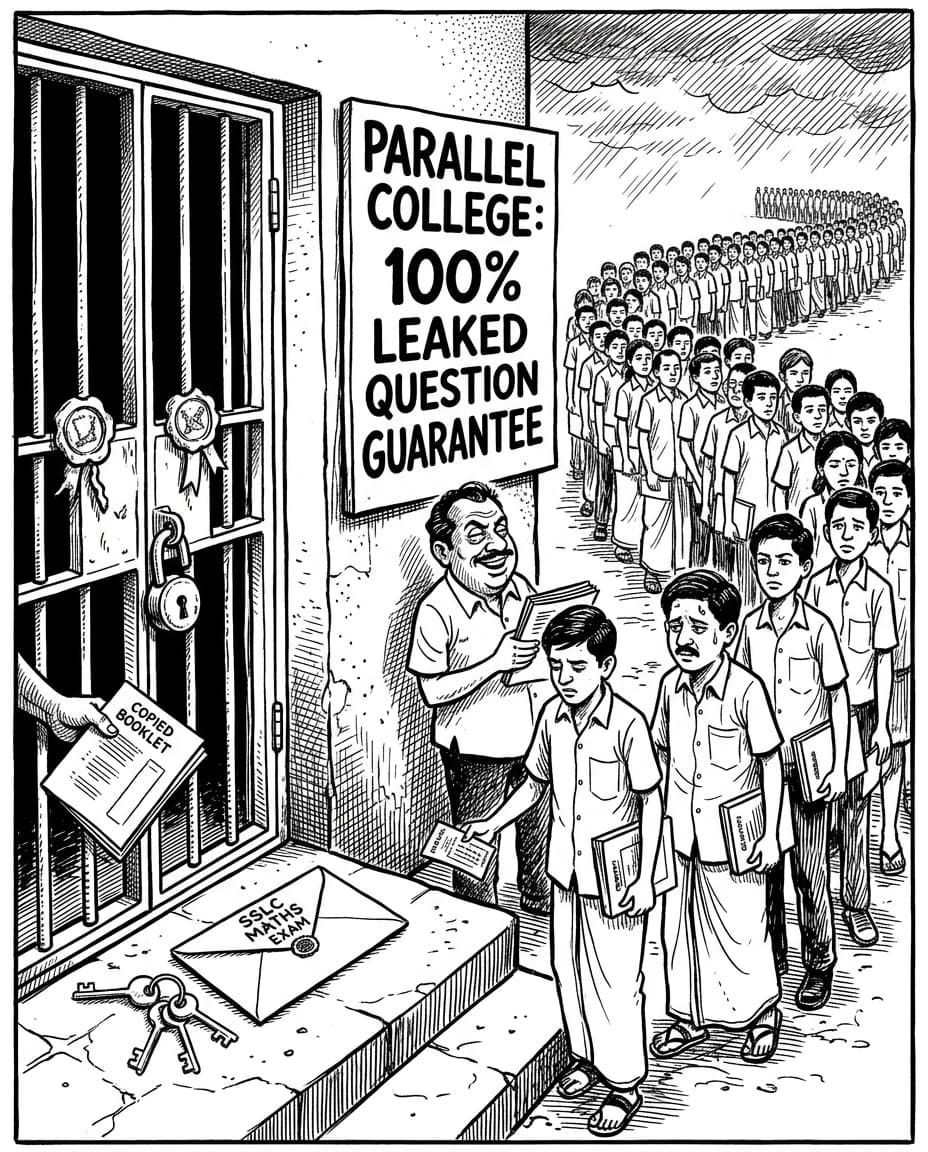
Editorial Illustration:Editorial illustration reflecting the events and context of The Parallel College Conspiracy: Inside the 2001 Kerala SSLC Mathematics Paper Leak, the Sub-Treasury Infiltration, and the Rescue of Half a Million Diplomas.
VINTAGE INK ARCHIVE
I. The Sanctity of the Ten-Digit Benchmark
To understand why the 2001 SSLC leak shook Kerala to its institutional foundations, one must grasp the unique sociology of schooling in the state at the beginning of the twenty-first century.
While northern states were grappling with mass copying, ghost candidates, and invigilator intimidation, Kerala’s public examination machinery—managed by the Office of the Commissioner for Government Examinations, universally known as the Pareeksha Bhavan in Poojappura, Thiruvananthapuram—enjoyed a near-mythic reputation for administrative probity.
The SSLC was perceived as incorruptible. Question papers were set by panels of veteran high school headmasters sequestered in undisclosed locations. The manuscripts were printed under strict cryptographic serialization inside the Government Central Press in Thiruvananthapuram. The printed booklets were sealed inside heavy waterproof wax-cloth bags, secured with official red lac seals, packed into metal or wooden lockboxes, and transported under armed police convoy to district treasuries and local sub-treasuries across all fourteen revenue districts.
There, under the custody of the Directorate of Treasuries, the lockboxes sat inside double-lock underground strongrooms until the designated morning of each examination, when authorized Chief Superintendents accompanied by department route officers signed physical ledgers and carried the parcels to local schools.
The Class 10 Mathematics paper was particularly pivotal. Under Kerala’s higher secondary admission framework, admission to the coveted "Science-Biology" and "Science-Mathematics" streams in Plus Two (Classes 11 and 12) was fiercely rationed. A distinction or high mark in SSLC Mathematics was the non-negotiable prerequisite. For families aspiring to see their children become doctors or software engineers in the nascent IT revolution, every single mark on that 100-mark paper was worth its weight in gold.
And where intense social pressure converges with institutional monopoly, an underground market inevitably forms.
II. The Parallel College Phenomenon
The commercial engine driving the 2001 leak was an institution uniquely prominent in late-twentieth-century Kerala: the Parallel College and private tutorial academy.
Throughout the 1980s and 1990s, parallel colleges had sprouted in every small junction and town across the state. While they primarily functioned as private coaching institutes offering supplemental instruction for high school and university students, many had evolved into multi-crore commercial enterprises. Their business model depended entirely on public advertising of their students’ board exam ranks and pass percentages.
A tutorial center that could claim that seventy of its students scored full marks in SSLC Mathematics could guarantee hundreds of lucrative enrollments for the subsequent academic session.
In the southern districts of Kollam and Thiruvananthapuram, a fierce rivalry had developed between several prominent parallel colleges and private coaching networks. Tutors competed relentlessly for wealthy clientele, charging affluent parents substantial fees for "crash courses" and "sure-shot revision modules" in the final weeks before the board exams.
It was within this hyper-competitive private coaching ecosystem that several tutorial proprietors decided to bypass pedagogy altogether and acquire the ultimate promotional weapon: the official board question paper itself.
III. The Sub-Treasury Infiltration: The Midnight Wax Seals
The conspiracy did not require sophisticated cyber espionage or brute-force physical break-ins. It relied instead on the quiet subversion of the weakest human link in the examination logistics chain: the sub-treasury office.
In the weeks preceding the March 2001 exams, middlemen representing tutorial proprietors in Kollam approached non-gazetted custodial staff at local district sub-treasuries, notably in and around the Kollam and Chadayamangalam jurisdictions.
These lower-cadre treasury clerks and record keepers received modest state salaries, yet held physical custody over the keys to the inner strongrooms where the examination trunks were stored.
Bribed with sums ranging from ₹50,000 to ₹1.5 lakh—a substantial fortune for a clerical employee in 2001—corrupt custodians facilitated clandestine entry into the vaults during the quiet evening hours of the third week of March.
The modus operandi was delicate and calculated: 1. The Vault Entry: Using authorized custody keys, the corrupt staff unlocked the strongroom grilles after regular public transaction hours had closed. 2. Slicing the Wax Seals: Rather than tearing open the fabric parcels—which would immediately alert school superintendents on exam morning—the conspirators used heated razor blades and fine surgical scalpels to delicately slice the underside of the red wax seals securing the confidential cloth envelopes. 3. The Handwritten Transcription: Working under the dim electric bulbs of the treasury annex, the conspirators did not dare steal the physical question paper booklets, as an inventory count on the morning of March 24 would reveal missing serial numbers. Instead, a hired teacher or literate middleman rapidly transcribed all 22 questions by hand onto plain paper sheets. 4. Resealing the Packet: The paper booklet was slipped back into the envelope. Conspirators reheated the red lac wax and carefully pressed the fractured pieces back together, smoothing the edges to simulate an intact, unbroken government seal.
By the night of Thursday, March 22, the complete handwritten master question paper—spanning quadratic equations, circle theorems, arithmetic progressions, and coordinate geometry problems—was in the possession of the tutorial syndicate.
IV. The Midnight Cramming Sessions and the Slip
On the night of Friday, March 23, 2001—hours before the examination was scheduled to take place—the parallel college operators executed their clandestine distribution.
In private tutorial centers in Kollam and rural Thiruvananthapuram, select batches of students whose parents had paid premium coaching fees were summoned for what was euphemistically termed an "exclusive midnight revision session."
Inside locked classrooms, the tutors wrote the leaked problems on blackboards. Students were instructed to copy the equations and rehearse the proofs repeatedly until they could solve them from memory. They were warned under strict oath never to reveal the source of the questions, told simply that these were "expert predictions based on previous question-paper trends."
However, the syndicate failed to account for the human dynamics of panic and adolescent indiscretion.
In 2001, mobile phones and internet messaging were virtually non-existent among school children in India. Distribution relied on hand-to-hand physical photocopies and telephone calls placed on fixed landlines.
During the early morning hours of Saturday, March 24, a frantic student who had attended one of the midnight sessions telephoned a close friend from another school, dictating several of the most difficult geometry problems. That friend’s father, a conscientious local school teacher, recognized that the questions were far too specific to be random guesswork. Suspicious, he obtained a handwritten copy of the revision sheet from another parent and immediately alerted a local education officer and a crime reporter in Thiruvananthapuram.
By 5:30 AM, a facsimile and handwritten transcript of the leaked notes had arrived on the desk of the Director of Public Instruction (DPI) and reached the official residence of Education Minister P.J. Joseph in Thiruvananthapuram.
V. 6:00 AM: The Agony of Poojappura and the Emergency Abort
Inside the Pareeksha Bhavan headquarters in Poojappura, senior subject-matter experts and examination controllers were summoned for an emergency crisis review.
The evaluators unlocked the master reserve envelope containing the authentic SSLC Mathematics paper and placed it side-by-side with the handwritten whistleblower transcript.
The verification took less than fifteen minutes.
Out of 22 questions on the official question paper, every single question matched the handwritten sheets. The numerical coefficients, the geometric diagrams, the algebraic variables, and even the sequential numbering of the questions were identical.
There was zero ambiguity: the state examination had been completely compromised.
Education Minister P.J. Joseph was faced with an excruciating policy dilemma. If the government allowed the examination to proceed, over half a million students who had studied honestly would be placed at an unfair competitive disadvantage against a few hundred students who had memorized the stolen paper, permanently corrupting the higher secondary merit rosters.
Conversely, cancelling an exam for 5.5 lakh candidates across 2,000 centers with barely three hours' notice would trigger massive logistical chaos and public outrage.
At 6:30 AM, Minister Joseph made the courageous executive call: abort the examination immediately.
Emergency bulletins were flashed across All India Radio and Doordarshan Kendra Thiruvananthapuram. Police wireless networks crackled as district collectors and superintendents of police were ordered to instruct all test centers not to unseal the question paper parcels.
At 7:00 AM, the General Education Department formally issued Government Order G.O.(MS) No. 98/2001/G.Edn, officially declaring the March 24 Mathematics examination cancelled and ordering an immediate, high-level criminal inquiry.
VI. The Shock of Half a Million: March 24 on the Streets
Despite the early morning radio broadcasts, tens of thousands of students who had already boarded state transport buses or walked miles from remote villages arrived at their schools to find the gates closed.
Handwritten notices taped to iron school gates carried the devastating news: SSLC Mathematics Exam Cancelled Due to Unavoidable Circumstances.
Tears, disbelief, and mounting fury swept across the state. In Thiruvananthapuram, hundreds of students carrying schoolbags and geometry boxes converged outside the Pareeksha Bhavan, chanting slogans against the government and demanding to know how their months of disciplined preparation could be casually discarded because of administrative negligence.
Protests erupted in Ernakulam, Kozhikode, and Kollam. Opposition parties staged demonstrations outside the Secretariat, demanding the resignation of the Education Minister.
Recognizing that prolonged uncertainty would destroy the academic morale of the entire student population, the government acted swiftly: 1. Announcing a definitive date for the statewide re-examination: Monday, April 9, 2001. 2. Handing the criminal investigation over to the specialized Crime Branch CID of the Kerala Police. 3. Placing the sub-treasuries of Kollam and surrounding taluks under immediate administrative seal and departmental audit.
VII. The Crime Branch Crackdown: Raiding the Parallel Colleges
The Kerala Police Crime Branch moved with forensic speed.
Led by senior detectives, teams fanned out across Kollam, Chadayamangalam, and southern Thiruvananthapuram. Investigators cross-referenced the call records of suspected private tutorial owners and focused on those institutes that had boasted of "100% guarantee" results in their newspaper advertisements.
Within 48 hours, Crime Branch detectives executed targeted raids on several private academies in Kollam.
Inside the offices of tutorial proprietors, detectives seized: - Handwritten question sheets identical to the leaked exam paper. - Registers containing the names and contact details of enrolled students who had attended the midnight cramming sessions. - Bundles of cash collected as illicit fees from parents.
Interrogations of the tuition center directors quickly unraveled the supply chain upwards to the state machinery. Tutors confessed that they had purchased the transcribed notes from intermediaries who claimed direct access to sub-treasury vaults.
Detectives descended on the sub-treasury offices, seizing the original examination lockboxes. Forensic examination of the wax seals confirmed the investigative hypothesis: the wax had been delicately sliced and reheated.
The Crime Branch arrested more than ten individuals, including sub-treasury custodians, private tutorial heads, and courier middlemen, charging them under Sections 409 (Criminal breach of trust by public servant), 420 (Cheating), 468 (Forgery), and 120-B (Criminal Conspiracy) of the Indian Penal Code.
VIII. April 9, 2001: The Flawless Retest
While detectives dismantled the syndicate, the Pareeksha Bhavan worked around the clock to organize the April 9 re-examination without a single procedural flaw.
The state completely discarded its old handling procedures: - An entirely new, third set of mathematics questions was drafted by an isolated panel of academicians working inside a secure room in the Secretariat without external communication lines. - The printing was carried out under armed police sentries at an undisclosed high-security press. - Instead of depositing question papers in sub-treasuries days in advance, the new papers were retained in a central vault in Thiruvananthapuram until 24 hours before the exam. - On the morning of April 9, armed police escorts accompanied every single delivery vehicle directly from district hubs to examination centers. - Police personnel were deployed at all 2,000 examination centers to maintain strict perimeter security.
On Monday, April 9, 2001, 5,50,000 students entered their examination halls for the second time. The examination proceeded with textbook precision. When the final bell rang at 12:15 PM, students walked out under clear April skies, relieved that the nightmare of uncertainty had finally ended.
The evaluation process was placed on a fast-track schedule, ensuring that the publication of the final SSLC results was delayed by barely two weeks, preventing any disruption to the higher secondary admission calendar.
IX. Institutional Legacy: The Modernization of Pareeksha Bhavan
The 2001 Kerala SSLC Mathematics paper leak was a painful rite of passage for the state’s educational bureaucracy, but it catalyzed enduring structural reforms that insulated Kerala’s school examinations for the next two decades.
The state government enacted permanent operational overhauls: 1. The Double-Padlock and Biometric Protocol: Sub-treasury vaults were stripped of unilateral access. Confidential examination lockboxes were fitted with dual, non-duplicable high-security padlocks whose keys were held by two separate authorities—the local Sub-Treasury Officer and the Department Route Officer—requiring both officials to be physically present simultaneously to open the strongroom. 2. Tamper-Evident Security Seals: The archaic practice of sealing cloth parcels with fragile red lac wax was abolished. Kerala introduced multi-layered, tamper-evident security plastic bags with holographic security strips and unique barcode serializations that irreversibly fractured upon opening. 3. Regulation of Parallel Colleges: The state introduced strict monitoring of commercial coaching institutions, mandating registration and prohibiting private tutorials from conducting late-night student camps during examination weeks. 4. Decentralized Reserve Sets: The Pareeksha Bhavan instituted a multi-set confidential printing protocol, printing three completely independent sets of question papers (Sets A, B, and C). The specific set to be unsealed was communicated to Center Superintendents via confidential telegraph/code barely thirty minutes before the exam, rendering advance vault theft practically useless.
For the 5.5 lakh students of the Class of 2001, the sudden cancellation on that March morning remains an indelible childhood memory. But for the state of Kerala, the crisis demonstrated that when an educational breach occurs, rapid executive courage, transparent communication, and an unsparing criminal crackdown are the only true safeguards of meritocracy and public trust.
Chronological Case Timeline
| Exact Date / Period | Authority / Entities Involved | What Happened & What Changed | Verified Source / Reference |
|---|---|---|---|
| Mid-March 2001 | Kerala Pareeksha Bhavan, District Sub-Treasuries | Question paper parcels for the 2001 SSLC examinations are printed under confidential government press guard and dispatched to sub-treasuries across 14 districts. | Office of the Commissioner for Government Examinations, Kerala |
| March 21–23, 2001 | Sub-Treasury Staff (Kollam district), Private Tutorial Operators | Vault custodians in southern Kerala tamper with sealed packets; question papers for the Mathematics paper are illicitly removed, transcribed by hand, and shared with select parallel college heads. | Kerala Police Crime Branch CID Investigation Diary |
| March 23, 2001 (Night) | Private Tuition Academies (Kollam & Thiruvananthapuram) | Secret night tutorial sessions held where enrolled students are drilled on specific geometry, algebra, and trigonometry problems identical to the board exam paper. | The Hindu, March 25, 2001: "Kerala Cancels SSLC Maths Exam After Question Paper Leak" |
| March 24, 2001 (05:30 IST) | Director of Public Instruction (DPI), Education Minister P.J. Joseph | Whistleblower delivers handwritten copy of the questions to education authorities; Pareeksha Bhavan subject experts confirm a 100% match with the master paper; Education Minister announces statewide cancellation hours before exam start. | Kerala Government Order G.O.(MS) No. 98/2001/G.Edn, March 24, 2001 |
| March 24, 2001 (09:00 IST) | School Principals, 5.5 Lakh Students, Kerala Police | Over 5,50,000 students arriving at 2,000+ examination centers statewide find gates marked with emergency cancellation notices; student demonstrations outside Pareeksha Bhavan. | Mathrubhumi, March 25, 2001: "SSLC Maths Exam Scrapped Statewide; 5.5 Lakh Students in Shock" |
| March 26, 2001 | Kerala Police Crime Branch CID | Crime Branch launches criminal probe under IPC Sections 409, 420, 120-B; raids parallel colleges across Kollam and Thiruvananthapuram, arresting tutorial teachers and seizing question transcripts. | The Indian Express, March 27, 2001: "Crime Branch Raids Tuition Academies in SSLC Paper Leak Case" |
| April 2, 2001 | High Court of Kerala at Ernakulam | High Court dismisses writ petitions challenging the re-examination schedule, holding that the state acted within its executive authority to protect the sanctity of merit. | High Court of Kerala Order in OP No. 11204/2001, April 2001 |
| April 9, 2001 | Kerala Pareeksha Bhavan, Kerala Police | Flawless statewide retest conducted for 5.5 lakh students across 2,000+ centers under armed police escort and newly drafted reserve question papers. | The Hindu, April 10, 2001: "SSLC Maths Re-Exam Passes Off Peacefully Across Kerala" |
| Late 2001 – 2002 | Kerala Government, Pareeksha Bhavan | Kerala completely overhauls SSLC confidential logistics: mandates double-custody locks at treasuries, tamper-evident color-coded seals, and criminal prosecution for private tuition commercial leaks. | Kerala Education Rules (KER) Structural Amendments 2002 |
Sources & Further Reading
- General Education Department, Government of Kerala — Government Order G.O.(MS) No. 98/2001/G.Edn: Cancellation of SSLC Mathematics Examination and Scheduling of Re-Examination, Thiruvananthapuram, March 24, 2001. https://education.kerala.gov.in
- Office of the Commissioner for Government Examinations (Pareeksha Bhavan) — Official Notification on Re-Conduct of SSLC Mathematics Examination on April 9, 2001, Poojappura, Thiruvananthapuram, March 25, 2001. https://pareekshabhavan.kerala.gov.in
- High Court of Kerala at Ernakulam — Judicial Order in Original Petition OP No. 11204/2001 regarding SSLC Re-Examination Validity, April 2, 2001. https://hckerala.gov.in
- Kerala Police Crime Branch CID — Case Diary and FIR Records in SSLC Mathematics Question Paper Theft Case (Kollam & Thiruvananthapuram), March 2001. https://keralapolice.gov.in
- The Hindu — Kerala Cancels SSLC Maths Exam After Question Paper Leak, Thiruvananthapuram Bureau, March 25, 2001. https://www.thehindu.com/2001/03/25/kerala-sslc.htm
- Mathrubhumi — SSLC Maths Exam Scrapped Statewide; 5.5 Lakh Students in Shock Over Sub-Treasury Leak, Kozhikode/Thiruvananthapuram, March 25, 2001. https://www.mathrubhumi.com/archives/2001-sslc-maths-leak
- The Indian Express (South India Edition) — Crime Branch Raids Tuition Academies in SSLC Paper Leak Case: Hand-Written Notes Seized in Kollam, Special Correspondent, March 27, 2001. https://indianexpress.com/archive/2001-kerala-sslc-paper-leak
- The Hindu — SSLC Maths Re-Exam Passes Off Peacefully Across Kerala: Over 5.5 Lakh Candidates Sit for Third Attempt Under Police Guard, Staff Reporter, April 10, 2001. https://www.thehindu.com/2001/04/10/stories/kerala-re-exam.htm
Comments
0Want to participate in the discussion?
No comments yet. Start the discussion above.