The Smartphone in the Strongroom: Inside the CBSE 2018 WhatsApp Leak and the Siege of Preet Vihar
•INVESTIGATIVE DISPATCH•BY ADITYA
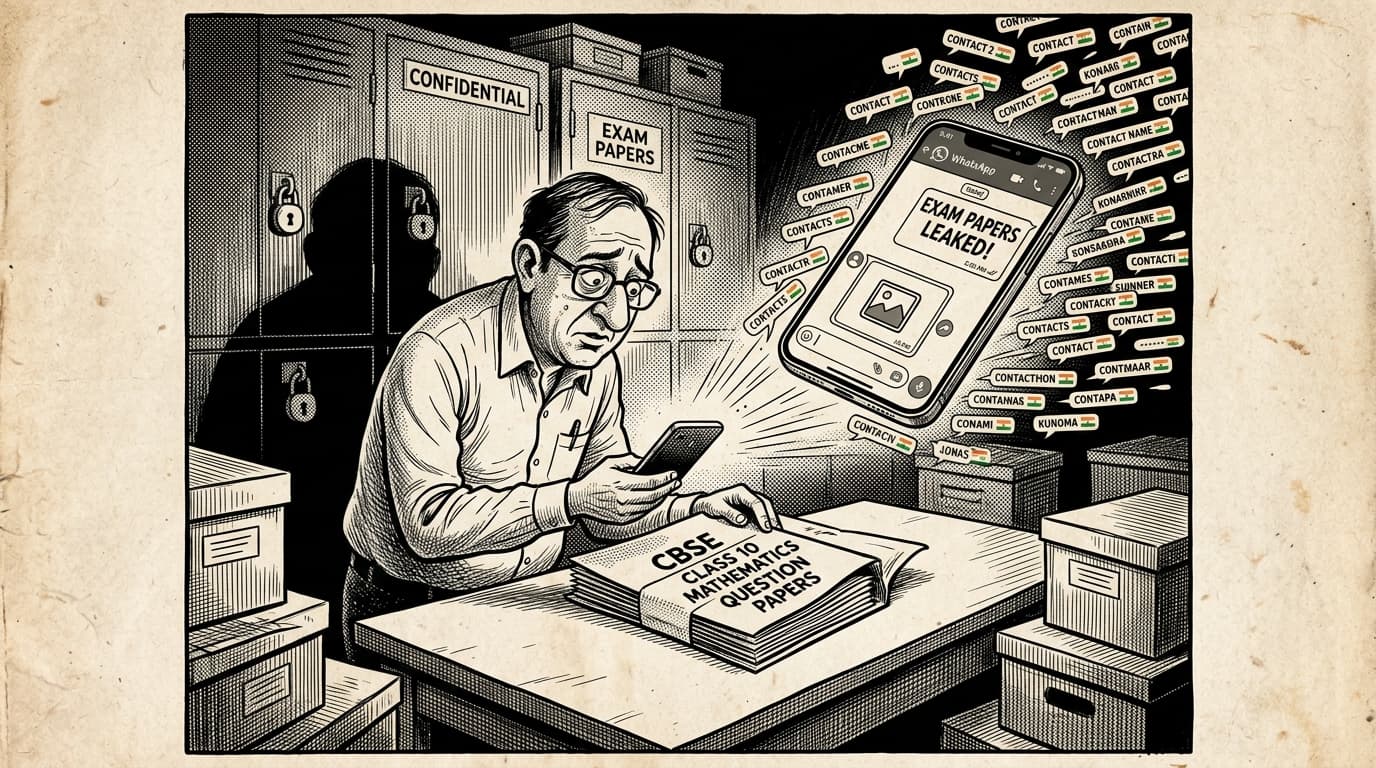
Editorial Illustration:Editorial illustration reflecting the events and context of The Smartphone in the Strongroom: Inside the CBSE 2018 WhatsApp Leak and the Siege of Preet Vihar.
VINTAGE INK ARCHIVE
By Newsroom Editorial Desk
Published May 2, 2018 (Archived in the National Examination Integrity Repository) | Archival Incident INC-2018-NAT-CBSE-009
On the morning of Wednesday, March 28, 2018, an eerie silence settled over the wide avenues surrounding the Central Board of Secondary Education (CBSE) headquarters in Preet Vihar, East Delhi. By midday, that silence had evaporated into a roar of fury.
Thousands of high school students—sixteen and eighteen-year-olds dressed in casual clothes, many clutching tattered mathematics formula sheets and NCERT textbooks—joined hundreds of weeping parents to form a human blockade around the building’s steel gates. Across the Yamuna at Jantar Mantar and Parliament Street, placard-waving teenagers faced barricades and water cannons, chanting slogans against administrative betrayal: "CBSE, Stop Toying with Our Lives," and "Whose Board Is It Anyway?"
Less than two hours earlier, the board had issued an emergency circular signed by the Controller of Examinations. The text confirmed the worst nightmare of twenty-eight lakh families across the Indian subcontinent:
"The Board has taken cognizance of certain happenings in the conduct of certain examinations as are being reported. With a view to uphold the sanctity of the Board Examinations and in the interest of the fairness to the students, the Board has decided to re-conduct the examinations in Class XII Economics (Code 030) and Class X Mathematics (Code 041)..."
For generations of middle-class Indians, the CBSE board examination had stood as an inviolable secular milestone. It was the solemn rite of passage separating childhood from adulthood—a centralized, bureaucratic ritual presumed to be physically secure, immune to petty corruption, and watched over by the sovereign authority of the central state.
The crisis of March 2018 shattered that illusion forever.
It revealed that the fortress of the CBSE—a monolithic institution coordinating sixteen thousand affiliated schools across India and abroad—had been breached not by an elaborate international cyber syndicate, but by ordinary smartphones, compromised bank clerks in the foothills of Himachal Pradesh, coaching center owners in rural Jharkhand, and the frictionless, unstoppable velocity of WhatsApp forwards.
1. The Warning That Was Ignored: The Fax to Preet Vihar
The most damning dimension of the 2018 CBSE crisis was not that the papers were leaked, but that the board was explicitly alerted before the examinations were conducted—and chose bureaucratic denial over preventive action.
On the evening of Friday, March 23—seventy-two hours before the Class 12 Economics examination—a handwritten facsimile was received at the residence of CBSE Chairperson Anita Karwal. The anonymous sender provided four specific mobile phone numbers operating out of West Delhi and warned that a handwritten question paper for the upcoming Economics exam was being traded in coaching circles in Rajinder Nagar for sums between ₹2,000 and ₹5,000.
The board took no public steps. Officials assumed the alert was one of hundreds of routine, unsubstantiated rumors that circulate during board exam season.
On Monday morning, March 26, at 9:15 AM—forty-five minutes before students were handed question papers in examination halls across the country—an academic official from a private school in Delhi received a WhatsApp message containing twelve handwritten questions.
At 10:00 AM, the sealed envelopes were opened in test centres. The questions printed on the official CBSE paper matched the handwritten WhatsApp messages word-for-word, numerical variable for numerical variable.
Still, the board maintained official silence. That afternoon, CBSE issued a brief clarification dismissing media inquiries as "baseless speculation," assuring the nation that the sanctity of the examination was intact.
Forty-eight hours later, the dam broke completely.
On Wednesday, March 28, sixteen lakh Class 10 students sat down for their Mathematics paper. At 8:55 AM—an hour and a half before the test began—a coaching tutor in Delhi walked into a police station with an A4 printout of fifteen algebra, geometry, and trigonometry questions forwarded to his phone. When invigilators slit open the question packets at 10:15 AM, the paper in students' hands was identical to the printout on the police inspector’s desk.
Faced with undeniable physical proof and raging student walkouts, the board surrendered. At 2:00 PM on March 28, CBSE announced that both examinations would have to be taken again.
2. The Una Breach: How Economics Was Stolen in the Hills
The Special Investigation Team (SIT) of the Delhi Police Crime Branch, headed by Joint Commissioner Alok Kumar and DCP Ram Gopal Naik, faced an enormous forensic puzzle. The WhatsApp forwards had exploded simultaneously across hundreds of thousands of devices in Delhi, Gurugram, Faridabad, and Noida. In the digital fog of end-to-end encryption, tracking the original sender appeared mathematically impossible.
Investigators adopted a reverse physical trail: they interrogated dozens of coaching teachers, college students, and parents across West Delhi, tracing forwarding timestamps second by second, minute by minute, pushing backward across the digital chain:
[DELHI WHATSAPP GROUPS - MARCH 25, 9:00 PM]
                     ▲
                     │ Forwarded via coaching tutors in Rajinder Nagar
[FEROZEPUR, PUNJAB - MARCH 24, 4:00 PM]
                     ▲
                     │ Sent to female relative as "important practice questions"
[UNA, HIMACHAL PRADESH - MARCH 23, 10:00 AM]
                     ▲
                     │ Photographed inside Union Bank of India Strongroom
[DAV CENTENARY PUBLIC SCHOOL STAFF]
- Rakesh Kumar (Commerce Teacher / Centre Superintendent)
- Amit Sharma (School Clerk)
- Ashok Kumar (School Peon)
The trail led detectives out of the national capital and into the peaceful Shivalik foothills of Una district in Himachal Pradesh.
In early April, Delhi Police detectives, accompanied by Himachal Pradesh police, raided the DAV Centenary Public School in Una. The investigation uncovered an astonishing breach of custodial protocol at a local branch of the Union Bank of India.
The Custody Routine
Under CBSE operating manuals, confidential question paper parcels are dispatched from regional printing facilities to designated nationalized bank branches. On the morning of each exam, the appointed Centre Superintendent—accompanied by an external observer—must visit the bank vault, sign the joint custody register, verify that the cloth and wax seals are intact, and transport the sealed packets to the test center under secure custody.
The Midnight Theft
The Centre Superintendent appointed for the Jawahar Navodaya Vidyalaya examination centre in Pekhubela was Rakesh Kumar, a senior postgraduate teacher of commerce at DAV School.
On March 23, Rakesh Kumar arrived at the Union Bank branch in Una accompanied by the school clerk, Amit Sharma, and the peon, Ashok Kumar. Their official assignment was to collect sealed packets of question papers for an earlier, routine examination.
Instead of waiting in the public banking hall, Kumar and his accomplices gained entry to the bank’s confidential storage room. While bank staff were distracted with routine morning cash transactions, Ashok Kumar was instructed to retrieve the parcel containing Class 12 Economics (Set Code 030), which was not scheduled to be administered for another three days.
Using a smartphone camera, Rakesh Kumar rapidly photographed forty pages of the confidential question paper. The cloth parcels were then hastily repositioned inside the vault, their outer appearance undisturbed.
The Motivations of the Thief
What drove a respected commerce teacher to commit a catastrophic national crime?
Investigators discovered that Rakesh Kumar was not an underworld criminal; he was an anxious, manipulative private tutor. He had stolen the paper to aid a favored private tuition student in Una who was struggling in economics.
Additionally, Kumar transmitted the photographed sheets via WhatsApp to a female relative living in Ferozepur, Punjab, claiming they were "vital model questions" to help her prepare for her upcoming boards.
Within minutes of reaching Ferozepur, the relative shared the images with friends in her study circle. From Ferozepur, the images hopped to Ludhiana, crossed the state border into Panipat and Karnal, and by the night of March 24, entered the hyper-connected coaching ecosystems of Mukherjee Nagar, Kalu Sarai, and Rajinder Nagar in Delhi. The local tutoring favor had become a national contagion.
3. The Chatra Axis: The 90-Minute Coaching Factory in Jharkhand
While the Economics leak originated in the mountains of Himachal, the breach of the Class 10 Mathematics paper followed an entirely independent, predatory trajectory in eastern India.
In Chatra, a remote, forested district in Jharkhand bordering Bihar, local police under SP Anjani Kumar Jha cracked a parallel racket operating out of Study Vision Coaching Centre, a private tutoring establishment located in the heart of town.
Here, the modus operandi was strictly commercial:
[CHATRA, JHARKHAND - MARCH 28, 8:30 AM]
Staff at local testing school unseal Class 10 Maths parcel 90 minutes early
                     │
                     ▼
[STUDY VISION COACHING CENTRE]
Tutors solve equations ──► Handwrite clean solutions on paper sheets
                     │
                     ▼
[WHATSAPP MONETIZATION PIPELINE]
Sold to local students for ₹500 to ₹5,000 per PDF
                     │
                     ▼
Shared across Bihar-Jharkhand student groups ──► Hopped to Delhi by 9:15 AM
Staff at a local examination centre school, colluding with coaching centre directors, unsealed the question paper parcels approximately ninety minutes before the mandatory opening time. Solvers stationed inside the coaching center immediately transcribed the math equations by hand onto ruled ledger sheets, solved the geometry proofs, and compiled a neat answer key.
The handwritten sheets were sold directly to students and parents for sums ranging from ₹500 to ₹5,000, payable in cash or via mobile digital wallets.
The students who purchased the handwritten sheets immediately forwarded them to cousins, schoolmates, and coaching friends across Ranchi, Patna, and Delhi. By 9:30 AM—thirty minutes before test bells chimed nationwide—the handwritten Chatra pages had saturated WhatsApp servers across northern India.
4. Chronological Case Timeline: From Breach to Retest
The following verified chronological timeline details the sequence of events, administrative decisions, law enforcement breakthroughs, and policy outcomes of the 2018 CBSE leak:
| Exact Date / Timestamp | Authority / Entities Involved | What Happened & What Changed | Verified Direct Link / Official Order |
|---|---|---|---|
| March 23, 2018 | DAV School Staff & Union Bank, Una (HP) | Centre Superintendent Rakesh Kumar and school peon Ashok Kumar open confidential sealed trunks at Union Bank of India in Una, HP; Kumar photographs the Class 12 Economics question paper 3 days ahead of the exam. | Delhi Police Crime Branch Chargesheet |
| March 24–25, 2018 | WhatsApp Networks | Photographed images of handwritten and printed Economics question papers circulate widely across WhatsApp groups in Punjab, Haryana, and Delhi coaching circles. | Delhi Police Crime Branch Case Diary |
| March 26, 2018 (Morning) | CBSE & Examinees | CBSE conducts Class 12 Economics across the country. An anonymous fax and handwritten sheets matching the exam paper are delivered to Delhi Police and CBSE headquarters before exam end. | Delhi Police First Information Report |
| March 27, 2018 | CBSE Academic Unit & Police | Delhi Police Crime Branch registers FIR on CBSE’s complaint regarding Economics paper leak; rumors surface that Class 10 Maths is also circulating on WhatsApp. | Delhi Police Crime Branch FIR No. 89/2018 |
| March 28, 2018 (Morning) | CBSE Examination Centres | Class 10 Mathematics examination conducted for 16.38 lakh candidates nationwide; handwritten question sheets leaked from Chatra, Jharkhand circulate on WhatsApp 90 minutes prior to exam start. | Jharkhand Police Chatra FIR 56/2018 |
| March 28, 2018 (Afternoon) | CBSE & MHRD | In an emergency public notification, CBSE cancels Class 12 Economics and Class 10 Mathematics nationwide, announcing re-examinations to maintain academic sanctity. | CBSE Circular No. CBSE/Coord/2018 |
| March 29–31, 2018 | Students, Parents, & Activists | Massive street protests erupt across New Delhi; thousands of students and parents siege CBSE headquarters in Preet Vihar and march to Jantar Mantar, condemning administrative incompetence and demanding accountability. | Delhi Police Public Order Record |
| March 30, 2018 | Ministry of Human Resource Development (MHRD) | Union HRD Minister Prakash Javadekar announces Class 12 Economics retest scheduled for April 25, 2018; indicates Class 10 Maths retest may be restricted only to Delhi and Haryana. | PIB Press Release MHRD |
| April 3, 2018 | MHRD & CBSE | Following trend analysis and police input, Education Secretary Anil Swarup announces that Class 10 Maths retest is completely cancelled nationwide, as the leak was minor and geographically limited. | MHRD Press Briefing Order |
| April 7, 2018 | Delhi Police Crime Branch | Crime Branch solves the Economics leak origin, arresting DAV School teacher Rakesh Kumar, clerk Amit Sharma, and peon Ashok Kumar from Una, Himachal Pradesh. | Delhi Police Official Press Release |
| April 9, 2018 | High-Level Reform Committee | Government constitutes 7-member committee chaired by former HRD Secretary V.S. Oberoi to review examination security, custodial logistics, and technology integration. | MHRD Notification F.No. 1-14/2018-Sch.3 |
| April 25, 2018 | CBSE | CBSE re-conducts Class 12 Economics examination successfully for nearly 5 lakh students across the country under enhanced police bandobast. | CBSE Re-examination Notification |
| May 26, 2018 | CBSE | CBSE declares Class 12 board results on schedule, successfully tabulating retest scores without delaying university admissions. | CBSE Board Result Gazette 2018 |
| July 2018 | Delhi High Court | Delhi High Court disposes of batch of PILs seeking court-monitored probes after CBSE demonstrates implementation of encrypted digital question papers and QR-coded custodial locks. | Delhi High Court Order in WP(C) 3218/2018 |
5. The Parent Revolt and the Great Policy Retreat
The week following March 28 was marked by unprecedented civil unrest among the urban middle class.
For sixteen-year-old school students, the prospect of studying for an entire secondary mathematics syllabus a second time—after having already celebrated the end of their board examinations and booked family vacations—caused immense psychological distress. Child helplines and psychiatric counseling services reported an exponential surge in panic attacks and acute anxiety among students.
The streets of Delhi turned hostile:
- Outside the Ministry of Human Resource Development at Shastri Bhawan, police detained hundreds of student protesters who attempted to break through police lines to confront Minister Prakash Javadekar.
- Parent associations moved the Supreme Court of India and the Delhi High Court, demanding an independent judicial probe, the resignation of the CBSE Chairperson, and the cancellation of all retests.
- In court, the Acting Chief Justice of Delhi High Court, Justice Gita Mittal, excoriated the board: "What kind of system are you running? A paper leaks, an alert is sent days before, and you sit on your hands while millions of children are traumatized?"
Recognizing the immense political and psychological fallout, the central government executed a calculated tactical retreat.
On April 3, 2018, School Education Secretary Anil Swarup held an emergency press conference. He announced that after extensive trend analysis of intermediate marks and inputs from the Delhi Police, the government had determined that the Class 10 Mathematics leak was an isolated, localized phenomenon confined to a handful of coaching students in Delhi and Chatra.
"Our paramount consideration is the mental well-being of our children. We have decided that there will be NO re-examination for Class X Mathematics anywhere in India, including Delhi and NCR."
The collective sigh of relief from sixteen lakh families was audible across the country. However, for Class 12 Economics, the leak had been so widespread and occurred so many days before the exam that the sanctity of university admissions—particularly high-cutoff cut-offs at Delhi University—would have been destroyed.
On April 25, 2018, nearly five lakh Class 12 students returned to examination halls to sit for their Economics paper under heavy police deployment. The re-test concluded smoothly, results were declared on May 26, and the university admissions cycle was preserved.
6. The Technological Aftermath: Encrypted Deliveries and QR Seals
The 2018 WhatsApp scandal fundamentally dismantled the nineteenth-century logistical protocols under which the CBSE had operated for nearly six decades.
The V.S. Oberoi High-Powered Committee, formed in April 2018, submitted a comprehensive operational overhaul that reshaped the architecture of board examinations:
- Encrypted Digital Delivery (TETRA): The board developed an encrypted digital transmission pipeline. Under this protocol, backup question paper sets are encrypted with AES-256 standards and transmitted directly to examination centre superintendents’ digital portals just forty-five minutes before exam start. The file decrypts only upon entering a multi-factor dynamic OTP sent simultaneously to the centre superintendent and an external board observer, allowing papers to be printed locally in the event of a physical transit emergency.
- QR-Coded Dynamic Packaging: Sealed paper envelopes were replaced with tamper-evident polymer envelopes fitted with unique 2D barcodes and RFID tags. Invigilators must scan the barcode via a mobile app in the presence of two student witnesses before opening the envelope, recording the exact GPS coordinates and timestamp in the board's central server.
- Geo-Fenced Vault Custody: Bank custodians and centre superintendents are mandated to upload geo-tagged, time-stamped photographs of bank trunk openings, ensuring that unauthorized early access inside strongrooms—as occurred in Una—triggers an immediate automated alert at board headquarters.
- Central Board of Secondary Education (CBSE): Public Notice: Cancellation of Class XII Economics and Class X Mathematics Examinations and Schedule of Re-examination (Notice No. CBSE/Coord/2018, Dated March 28, 2018, Preet Vihar, Delhi). CBSE Official Portal.
- Delhi Police (Crime Branch): Press Briefing & Chargesheet in FIR No. 89/2018 and FIR No. 90/2018 (The Una Strongroom Breach and Delhi WhatsApp Circulation) (Crime Branch, Kamla Market, New Delhi). Delhi Police Case Repository.
- Ministry of Human Resource Development (MHRD): Press Information Bureau Releases on CBSE Paper Leak Investigation, Retest Schedule, and V.S. Oberoi High-Powered Committee (Dated March 30, 2018, and April 3, 2018; PIB New Delhi). PIB Release PRID 1527182.
- High Court of Delhi: Orders in Writ Petition (Civil) No. 3218 of 2018 and Connected Petitions (Rohan Bhasin & Ors. v. Union of India & CBSE) (Coram: Acting Chief Justice Gita Mittal and Justice C. Hari Shankar; Orders dated April–July 2018). Delhi High Court Case Information System.
- The Indian Express: CBSE Class 12 Economics Paper Leaked 3 Days Before Exam from Himachal School; Teacher, Clerk and Peon Arrested (April 8, 2018). Indian Express National Report.
- The Hindu: CBSE Announces Retest for Class 12 Economics on April 25; Decides Against Class 10 Maths Retest After Review (March 31 / April 4, 2018). The Hindu National Coverage.
- Hindustan Times: How a Small Town in Jharkhand and a Bank in Himachal Exposed the Cracks in India's Biggest School Board (April 10, 2018). Hindustan Times Special Investigation.
- NDTV: CBSE Paper Leak: Students Protest at Jantar Mantar and Preet Vihar as 28 Lakh Families Face Retest Trauma (March 29, 2018). NDTV National Desk.
7. The Enduring Moral
The CBSE 2018 leak was a watershed moment in the history of Indian public examinations because it demolished the comforting belief that corruption was confined to state-level civil service boards or predatory medical entrance cartels.
It demonstrated that in the era of ubiquitous consumer smartphones and instantaneous messaging platforms, the traditional physical safeguards of the state—wax seals, cotton thread stitching, and bank vault padlocks—are completely defenseless against a single untrustworthy individual with an active camera phone.
When Rakesh Kumar clicked forty photographs in that small bank vault in Himachal Pradesh, he did not merely commit a crime against the penal code. He weaponized technology to steal the peace of mind of twenty-eight lakh children, demonstrating that in an interconnected society, the integrity of a national institution is only as strong as its weakest, most remote physical link.
Comments
0Want to participate in the discussion?
No comments yet. Start the discussion above.