The Swapped Scripts of Mantralaya: Inside the Maharashtra Public Service Commission's Answer-Sheet Syndicate
•INVESTIGATIVE DISPATCH•BY ADITYA
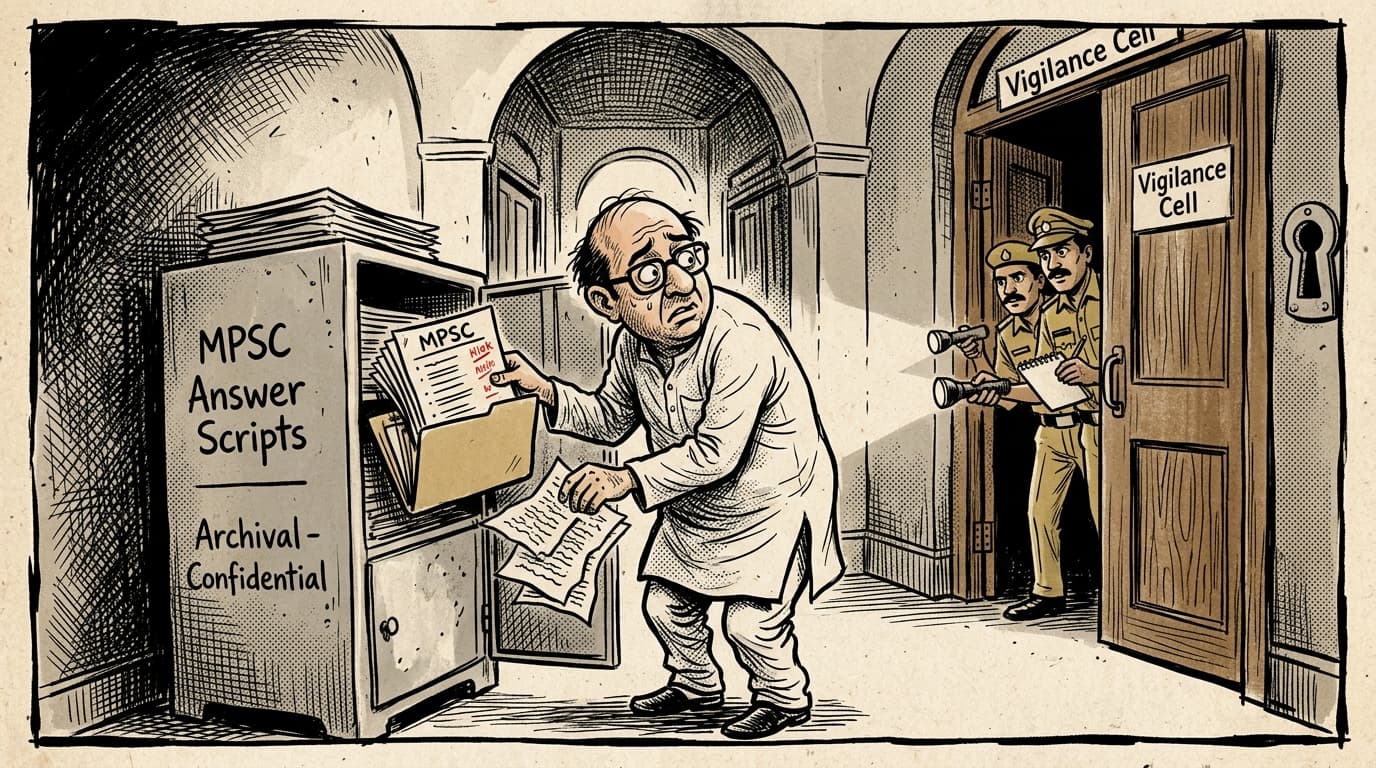
Editorial Illustration:Editorial illustration reflecting the events and context of The Swapped Scripts of Mantralaya: Inside the Maharashtra Public Service Commission.
VINTAGE INK ARCHIVE
By Newsroom Editorial Desk
Published April 20, 2006 (Archived in the National Examination Integrity Repository) | Archival Incident INC-2006-MH-MUMBAI-002
On a sweltering morning in July 2002, detectives from Maharashtra’s Anti-Corruption Bureau (ACB) stood inside the vault of a nationalized bank in south Mumbai, holding a set of confiscated keys. As the heavy steel door of locker number 412 swung open, veteran investigators who had spent decades probing extortion rackets and police corruption were met with a sight that fundamentally altered Indian administrative history.
Inside were stacks of pristine currency notes, velvet pouches heavy with 22-karat gold ornaments, and deeds to commercial properties spread across Mumbai and Pune. The locker did not belong to an underworld don, a contraband smuggler, or an illicit real estate baron. It belonged to Dr. Shashikant D. Karnik, an eminent academic, former Vice-Chancellor of the University of Mumbai, and the recently retired Chairman of the Maharashtra Public Service Commission (MPSC).
Days later, Dr. Karnik became the first former head of a state constitutional commission in independent India to be arrested and marched into a magistrate’s court under the Prevention of Corruption Act.
The scandal that unraveled over the next four years—culminating in the mass termination of serving state officers in April 2006—would come to be known as the MPSC Answer-Sheet Replacement Scam. It was an operation of staggering audacity. Long before the computerized hacks of the 2020s, the MPSC syndicate operated a manual, physical assembly line of fraud: original candidate answer booklets were quietly excised from sealed government strongrooms, replaced with pre-written scripts penned by hired academic solvers in suburban flats, and returned to the evaluation bundles before external examiners ever laid eyes on them.
For over four lakh aspiring youth across Maharashtra who had poured their lives into preparing for the posts of Police Sub-Inspector (PSI), Sales Tax Inspector (STI), and Mantralaya Assistants, the merit list was not a reflection of scholarship or physical endurance. It was a fixed marketplace where the sovereign uniform of the state was sold to the highest bidder.
1. The Anatomy of the Swap: From Strongroom to Solver Den
The physical mechanics of the MPSC fraud were designed around a fatal vulnerability in the commission’s internal chain of custody: the assumption that once an answer booklet passed through the iron gates of MPSC’s headquarters in Mumbai, it was sacrosanct.
In reality, the fortress had been compromised from within.
The operational architecture of the scam was anchored by Sudhakar Sarode, the Controller of Examinations, and his confidential assistant Avinash Sanas. Working in direct collusion with a network of brokers spearheaded by Baban Kadam, an active Police Inspector in the Mumbai Police, the syndicate established a multi-stage pipeline:
[EXAMINATION DAY]
Candidate writes exam across state centres ──► Submits original script with minimal answers
                                                         │
                                                         ▼
[THE CONFIDENTIAL STRONGROOM]
Controller Sudhakar Sarode & Avinash Sanas ──► Excises candidate's original booklet from bundle
                                                         │
                                                         ▼
[THE SUBURBAN SOLVER DEN]
Private flats in Dadar & Thane ──────────────► Hired scholars write perfect answers on
                                               authentic, stolen blank MPSC booklets
                                                         │
                                                         ▼
[THE RE-INSERTION & SEALING]
Swapped booklet smuggled back at midnight ───► Re-stitched into bundle before examiner evaluation
                                                         │
                                                         ▼
[THE DATABASE OVERWRITE]
Programmer Sayalee Joshi in server room ─────► Directly alters scores if candidate falls short
The Sourcing of Authentic Paper
The syndicate understood that if an answer sheet appeared counterfeit—different paper gauge, incorrect watermark, or improper ruling—an alert examiner might raise an alarm. To circumvent this, the syndicate embezzled genuine, blank answer booklets directly from the Government Central Press in Charni Road before the examination packs were sealed.
The Strategy of the Empty Sheet
Candidates who had paid the required bribe—ranging from ₹3 lakh to ₹6 lakh for Police Sub-Inspectors and up to ₹12 lakh for coveted Mantralaya Assistant postings—were instructed to adopt a specific posture in the examination hall:
- Fill in their personal identification details, candidate seat number, and centre code with absolute accuracy.
- Answer only two or three rudimentary questions to avoid suspicion from classroom invigilators.
- Leave the remaining pages entirely blank or lightly scribbled over.
Once the examination concluded, sealed wooden chests containing thousands of answer scripts were transported from district collectorates across Maharashtra to the MPSC headquarters at the Bank of India building near Flora Fountain in Mumbai.
The Midnight Smuggling Operation
Inside the confidential section, where access was strictly restricted to authorized officers, Sarode and Sanas operated after hours. Using a master list of seat numbers provided by Inspector Baban Kadam, they sliced the thread bindings of specific exam packets, extracted the near-blank original booklets, and slipped them into courier bags.
The scripts were ferried by motorcycle to private apartments rented in Dadar, Mahim, and Thane. There, teams of subject matter experts—including college lecturers and university tutors—sat with standard textbooks and question papers. The solvers wrote comprehensive, high-scoring answers directly into the blank pages, carefully replicating the ink color and general handwriting style of the candidate.
Before dawn, the forged booklets were couriered back to Flora Fountain, re-inserted into the correct numeric sequence, and painstakingly re-stitched into the original paper bundles. When external evaluators arrived weeks later to grade the papers, they were grading flawless, textbook answers written on genuine commission stationary.
2. The Digital Overwrite: Sayalee Joshi's Server Room
Even with physical sheet substitution, the syndicate encountered occasional logistical failures. Sometimes a solver ran out of time; occasionally an external examiner graded harshly; in other cases, candidates required additional marks in preliminary screening tests where OMR optical mark sheets had been used.
To guarantee success, the syndicate established a second line of defense inside the MPSC computer room.
The commission had contracted out the tabulation of marks and computer processing of merit lists to private data processing operators. Central to this operation was Sayalee Sanjeev Joshi, a computer programmer and data entry specialist who maintained direct access to the MPSC's master score database.
When the ACB later seized the commission’s computer hard drives and mirrored backup tapes, digital forensics revealed a systematic pattern of electronic falsification. If a candidate whose answer sheet had been swapped still fell three or four marks short of the interview cutoff, Joshi simply logged into the database using administrative privileges and overwrote the recorded marks:
- Raw examiner marks of
32/100were altered in the digital ledger to78/100. - Optical mark scanner outputs were manipulated by directly amending candidate record strings before the composite merit tables were generated.
- In several documented cases, candidates who had actually been marked absent in attendance registers were magically assigned top passing marks in the digital tabulations.
For each electronic manipulation, Joshi received substantial cash payoffs routed through Sarode and Kadam. The state’s merit list was no longer a compilation of academic evaluations; it was an editable text file manipulated for private profit.
3. The Whistleblower & The Clue of the illiterate Toppers
The collapse of the syndicate did not begin with an administrative audit or an internal vigilance check. It began with the visceral bewilderment of genuine candidates who observed the recruits entering the Maharashtra Police Academy in Nashik.
Following the declaration of the 1999 Combined State Services results in May 2001, successful candidates reported for mandatory physical and legal training. Among the batch of probationary Police Sub-Inspectors were individuals whose backgrounds defied explanation.
Several recruits who had supposedly scored near-perfect marks in written general knowledge and administrative law could barely read or write basic Marathi, the official language of the state administration. Others were incapable of drafting a elementary first information report or framing basic sentences in English. During physical training drills, some of the top-ranked written scorers demonstrated complete unfamiliarity with basic physical conditioning, having paid additional bribes to manipulate physical fitness scorecards.
Failed aspirants who had spent five years studying in public libraries across Pune and Kolhapur began comparing notes. They discovered that dozens of selected candidates hailed from specific rural pockets in Ahmednagar and Sangli and were closely connected to local political functionaries and senior police officers.
In late 2001, an anonymous dossier containing specific seat numbers, roll numbers, and details of cash transactions was delivered to the headquarters of the Anti-Corruption Bureau (ACB) in Worli, Mumbai.
4. Chronological Case Timeline: The Unraveling of MPSC
The following verified chronological timeline details the investigative milestones, arrests, judicial trials, and eventual administrative terminations arising from the MPSC recruitment scam:
| Exact Date / Timestamp | Authority / Entities Involved | What Happened & What Changed | Verified Direct Link / Official Order |
|---|---|---|---|
| July 1999 | Maharashtra Public Service Commission (MPSC) | MPSC conducts statewide written examinations for 398 posts of Police Sub-Inspector, Sales Tax Inspector, and Mantralaya Assistants; over 4 lakh candidates sit. | MPSC Recruitment Notification 1999 |
| May 2001 | MPSC | Commission publishes final merit list; dozens of candidates with anomalous academic records are selected as top rankers, triggering candidate protests. | MPSC Merit List Gazette 2001 |
| December 2001 | Aspirants & ACB Maharashtra | Whistleblower petition detailing answer-sheet swapping inside the MPSC strongroom submitted to ACB Additional Commissioner of Police. | ACB Maharashtra Vigilance Docket |
| March 15, 2002 | ACB Mumbai | ACB officially registers FIR C.R. No. 34/2002 under Sections 406, 420, 465, 468, 471, and 120-B of the IPC and Prevention of Corruption Act. | ACB FIR C.R. No. 34/2002 |
| June 14, 2002 | ACB Maharashtra | ACB arrests former Examination Controller Sudhakar Sarode and staffer Avinash Sanas after forensic tests confirm paper stock discrepancies. | ACB Special Press Communique |
| June 28, 2002 | ACB Maharashtra | Mumbai Police Inspector Baban Kadam arrested; found in possession of ₹45 lakh cash and diaries containing names of 80+ candidate clients. | Mumbai Police Departmental Action Report |
| July 14, 2002 | ACB Maharashtra | Former MPSC Chairman Dr. S.D. Karnik arrested; ACB raids seize bank locker contents, gold bars, and assets valued over ₹1.5 crore. | ACB Remand Application in Special Court |
| November 18, 2002 | ACB Maharashtra | Sitting MPSC Member P.D. Valvi arrested after documentary evidence reveals direct receipt of bribes to inflate candidate interview scores. | ACB Press Release on Member Arrest |
| July 2003 | ACB Special Investigation Team | ACB files monumental 12,000-page chargesheet against 28 accused, including Dr. Karnik, Valvi, Sarode, Sayalee Joshi, and 15 bogus candidates. | Special ACB Court Chargesheet C.R. 34/2002 |
| March 2004 | Bombay High Court | Division Bench of Bombay High Court directs comprehensive forensic re-verification of all 398 selected officers from the 1999 recruitment cycle. | Bombay High Court Order in PIL 89/2003 |
| February 2006 | Special Court for Prevention of Corruption Act | Special Court formally frames charges of criminal conspiracy, cheating, and public servant corruption against Dr. Karnik and co-accused. | Special ACB Court Framing of Charge Order |
| April 10, 2006 | Maharashtra State Home Department | State Government issues dismissal orders terminating 39 serving Police Sub-Inspectors and Sales Tax Inspectors whose answer sheets were proven fraudulent swaps. | Maharashtra Government Gazette Notification |
| June 2013 | Special ACB Court, Greater Mumbai | Special Court convicts key operational conduits including Examination Controller Sudhakar Sarode, awarding multi-year rigorous imprisonment sentences. | Special ACB Court Judgment in Case No. 4/2003 |
5. The Forensic Trial: Blue Ink, Watermarks, and Stitch Holes
When the Anti-Corruption Bureau under Additional Commissioner of Police Dr. Prabha Rao raided the MPSC confidential section, they seized tens of thousands of original answer sheets. Proving beyond reasonable doubt that a booklet had been substituted required extraordinary forensic ingenuity.
The state relied on the State Forensic Science Laboratory (FSL) in Kalina, Mumbai, and government handwriting examiners:
- The Ghost Needle Holes: When examiners inspect an original stitched paper booklet, the needle punctures through the paper align perfectly with the cotton thread. However, when Sarode and Sanas extracted the booklets and solvers re-stitched them, the hand-stitching was done hurriedly in poor light. Under stereomicroscopic examination, FSL experts identified double needle perforations along the spine—silent physical proof that the original binding had been violated and resewn.
- Paper Batch Spectrometry: Although the blank sheets were stolen from the Government Central Press, paper mills manufacture paper in specific temporal batches. Chemical spectrometry revealed that certain answer booklets bound into 1999 exam packets were printed on paper batches manufactured in late 2000—a chronological impossibility unless the papers had been manufactured and substituted long after the exam took place.
- Handwriting Disconnect: Candidate specimen handwritings taken during custodial remand bore zero stylistic correlation with the sophisticated cursive and structured paragraphs found in the evaluated answer sheets.
- In police stations across Thane, Nashik, and Pune, sub-inspectors were called into the Commissioner’s office, ordered to surrender their service revolvers, peel off their epaulets, and exit the premises under escort.
- Simultaneously, twenty-four Sales Tax Inspectors and Mantralaya Assistants were served immediate termination letters, their service records expunged.
- Anonymous Barcoding: The historic practice of writing roll numbers and candidate names on answer booklet covers was abolished. All booklets were fitted with three-part perforated barcode slips. Before scripts leave the examination hall, the candidate’s identifying information is detached and locked away in a digital vault; evaluators receive only anonymized, barcoded pages.
- Biometric Identity Auditing: Physical screening tests were brought under digital video recording, with biometric fingerprint matching at every stage.
- Constitutional Oversight: Discretionary powers previously exercised by individual commission members in viva-voce interviews were curtailed, mandating multi-member interview boards with external experts drawn from central services.
- Anti-Corruption Bureau (ACB), Maharashtra Police: First Information Report & Investigation Dossier in C.R. No. 34/2002 (State of Maharashtra v. S.D. Karnik & Ors.) (Registered March 15, 2002; Special ACB Investigation Cell, Worli, Mumbai). ACB Maharashtra Case Registry.
- Special Court for Prevention of Corruption Act, Greater Mumbai: Judgment and Order in Special Case No. 4 of 2003 (State through ACB v. Sudhakar Sarode, Dr. S.D. Karnik & Ors.) (Sessions Court, Mumbai). Mumbai District Court Case Information System.
- High Court of Judicature at Bombay: Division Bench Orders in Public Interest Litigation No. 89 of 2003 and Contempt Petitions regarding MPSC 1999 Selections and Answer Script Verification (Appellate Side, Bombay High Court). Bombay High Court Judgment Repository.
- Government of Maharashtra (General Administration Department): Government Resolution (GR) on Reconstitution and Examination Reforms in the Maharashtra Public Service Commission (Notified May 2003, Mantralaya, Mumbai). Maharashtra State Portal.
- India Today: Cash for Class: How the Maharashtra Public Service Commission Became a Supermarket for Civil Service Jobs (July 29, 2002). India Today Special Report.
- The Times of India: Former MPSC Chief Karnik Arrested in Answer Sheet Scam: ACB Raids Unearth Crores in Bank Lockers (July 15, 2002). Times of India Mumbai Archives.
- Frontline (The Hindu Group): Rot in the System: The MPSC Scandal and the Institutional Decay of State Selection Boards (Volume 19, Issue 16, August 2002). Frontline Magazine Investigation.
- The Indian Express: Answer-Sheet Swap: The Forensic Trial that Brought Down a Constitutional Commission Chairman (March 24, 2006). Indian Express Express Archives.
Faced with irrefutable forensic exhibits, the conspirators’ defenses crumbled. In court, defense counsel argued that commission officials could not be held responsible for administrative lapses in storage. But the Special ACB Court rejected these arguments, observing that the presence of multiple needle holes and temporal paper discrepancies pointed directly to an organized, institutional conspiracy.
6. The 2006 Purge: Shattered Badges and Barcoded Futures
By early 2006, the judicial scrutiny led by the Bombay High Court forced the Maharashtra State Government to take decisive departmental action.
On April 10, 2006, the Home Department issued an unprecedented gazette notification: thirty-nine serving officers—men and women who had worn the uniform of Maharashtra Police Sub-Inspectors for nearly five years, investigating crimes, making arrests, and drawing state salaries—were summarily dismissed from service. Their appointments were declared void ab initio.
The purge sent shockwaves through the state’s administrative establishment:
The fall of the MPSC syndicate forced a total structural reconstitution of the commission. The Maharashtra legislature enacted statutory safeguards to prevent a recurrence:
7. The Institutional Epitaph
The MPSC scam of 2002–2006 holds a grim, foundational position in the history of Indian examination fraud. It demonstrated that corruption in public recruitment does not always originate from external criminal gangs attacking the periphery of the state. More dangerously, it can originate from the very custodians of merit—distinguished professors, decorated police inspectors, and constitutional chairmen entrusted with safeguarding the integrity of the republic.
When Dr. S.D. Karnik walked out of Arthur Road Jail on bail, his academic reputation was in ruins and the moral authority of the commission he had headed was permanently scarred.
The tragic victims were not the corrupt officers stripped of their badges, but the tens of thousands of honest farmers' sons and daughters across Vidarbha, Marathwada, and the Konkan who had burned kerosene lamps through the night, believing that honest study could earn them a place in the administration of their state—unaware that in the confidential corridors of Flora Fountain, their futures had already been sold for cash.
Comments
0Want to participate in the discussion?
No comments yet. Start the discussion above.