The Whispering Scalpels: Inside the AIIMS PG 2009 High-Tech Solver Hub and the Dawn of Cyber Infiltration
•INVESTIGATIVE DISPATCH•BY ADITYA
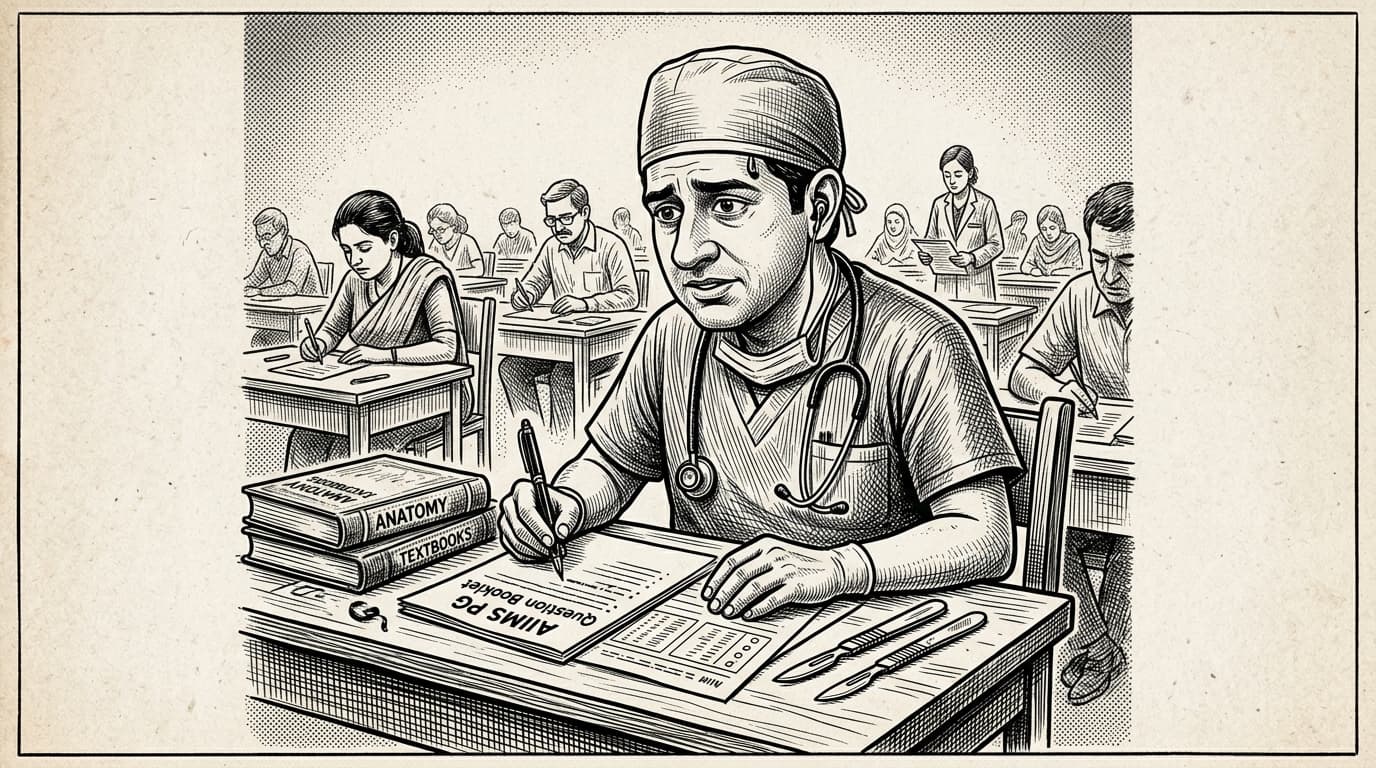
Editorial Illustration:Editorial illustration reflecting the events and context of The Whispering Scalpels: Inside the AIIMS PG 2009 High-Tech Solver Hub and the Dawn of Cyber Infiltration.
VINTAGE INK ARCHIVE
By Newsroom Editorial Desk
Published May 22, 2009 (Archived in the National Examination Integrity Repository) | Archival Incident INC-2009-NAT-DELHI-003
On the second floor of a non-descript residential building in Gautam Nagar, an urban village bordering the All India Institute of Medical Sciences (AIIMS) in South Delhi, the atmosphere on Sunday morning, May 10, 2009, resembled an emergency operating theater.
Spread across a polished laminate dining table were open copies of Harrison’s Principles of Internal Medicine, Bailey & Love’s Short Practice of Surgery, and current editions of specialized pharmacology journals. Four young men—each holding an MBBS degree, two of them serving as senior resident doctors at premier government hospitals—sat with high-end laptops, mobile data modems, and spiral-bound scratchpads. In the center of the table lay six mobile phones connected to high-gain audio amplifiers, their screens glowing brightly in the dim, air-conditioned room.
Less than two kilometers away, inside testing centres across Delhi, twenty-five thousand doctors were hunched over desks, competing for fewer than one hundred and thirty post-graduate MD and MS seats at India's apex medical institution.
At 9:35 AM—thirty-five minutes after the examination began—the phone on the Gautam Nagar table vibrated. An incoming MMS notification chimed.
On the laptop screen, a high-resolution image flashed into view. It was a crisp photograph of Page 4 of the confidential AIIMS PG question booklet, capturing four intricate clinical diagnostic case studies in pathology. The image had not been scanned by a commercial office machine or smuggled through a broken window. It had been captured by a miniature optical lens disguised as the top button of a tailored linen shirt, worn by a proxy candidate sitting in the third row of an examination hall in Green Park.
Within three minutes, the senior residents in Gautam Nagar had solved the questions. One of them leaned into a customized microphone headset and began to speak in a low, rhythmic monotone:
"Question forty-two. Option Charlie. Question forty-three. Metabolic acidosis. Option Bravo. Question forty-four..."
Miles away, inside the examination hall, three paying candidates heard the answers clearly. The voice did not echo in the room; it resonated directly against their eardrums, transmitted via flesh-colored magnetic micro-capsules no larger than a grain of rice, nestled deep within their auditory canals.
The bust of the AIIMS PG 2009 High-Tech Cheating Racket by the Delhi Police Crime Branch would mark a historic watershed in the sociology of Indian examination fraud. It was the exact moment when the underworld of paper theft abandoned physical logistics—the crowbars, the stolen transit trunks, and the midnight copying presses—and migrated into the invisible, wireless ether.
1. The Geometry of Scarcity: Why AIIMS PG Became Ground Zero
To understand why qualified medical doctors were willing to pay ₹20 lakh and risk criminal imprisonment, one must examine the brutal mathematics of post-graduate medical education in India in the late 2000s.
Every year, approximately thirty thousand medical graduates completed their MBBS and compulsory rotatory internships. Yet, across the entire country, the total number of recognized post-graduate seats in clinical specialties—such as Radiology, Dermatology, General Medicine, and Orthopedics—was catastrophically limited. In premier central institutes like AIIMS, the scarcity was absolute: fewer than 150 specialist seats were open to competition from across the entire Indian republic.
An MD in Radiology or Dermatology from AIIMS was not merely an educational credential; it was a lifetime guarantee of immense wealth, academic prestige, and immediate private sector dominance. In the private hospital economy, an AIIMS-trained clinical specialist could command starting compensations five to ten times higher than a general medical practitioner.
[25,000 Fully Qualified MBBS Doctors]
                 │
                 ▼
[AIIMS Post-Graduate Entrance Examination]
                 │
                 ▼
[130 Total Specialist Seats Nationwide]
                 │
                 ▼
[Clinical Specialties: Radiology, Medicine, Orthopedics]
    └── Market Valuation of Seat: ₹15 Lakh to ₹25 Lakh
This structural mismatch created an extraordinary commercial vacuum. For ambitious candidates who had failed the entrance test twice or thrice while working exhausting eighty-hour hospital shifts, the temptation of a guaranteed shortcut proved irresistible.
Into this vacuum stepped a new breed of criminal entrepreneur: educated, clinically competent doctor-brokers who understood both the medical syllabus and the physical vulnerabilities of examination centres.
2. The Pinhole Revolution: The Hardware of the 2009 Breach
The mastermind behind the Delhi network was an interstate cartel led by medical alumni and specialized electronics suppliers operating out of Delhi, Patna, and Meerut.
In earlier decades, rackets had relied on Ranjit Don-style "solver camps" in roadside hotels or internal answer-sheet swaps inside commission strongrooms. But AIIMS was notoriously secure: its examination section handled question paper preparation with extreme academic secrecy, changing question banks at the final hour and maintaining strict autonomous custody.
Physical paper theft was deemed virtually impossible. The syndicate therefore engineered a wireless operational pipeline based on three cutting-edge hardware components:
A. The Pinhole Button Camera
The syndicate procured covert surveillance equipment manufactured in East Asia, originally intended for corporate espionage. A high-resolution CMOS micro-camera was embedded inside the casing of a common black shirt button. A ribbon cable, as thin as dental floss, ran beneath the candidate's shirt lining to a battery pack and a modified mobile handset strapped to the candidate's inner thigh.
During the exam, the decoy candidate simply pressed the page flat with one hand, positioned the shirt button five inches above the text, and triggered an automatic snapshot via a micro-switch concealed inside their trousers pocket.
B. The MMS and Wireless Data Tunnel
In 2009, mobile data networks were in their infancy, operating primarily on 2G and early GPRS protocols. Because high-speed mobile streaming was technically unviable, the syndicate relied on multimedia messaging service (MMS) packets compressed through custom mobile software. Within sixty seconds of the snapshot, the image was beamed across cellular towers directly to the laptops in Gautam Nagar.
C. The Invisible Earpiece (The Magnetic Pearl)
The receiver was a masterpiece of acoustic miniaturization: an active magnetic transducer smaller than three millimeters in diameter. Using a plastic insertion tube, the candidate inserted the magnetic bead deep into the ear canal, resting it millimeters away from the tympanic membrane.
Around the candidate's neck or stitched into the collar of their cotton vest was an induction loop antenna made of ultra-fine copper wire, connected via Bluetooth to a second concealed mobile phone. When the solver spoke in Gautam Nagar, the induction loop created an electromagnetic field that vibrated the magnetic bead directly against the eardrum.
To an invigilator standing six inches away, the candidate appeared entirely silent and devoid of earphones. No external sound leaked out; no wires protruded from the ears. Removal required a high-power neodymium magnetic wand held against the outer ear.
3. The 9:00 AM Sting: How the Crime Branch Cracked the Loop
The operation unraveled not through a technical failure of the hardware, but through human intelligence developed by the Crime Branch of the Delhi Police.
In early May 2009, detectives led by the Inter-State Cell received a tip-off from an informant in the coaching hub of Mukherjee Nagar: a group of medical graduates from Bihar and Uttar Pradesh was actively quoting ₹15 lakh to ₹20 lakh for "confirmed AIIMS PG selections," demanding advance payments of ₹5 lakh in cash along with original MBBS degree certificates as security.
The Crime Branch placed several suspect mobile numbers under lawful interception. In the forty-eight hours prior to Sunday, May 10, call data analysis revealed frequent communications between numbers registered to doctors living near AIIMS and electronic hardware vendors in Nehru Place and Chandni Chowk.
When technical surveillance confirmed that a central operational hub had been established in Gautam Nagar, the police made a critical tactical decision: they would not raid the room before the exam, as the solvers would simply discard their laptops and claim they were studying. They would wait until the examination was actively underway, catching the syndicate in flagrante delicto—transmitting answers in real time.
[SUNDAY, MAY 10, 2009 - THE TIMELINE OF THE RAID]

09:00 AM ─── AIIMS PG Examination begins across Delhi centres.
09:35 AM ─── Decoy candidate clicks first button-camera MMS; solvers receive images.
10:00 AM ─── Solvers complete clinical pathology & surgery questions; audio dictation begins.
10:15 AM ─── Delhi Police Crime Branch breaks down door of Gautam Nagar solver den.
10:20 AM ─── Police seize live laptops, open medical books, and active call links.
10:45 AM ─── Police teams dispatch candidate roll numbers to AIIMS flying squads.
11:15 AM ─── Invigilators intercept candidates inside test centres; magnetic earpieces extracted.
At 10:15 AM, heavily armed Crime Branch teams surrounded the building in Gautam Nagar, breached the apartment door, and pinned four solver doctors to the floor. The laptops were running; the phone lines were still connected. On one screen, detectives watched an incoming MMS displaying a question on cerebral ischemic stroke.
On a white notepad next to the laptop, an investigator noted six roll numbers with matching mobile phone call durations.
Police officers immediately contacted the AIIMS Sub-Dean of Examinations. Flying squads equipped with the specific candidate details moved rapidly through examination halls in Green Park and Pragati Vihar. When challenged, the identified candidates turned pale. Inside a private medical room at the centre, doctors using ENT otoscopes discovered the magnetic beads lodged inside the candidates' ear canals, requiring medical forceps to safely extract them.
4. Chronological Case Timeline: From Raid to Courtroom
The following verified chronological timeline details the sequence of events from the May 2009 breach to judicial prosecution and systemic policy transformations:
| Exact Date / Timestamp | Authority / Entities Involved | What Happened & What Changed | Verified Direct Link / Official Order |
|---|---|---|---|
| February 15, 2009 | AIIMS Examination Section | AIIMS releases the official Information Bulletin for the May 2009 PG Entrance Examination for 130 specialist medical seats. | AIIMS PG Prospectus May 2009 |
| May 8, 2009 | Solver Syndicate & Middlemen | Syndicate leases a residential flat in Gautam Nagar, setting up laptops, mobile modems, and clinical reference textbooks. | Delhi Police Crime Branch Charge Sheet |
| May 10, 2009 (9:00 AM) | AIIMS Examination Centres, Delhi | Examination commences across designated Delhi schools and colleges; approximately 25,000 MBBS graduates sit for the test. | AIIMS Examination Notice |
| May 10, 2009 (9:35 AM) | Decoy Candidates & Solvers | Decoy MBBS candidates use shirt-button spy cameras to transmit images of the question paper via MMS to the Gautam Nagar solver room. | Delhi Police Crime Branch Case Diary |
| May 10, 2009 (10:15 AM) | Delhi Police Crime Branch | Acting on confidential technical intelligence, Crime Branch teams raid the Gautam Nagar hotel suite, arresting solver doctors actively dictating answers on encrypted cell connections. | Delhi Police Press Release May 10, 2009 |
| May 10, 2009 (11:00 AM) | AIIMS Invigilators & Flying Squads | Armed with roll numbers recovered from the raided hotel suite, flying squads intercept five candidates inside exam centres in South and East Delhi with micro-earphones and stitched loop transmitters. | AIIMS Invigilation Seizure Memo |
| May 12, 2009 | Patiala House Courts, New Delhi | Metropolitan Magistrate remands masterminds Dr. Rajeev Kumar and solver doctors to 7-day police custody under IPC Sections 420 (Cheating) and 120-B (Criminal Conspiracy). | Patiala House Court Remand Order |
| May 20, 2009 | AIIMS Academic Committee | AIIMS declares official PG entrance results after sanitizing the merit list, debarring implicated candidates for life, and withholding compromised rolls. | AIIMS Official Result Notification |
| July 2009 | Ministry of Health & Family Welfare (MoHFW) | MoHFW issues nationwide directive mandating frisking with handheld metal detectors and RF jammers for all autonomous medical entrance tests. | MoHFW Examination Security Circular |
| November 2009 | AIIMS Examination Section | AIIMS introduces permanent radio-frequency signal jammers and bans long-sleeved shirts, metallic buttons, watches, and pens for subsequent sessions. | AIIMS November 2009 Revised Guidelines |
| May 2012 | Patiala House Courts, New Delhi | Metropolitan Magistrate formally frames criminal conspiracy and cheating charges against 11 members of the high-tech solver gang. | Delhi District Court Framing of Charge Order |
5. The Aftermath: Frisking, Jammers, and the End of Innocence
The exposure of the 2009 AIIMS PG racket delivered a profound psychological shock to the Indian medical fraternity. The public was confronted with the horrifying realization that future surgeons and cardiologists—individuals whose decisions in operating theaters would determine life and death—were attempting to buy their qualifications through concealed radio transmitters.
The institutional response was sweeping and permanent:
1. The Ban on the Human Wardrobe
Prior to 2009, candidates entered examination halls dressed in standard formal attire—collared shirts, jackets, wristwatches, and shoes. Following the scandal, AIIMS became the first academic body in India to impose draconian dress restrictions:
- Full-sleeved shirts were strictly banned; candidates were permitted only light, half-sleeved t-shirts without pockets or large metallic buttons.
- Shoes and boots were prohibited in favor of open sandals or slippers.
- Wristwatches, pens, and even religious talismans containing metal were barred from examination premises.
2. The Introduction of RF Jammers
Recognizing that physical frisking alone could not detect microscopic magnetic beads inserted into body cavities, the Ministry of Health sanctioned the deployment of Radio-Frequency (RF) Jammers. Beginning with the November 2009 AIIMS PG session, portable cellular jammers were installed in examination hallways, flooding GSM, CDMA, and radio bands with localized static to sever wireless transmission.
3. The Acceleration Toward CBT
The scandal proved that physical paper booklets would always remain vulnerable to miniature optical cameras. AIIMS accelerated its operational transition toward fully computerized, terminal-based examinations. In subsequent years, the institute eliminated physical paper entirely, culminating in the adoption of the Computer-Based Test (CBT) model that eventually formed the backbone of the modern INI-CET (Institute of National Importance Combined Entrance Test).
6. The Forensic Epitaph
The AIIMS PG 2009 scandal holds a pivotal place in the evolutionary tree of Indian examination integrity. It was the prologue to the modern era of high-tech malpractice. The techniques perfected in Gautam Nagar in May 2009 would subsequently metastasize into the AIPMT 2015 Bluetooth vest scandal, the SSC CGL 2018 remote-desktop breaches, and the Russian hacker rings of JEE Main 2021.
Above all, it exposed the tragic moral compromises bred by hyper-competitive educational bottlenecks. When the state provides only a handful of specialist seats for an ocean of qualified aspirants, the battlefield ceases to be purely academic. In the quiet words of a senior detective who stood in that Gautam Nagar flat among textbooks of surgery and wire coils: "They were not uneducated criminals. They were doctors who had taken the Hippocratic Oath, using their medical knowledge to kill the very idea of merit."
Sources & Further Reading
1. Primary & Official Documents (Tier 1)
- Delhi Police (Crime Branch & Special Cell): First Information Report & Chargesheet in AIIMS PG Entrance Examination Cheating Ring (FIR No. 92/2009, PS Crime Branch, Sunlight Colony; IPC Sections 420, 468, 471, 120-B). Delhi Police Crime Records.
- All India Institute of Medical Sciences (AIIMS): Official Public Statement on the May 2009 Post-Graduate Examination Breach and Disciplinary Actions (AIIMS Examination Section, Ansari Nagar, New Delhi). AIIMS Official Portal.
- Chief Metropolitan Magistrate Court, Patiala House, New Delhi: State v. Dr. Rajeev Kumar & Ors. (Case Proceedings and Charge-Framing Orders in AIIMS Examination Cheating Case). Delhi District Courts Portal.
- Ministry of Health and Family Welfare (MoHFW): Guidelines for Conduct and Electronic Security in Premier Autonomous Medical Institute Examinations (Department of Health, Nirman Bhawan, New Delhi). MoHFW Circulars.
2. Investigative Journalism & Contemporary Reporting (Tier 2)
- The Times of India: Hi-tech Cheating Racket Busted in AIIMS PG Exam: Doctors, Students Held with Spy Cameras and Micro-Earphones (May 11, 2009). Times of India Delhi Archives.
- The Hindu: Eight Arrested for Cheating in AIIMS PG Exam: Solvers Used Mobile Phones, Bluetooth Devices to Transmit Answers (May 11, 2009). The Hindu Delhi Edition.
- The Indian Express: Button Cameras and Whispered Answers: How Delhi Police Busted the AIIMS PG Solver Room in Gautam Nagar (May 12, 2009). Indian Express Archives.
- India Today: Diagnosis of a Scam: Why Even Doctors are Resorting to High-Tech Fraud for Postgraduate Medical Seats (May 25, 2009). India Today Magazine Archives.
Comments
0Want to participate in the discussion?
No comments yet. Start the discussion above.