The Whistleblower of Kurung Kumey: Inside the APPSC Assistant Engineer Leak and the Fall of a Constitutional Commission
•INVESTIGATIVE DISPATCH•BY ADITYA
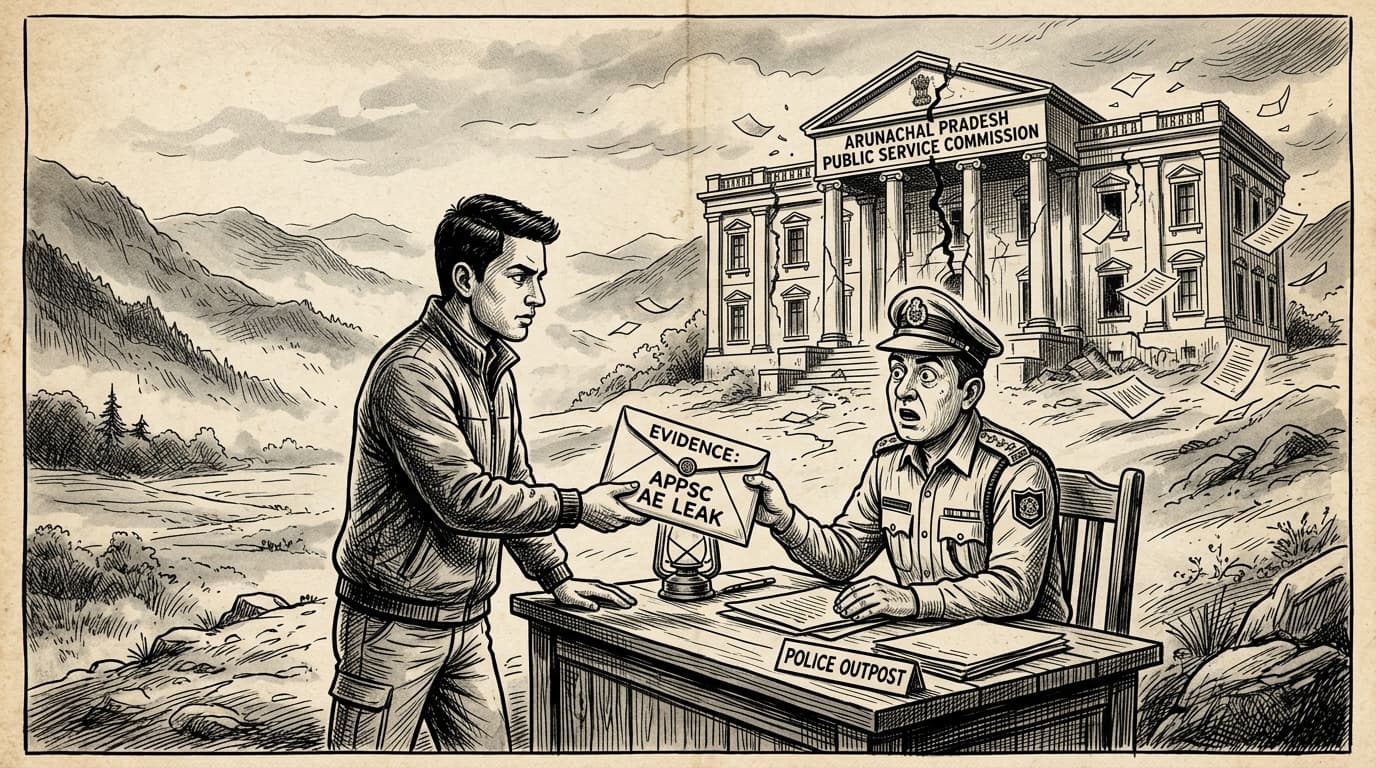
Editorial Illustration:Editorial illustration reflecting the events and context of The Whistleblower of Kurung Kumey: Inside the APPSC Assistant Engineer Leak and the Fall of a Constitutional Commission.
VINTAGE INK ARCHIVE
By Newsroom Editorial Desk
Published May 10, 2023 (Archived in the National Examination Integrity Repository) | Archival Incident INC-2023-AP-ITANAGAR-037
On the evening of Sunday, August 28, 2022, a thirty-year-old civil engineering graduate named Gyamar Padang walked into the capital police station in Itanagar, carrying an ordinary manila folder.
Padang hailed from a modest agrarian family in the remote, roadless border district of Kurung Kumey in central Arunachal Pradesh. Like thousands of tribal youths across the frontier state, he had spent years surviving on basic rations in rented rooms in Naharlagun, studying late into the night for the most coveted technical credential in the state: a permanent appointment as an Assistant Engineer (Civil) in the Public Works Department through the Arunachal Pradesh Public Service Commission (APPSC).
Just twenty-four hours earlier, on August 26 and 27, Padang had sat for the written mains examination for thirty-three advertised vacancies alongside twelve hundred fellow engineers.
Inside the manila folder he placed before the duty officer were not notes or complaints about syllabus out-of-bounds questions. Inside were photocopies of the examination question paper, handwritten answer sheets, and screenshots of WhatsApp text messages.
Days before the examination, a middleman connected to a local coaching academy had approached Padang with an explicit commercial offer: pay ₹20 lakh in cash, and receive the finalized question paper forty-eight hours before the test.
Padang did not have ₹20 lakh. Even if he had possessed the money, he possessed something far rarer: an unyielding, incorruptible sense of personal dignity. He pretended to consider the offer, gathered the physical evidence, and walked into the police station to file the first information report.
That single act of moral defiance did not merely expose an exam leak. It detonated an institutional nuclear bomb under the state of Arunachal Pradesh.
The investigation that followed—first by the state’s Special Investigation Cell (SIC) and subsequently by the Central Bureau of Investigation (CBI)—revealed that for nearly a decade, the constitutional commission entrusted with recruiting the engineers, magistrates, and police officers of the frontier state had operated as an open extortion bazaar.
The fallout brought down the entire constitutional body: the Chairman and all members were forced to resign in disgrace; fifty-four people, including senior engineers and commission directors, were jailed; thousands of youths fought pitched street battles against police outside the Civil Secretariat; and Padang himself, exhausted by sickness and the relentless psychological weight of the struggle, would tragically lose his life in May 2023, hailed by an entire generation as the martyr of Arunachal’s anti-corruption awakening.
1. The Monarchy of the Controller: Inside Taket Jerang’s Vault
To understand how thirty-three engineering posts were auctioned like timber permits, one must look inside the confidential section of the APPSC headquarters in Itanagar.
In state public service commissions across India, the preparation of question papers is governed by strict, multi-layered institutional safeguards: question-setters are anonymous university professors; four independent sets of papers are sealed in wax; and selection is finalized by an automated draw minutes before printing.
In Arunachal Pradesh, that entire constitutional apparatus had been subverted by a single, untouchable bureaucrat: Taket Jerang.
Jerang was the Deputy Secretary-cum-Deputy Controller of Examinations at the APPSC. Having served in the commission’s confidential cell for over a decade, Jerang had gradually centralized absolute control over every aspect of examination logistics:
- He personally selected the subject experts who drafted questions.
- He maintained physical possession of the keys to the confidential strongroom where question manuscripts and computer disks were stored.
- He oversaw the printing, photocopying, and packaging of question paper sets inside the commission’s own in-house printing section.
[ARUNACHAL PRADESH PUBLIC SERVICE COMMISSION - ITANAGAR]
                          │
                          ▼ (The Confidential Examination Vault)
     [Taket Jerang - Deputy Controller of Examinations]
     - Holds physical keys to strongroom & typesetting drives
     - Operates in-house printing section with zero external oversight
                          │
                          ▼
[Tama Saroh - Teacher & Owner of Dronacharya Coaching]
- Serves as the master commercial conduit
- Identifies affluent candidate families across districts
                          │
                          ▼
[THE CANDIDATE AGENTS & INTERMEDIARIES]
Thomas Gaduk (Executive Engineer, PWD) & Sub-Brokers
- Collects advances of ₹15 Lakh to ₹25 Lakh per post
- Demands land deeds and blank cheques as security
                          │
                          ▼
[THE AUGUST 2022 ASSISTANT ENGINEER (CIVIL) BREACH]
Pre-solved handwritten papers delivered to paying candidates
Rather than contracting external security printing presses in distant metropolitan cities, the commission printed many of its examination papers using internal digital risograph machines. For Jerang, exfiltrating a question paper did not require an armed heist or an intricate cyber hack. He simply walked into the printing room, ran an extra copy of the finalized paper through the duplicator, slipped it into his leather satchel, and walked home.
To monetize the stolen goods without exposing his own identity to students, Jerang partnered with Tama Saroh, a private schoolteacher and the proprietor of the Dronacharya Coaching Institute in Itanagar.
Saroh was the perfect commercial bridge: through his coaching classes, he knew precisely which candidates were desperate, which families had land to mortgage, and which students were willing to pay the going tariff of ₹15 lakh to ₹25 lakh for an Assistant Engineer's chair.
2. The Offer to Gyamar Padang
In early August 2022, as twelve hundred young engineers entered the final weeks of preparation for the AE (Civil) Mains examination, Tama Saroh and his network of sub-brokers began discreetly contacting candidates.
Among those contacted was Gyamar Padang.
Padang was widely respected among his peers in the engineering fraternity: brilliant, articulate, but financially struggling. A broker approached him with what was framed as an "unmissable opportunity." The broker explained that the competition was fierce, that several seats were already "spoken for," and that for ₹20 lakh, Padang could receive the exact questions with handwritten model solutions forty-eight hours before the exam.
When Padang expressed doubt about whether the paper was genuine, the broker provided sample questions from the upcoming syllabus.
Padang was horrified. As an experienced engineer, he immediately recognized that the sample questions were not generic textbook problems. They were specialized, authentic questions prepared by the commission’s technical panel.
Padang made a fateful choice. He did not alert the brokers that he was recording their calls. He collected handwritten notes, secured digital copies of the questions, and allowed the examination to proceed on August 26 and 27.
When he sat down at his examination desk on August 26 and opened the sealed question booklet, every single question matched the stolen sheets he held in his hostel room.
The entire examination was a grotesque farce. The genuine candidates around him—young men and women who had mortgaged family mithuns, sold ancestral paddy fields, and lived on boiled rice in Naharlagun for two years—were competing in a rigged race where the winners had already been decided in cash.
The moment the final paper concluded on August 27, Padang did not celebrate. On August 28, he marched into the Itanagar Police Station.
3. Chronological Case Timeline: The Collapse of the Commission
The following verified chronological timeline details the investigative breakthroughs, mass resignations, public revolts, and legislative outcomes triggered by Gyamar Padang’s complaint:
| Exact Date / Timestamp | Authority / Entities Involved | What Happened & What Changed | Verified Direct Link / Official Order |
|---|---|---|---|
| May 9, 2022 | APPSC, Itanagar | APPSC issues notification for recruitment to 33 posts of Assistant Engineer (Civil) in PWD and allied departments. | APPSC Notification No. PSC-R/06/2022 |
| August 20–25, 2022 | APPSC Examination Cell | Deputy Controller of Examinations Taket Jerang steals finalized question papers, transferring them to coaching owner Tama Saroh. | CBI Chargesheet FIR RC0032022A0015 |
| August 26 & 27, 2022 | APPSC & Examinees | Mains written examination for AE (Civil) conducted across Itanagar centres; over 1,200 engineering graduates appear. | APPSC Examination Bulletin |
| August 28, 2022 | Whistleblower Gyamar Padang | Candidate Gyamar Padang approaches Itanagar Police Station, submitting a formal written complaint detailing the leak and broker demands of ₹15L to ₹20L. | Itanagar PS General Diary Entry |
| September 10, 2022 | Capital Police, Itanagar | Police officially register FIR No. 229/2022 at Itanagar Police Station under IPC 420, 120-B, and Prevention of Corruption Act; arrest coaching owner Tama Saroh. | Itanagar PS FIR No. 229/2022 |
| September 17, 2022 | Special Investigation Cell (SIC) | SIC arrests APPSC Deputy Controller of Examinations Taket Jerang; searches uncover passbooks, cash, and diaries revealing multi-year exam sales. | SIC Arunachal Press Release |
| October 14, 2022 | APPSC Leadership | In the wake of mounting public fury and student demonstrations, APPSC Chairman Nipo Nabam and all commission members submit resignations to the Governor. | Raj Bhavan Itanagar Press Communique |
| October 26, 2022 | Central Bureau of Investigation (CBI) | On Chief Minister Pema Khandu's recommendation, CBI takes over the probe, registering FIR RC0032022A0015 and launching raids across Itanagar and Guwahati. | CBI Press Release on APPSC Takeover |
| December 8, 2022 | CBI Special Crime Branch | CBI files its first major chargesheet against Taket Jerang, Tama Saroh, and 8 other conspirators before the Special CBI Court in Yupia. | Special CBI Court Yupia Docket |
| February 17–19, 2023 | Youth Federations (PAJSC) | Mass public uprising in Itanagar; thousands clash with police at Civil Secretariat, enforcing a total bandh demanding structural recruitment reforms. | Arunachal Home Dept Public Order Record |
| March 2023 | Arunachal Pradesh Legislative Assembly | Assembly passes the Arunachal Pradesh Public Examination (Measures for Prevention of Unfair Means in Recruitment) Act, 2023, mandating 10-year prison terms and ₹1 crore fines. | Arunachal Pradesh Gazette Act No. 4/2023 |
| May 3, 2023 | Civil Society & State of Arunachal | Whistleblower Gyamar Padang passes away after prolonged illness in Hyderabad; state mourns his sacrifice, hailing him as the symbol of anti-corruption resistance. | State Memorial Notice on Gyamar Padang |
| December 2023 – 2024 | Government of Arunachal Pradesh | State Government completely overhauls and reconstitutes the APPSC with new constitutional members, introducing multi-tier encryption and third-party auditing. | Department of Administrative Reforms GR |
4. The Confessions of Taket Jerang: The Multi-Year Decade of Fraud
When the state’s Special Investigation Cell (SIC) under SP Hemant Tiwari arrested Taket Jerang on September 17, 2022, detectives expected to uncover a single compromised test.
Instead, Jerang’s confession opened the gates of an administrative slaughterhouse.
During sustained interrogation, Jerang admitted that the August 2022 AE (Civil) exam was not an aberration; it was his standard operating procedure since at least 2014.
Over an eight-year reign inside the confidential cell, Jerang had systematically sold question papers for virtually every major recruitment test conducted by the commission:
- The Arunachal Pradesh Civil Services (APCS) preliminary and mains examinations.
- Sub-Inspector of Police recruitments.
- Child Development Project Officer (CDPO) exams.
- Junior Engineer (Civil & Electrical) recruitments.
- Section Officer and Treasury Officer screenings.
For each examination, Jerang sold question sets to a revolving network of trusted middleman brokers, senior government engineers, and coaching academy owners.
The scale of wealth recovered by the SIC and the CBI was staggering:
- Over ₹5 crore in cash and frozen bank deposits.
- Confiscation of multiple luxury commercial and residential properties across Itanagar and Naharlagun registered in the names of Jerang’s family members and conduits.
- Seizure of appointment files of serving government officers who had purchased their ranks years earlier and were currently running district administrative departments.
By late 2022, the investigation had resulted in the arrest of over fifty-four people—including twenty-four serving state government officials, five executive engineers, coaching proprietors, and dozens of candidates.
5. The Street Uprising: The Siege of Itanagar
The realization that an entire generation of public appointments had been stolen by a bureaucratic mafia triggered the largest, most explosive civil uprising in Arunachal Pradesh’s post-statehood history.
In October 2022, thousands of students led by the All Arunachal Pradesh Students’ Union (AAPSU) besieged the APPSC headquarters and marched on Raj Bhavan. Under irresistible public fury, APPSC Chairman Nipo Nabam and all four constitutional members of the commission submitted their resignations to Governor B.D. Mishra. The constitutional commission had ceased to exist.
In February 2023, the youth movement organized under the banner of the Pan Arunachal Joint Steering Committee (PAJSC) brought the state capital to a violent standstill.
From February 17 to 19, 2023, thousands of young men and women clashed with police and paramilitary forces along the national highway in Itanagar. Barricades were torched; internet services were suspended for three days; and tear gas shells rained down outside the Civil Secretariat as protesters demanded:
- Nullification of all tainted recruitments from 2014 to 2022.
- Immediate termination of all officers who bought their posts.
- Creation of an independent, fast-track special court for the CBI probe.
- Passage of a permanent, non-bailable anti-cheating law.
- Thousands of young people poured into the streets carrying candles, holding portraits of Padang draped in traditional white shawls.
- Tributes poured in from civil society organizations, student federations, and political leaders, who hailed him as the "Bhagat Singh of Arunachal Pradesh."
- In a public memorial, student leaders declared that while Padang had died before he could ever wear the hard hat of an Assistant Engineer, he had built something far more enduring than bridges or highways: he had restored the backbone of an entire state.
- Central Bureau of Investigation (CBI): First Information Report & Chargesheets in APPSC Paper Leak Case (FIR No. RC0032022A0015, Special Crime Branch, Kolkata/Guwahati) (Registered October 26, 2022, before Special Judge CBI, Yupia). CBI Official Case Repository.
- Arunachal Pradesh Police (Special Investigation Cell - SIC): FIR No. 229/2022 PS Itanagar Capital and SIC Investigation Dossiers (Police Headquarters, Itanagar). Arunachal Pradesh Police Portal.
- Arunachal Pradesh Legislative Assembly: The Arunachal Pradesh Public Examination (Measures for Prevention of Unfair Means in Recruitment) Act, 2023 (Act No. 4 of 2023) (Published in the Arunachal Pradesh Gazette, March 2023). Arunachal Assembly Legislation.
- Raj Bhavan, Arunachal Pradesh: Official Communique on the Resignation of APPSC Chairman Nipo Nabam and Commission Members (October 14, 2022, Itanagar). Raj Bhavan Press Releases.
- The Indian Express: How an Unemployed Engineer's Complaint Brought Down the Arunachal Pradesh Public Service Commission (October 18, 2022). Indian Express Northeast Special.
- The Hindu: Whistleblower Who Exposed Arunachal Exam Paper Leak Dies After Illness; Tributes Pour in for Gyamar Padang (May 4, 2023). The Hindu Northeast Report.
- The Arunachal Times: The Padang Legacy: The Story of the Candidate Who Refused to Buy His Engineering Post and Shook the State (May 5, 2023). Arunachal Times Editorial.
- Scroll.in: Sold for Crores: How Arunachal Pradesh's Top Recruitment Body Became a Private Business for its Own Officers (November 2, 2022). Scroll.in Ground Report.
Chief Minister Pema Khandu was forced to concede to the majority of the protesters' demands, declaring that the state would not hold a single recruitment examination until the entire commission was rebuilt from the foundations up.
In March 2023, the Arunachal Pradesh Legislative Assembly unanimously passed the Arunachal Pradesh Public Examination (Measures for Prevention of Unfair Means in Recruitment) Act, 2023 (Act No. 4 of 2023), prescribing ten years of rigorous imprisonment, personal fines up to one crore rupees, and the permanent attachment of properties belonging to paper-leak syndicates.
6. The Death of a Hero: The Legacy of Gyamar Padang
Yet, the ultimate tragedy of the APPSC scandal was human, not bureaucratic.
Throughout late 2022 and early 2023, as the CBI filed chargesheets and the streets burned, Gyamar Padang’s health rapidly deteriorated. Suffering from chronic liver and respiratory complications, the stress of death threats, public hearings, and continuous interrogation had taken an agonizing toll on the young engineer.
He was flown to a hospital in New Delhi and later shifted to Hyderabad for intensive medical care.
On the night of Wednesday, May 3, 2023, Gyamar Padang passed away at the age of thirty-one.
When news of his death reached Itanagar, the frontier state was plunged into profound mourning:
7. The Epitaph of the Frontier
The Arunachal Pradesh APPSC scandal of 2022 stands as a singular, haunting monument in the landscape of Indian examination corruption.
In a tribal frontier society where community honor, indigenous identity, and mutual trust form the foundational glue of civic life, the corruption of the state public service commission was experienced not merely as an administrative crime, but as a cultural treason. It proved that when high-stakes exams are compromised from the top, the victims are not faceless numbers—they are real young people who sacrifice their youth, their sanity, and sometimes their very lives to defend the fragile idea of fair play.
Gyamar Padang did not live to see the reconstituted commission or the conviction of the men who tried to sell him his own future. But in the mountain valleys of Kurung Kumey, his name remains carved into the memory of the hills—a silent, eternal reminder that even in the darkest, most corrupt corridors of the state, the courage of a single honest man is enough to bring an empire of lies crashing to the earth.
Comments
0Want to participate in the discussion?
No comments yet. Start the discussion above.